

Reverse osmosis pretreatment resin regeneration operation method
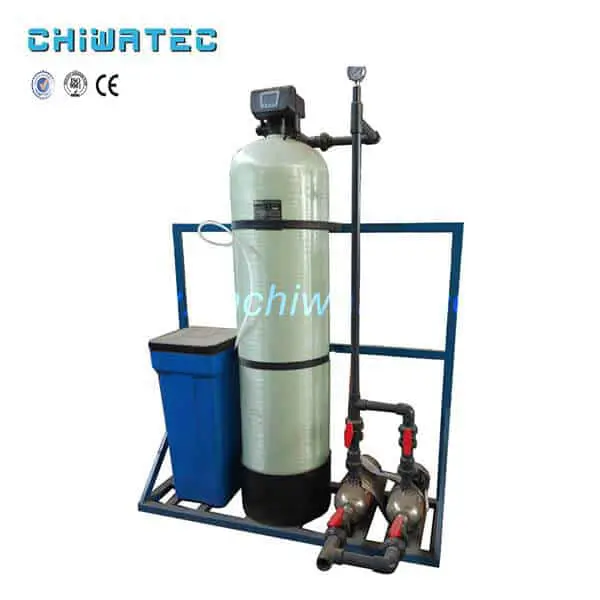
The salt absorption operation of manual softened water equipment refers to the operation method of reverse osmosis pretreatment resin regeneration, as follows: After the resin absorbs a certain amount of calcium and magnesium ions, it must be regenerated. The time is about every 48 hours of operation (when the raw water is municipal tap water), it must be regenerated once. The regeneration process is to wash the resin layer with the industrial salt in the salt tank, to replace the hardness ions such as calcium and magnesium on the resin, and to discharge the regeneration waste liquid out of the tank, and the resin will restore the softening and exchange capacity (the water softener cannot be added with the addition of water softener). Iodized salt, adding calcium salt as regeneration agent, regularly adding salt to the salt tank to ensure the saturated concentration of brine), the regeneration time is recommended in the evening, after the equipment is shut down, the salt is absorbed and left for one night. Steps After cleaning, start the host.
Resin regeneration steps:
Open the salt inlet valve, close the other valves, start the raw water pump, suck all the brine in the salt tank into the softener, and leave it for more than 4 hours.
Wash salt:
After the resin is regenerated, the salt in the softener must be rinsed before use, according to the manual valve flushing method (including forward flushing and back flushing).
The presence of calcium and magnesium ions in water is the main reason for the formation of scale when the water temperature changes. At present, the softening water equipment commonly used in China mainly includes manual type, domestic combined type, domestic multi-valve type and imported multi-way valve type. Among them, the imported multi-way valve type softened water equipment is the main product on the market. With the imported multi-way valve and controller as the core, it is equipped with domestic resin tanks, salt tanks, pipes and other materials to form a fully automatic softening water equipment.
Since the deposition of scale has a significant impact on people’s life and production, both production water and domestic water have certain requirements for hardness indicators, especially if the boiler water contains hardness salts, it will be formed on the heating surface of the boiler. Scale, thereby reducing the thermal efficiency of the boiler, increasing the fuel consumption, and even damaging parts and causing explosions due to local overheating of the metal wall. Therefore, water softening treatment should be carried out for low pressure boilers; water softening and desalination treatment should be carried out for medium and high pressure boilers.
Ion exchange method:
Using a specific cation exchange resin, the calcium and magnesium ions in the water are replaced with sodium ions. Due to the high solubility of sodium salts, the formation of scale with the increase of temperature is avoided. This method is the standard method in common use today. The main advantages are: The effect is stable and accurate, and the process is mature. The softening water equipment using this method is also generally called “ion exchanger” (because most of the sodium ion exchange resins are used, so it is also called “sodium ion exchanger”).
How the ion exchange method works:
Ion exchange resin is a polymer with corresponding functional gene groups. In general, conventional sodium ion exchange resins have a large amount of sodium ions.
When the content of calcium and magnesium ions in the water is high, the ion exchange resin can release sodium ions, and the functional gene group is combined with the calcium and magnesium ions, so that the content of calcium and magnesium ions in the water decreases, and the hardness of the water decreases. Hard water becomes soft water, which is the working process of softening water equipment.
When a large number of functional gene groups on the resin are combined with calcium and magnesium ions, the softening ability of the resin decreases, and sodium chloride solution can be used to flow through the resin. At this time, the sodium ion content in the solution is high, and the functional gene groups will release calcium and magnesium ions. When combined with sodium ions, the resin regains its exchange capacity, a process called “regeneration”.
Xi’an CHIWATEC Water Treatment Technology is a high-tech enterprise specialized in various water processing devices. Aside from these individual products, which cover a number of types and series, we can also help with related comprehensive engineering projects. Thanks to our hard work and dedication upon our founding, we are now one of the fastest-developing water treatment equipment manufacturers in Western China.
Further reading:
- Troubleshooting of ion exchangers
- Softened water treatment equipment: introduction of ion exchange method
- Electroplating wastewater treatment process and ion exchange treatment method (3)?
- Electroplating wastewater treatment process and ion exchange treatment method (2)?
- Electroplating wastewater treatment process and ion exchange treatment method (1)?
- Advantages of EDI technology compared with hybrid ion exchange technology
- Introduction to the working principle and pretreatment of ion exchange resin system
- Introduction to the characteristics and application fields of ion exchange resin ultrapure water preparation process
- Ion exchange resin, mixed bed ion exchange resin
- Ion exchange resin and mixed bed ion exchange resin
- Ion Exchange Filter, Ion Exchange Resin, Ion Exchanger
- What is the ion exchange method? What is the working principle of the ion exchange method?
- Other supplementary knowledge of ion exchange resin
- Physical properties of ion exchange resin
- Adsorption selectivity of ion exchange resin
- Physical structure of ion exchange resin
- Composition of ion exchange resin matrix
- Introduction to ion exchange resin
- Introduction to the application fields of ion exchange resins
- What are the basic types of ion exchange resins?
- Ion exchanger capacity of ion exchange resin
- Ion exchange soft water equipment
- Issues that should be paid attention to in ion exchange operation and regeneration
- Storage of ion exchange resin
- Application of ion exchange resin
- Matters needing attention in using ion exchange resin
- Ion exchange resin classification
- Questions and answers about ion exchange water treatment equipment
- Overview of ion exchange pure water equipment
- Characteristics and application of ion exchange resin
- Features of ion exchange resin
- Technical requirements for automatic control sodium ion exchanger
- Technical terms and definitions of automatic control sodium ion exchanger
- What is ion exchange resin? What is the preservation method and regeneration method?
- Factors affecting the exchange capacity of the fully automatic sodium ion exchanger
- C100E ion exchange resin
FOLLOW US
Do you have a water treatment project we can help with
* Designing,machining,installing,commissioning, customize and one-stop service






 English
  Spanish
  Portuguese




