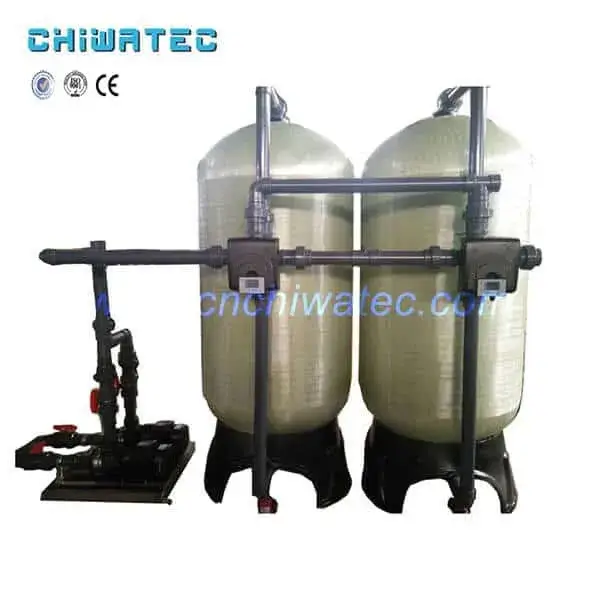
Factors Affecting the Exchange Capacity of the Fully Automatic Sodium Ion Exchanger
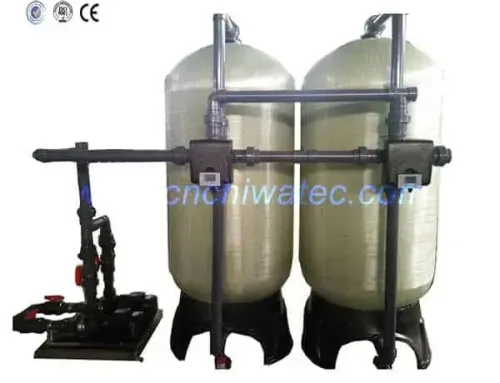
A fully automatic sodium ion exchanger—commonly used in industrial softening applications—removes hardness ions (Ca²⁺ and Mg²⁺) by exchanging them with sodium ions (Na⁺). The actual exchange capacity of the equipment depends on multiple operational and environmental factors. Understanding these variables is crucial for achieving stable effluent quality, extending resin life, and optimizing regeneration costs.
This guide explains 10 major factors that influence the exchange efficiency and performance of sodium ion exchangers.
We also reference related technologies such as our industrial water softening system and ultra-pure water system solutions from CHIWATEC.
1. Flow Rate (gpm/ft² or m/h)
Flow rate directly affects how efficiently ions penetrate the resin bed.
Effects of High Flow Rate
- Requires larger working layers in the resin bed
- Decreases resin utilization
- Increases total water production
Effects of Low Flow Rate
- Fewer working layers needed
- Higher resin utilization
- Reduced water production
- If flow is too low, ion exchange occurs only on the resin surface (about 20% of total capacity), preventing ions from reaching the interior (which provides 80% of exchange capacity)
Recommended Operating Range
- China: 20–30 m/h
- U.S.: 4–10 gpm/ft²
- Small units may increase flow rate appropriately
Maintaining a reasonable exchange flow rate ensures maximum resin performance and water output.
2. Contact Time Between Water and Resin (gpm/ft³)
Contact time determines how deeply water can diffuse into the resin.
Longer Contact Time
- More complete ion exchange
- Lower water production per unit of resin
Shorter Contact Time
- Less complete exchange
- Higher water production
Recommended Range
- 1.0–5.0 gpm/ft³
- Or 8–40 BV/h (bed volumes per hour)
Selecting the right contact time is essential for balancing economic performance and desired effluent quality.
3. Resin Layer Height
The height of the resin bed strongly influences flow distribution and exchange capacity.
- When the resin layer is too shallow, flow variations significantly affect exchange performance
- At ≥ 30 inches (762 mm), the effect of flow rate stabilizes and becomes less impactful
Recommended Resin Height
- ≥ 30 inches (762 mm)
A sufficiently high resin bed ensures even contact and consistent output water quality.
4. Inlet Water Salinity
The salinity—and specifically the levels of Na⁺ and K⁺—directly impacts effluent hardness.
Example Comparison
- Raw water salinity: 500 ppm
- If Na⁺ + K⁺ = 0 ppm and hardness = 10 mol/m³
- Regeneration at 240 g/L (15 lb/ft³) can achieve nearly 0 mmol/L effluent
- If Na⁺ + K⁺ = 250 ppm
- Hardness approaches 0.04 mmol/L
- To reach ≤ 0.03 mmol/L, regeneration must increase to 290 g/L (18 lb/ft³)
Conclusion
Higher inlet Na⁺/K⁺ concentrations require stronger regeneration to maintain soft water quality.
5. Temperature
Higher water temperature improves resin performance.
Effects
- Accelerates internal ion diffusion
- Increases exchange capacity
- Enhances regeneration efficiency
Moderately increasing inlet temperature benefits overall operation.
6. Regenerant Quality (NaCl Purity)
The quality of sodium chloride determines resin regeneration efficiency.
Higher NaCl Purity Results In:
- Better resin regeneration
- Lower ion leakage in effluent
- Improved long-term softening performance
Removing insoluble impurities and using high-purity salt significantly enhances regeneration results.
7. Regeneration Fluid Flow Rate
Regeneration flow rate influences how well brine penetrates the resin.
General Principle
- Lower flow rate → better regeneration
- But too low → longer regeneration time and risk of channeling (bypassing)
Recommended Range
- 0.25–0.9 gpm/ft³
- Or:
- 4–6 m/h (downflow regeneration)
- 2–3 m/h (upflow regeneration)
Uniform brine distribution ensures effective ion replacement.
8. Regeneration Liquid Concentration
Higher brine concentration improves resin regeneration—but only up to a point.
According to Ion Balance Theory
Increasing concentration enhances resin capacity.
But If Too High
- Contact time shortens
- Regeneration weakens
- Efficiency decreases
Optimal Concentration
- Around 10% NaCl solution
This provides the best balance between penetration and regeneration effect.
9. Regenerant Dosage
The theoretical equivalent exchange is:
- 1 mol NaCl regenerates 1 mol of resin exchange capacity
However, actual use is always higher.
Practical Considerations
- More regenerant → higher exchange capacity
- But diminishing returns occur as dosage increases
- Economic efficiency must be balanced with water quality requirements
Typical Recommendation
- 240 g/L NaCl per liter of resin for low-pressure boiler softeners (U.S. standard)
Dosage should be adjusted according to raw water quality and hardness.
10. Resin Quality
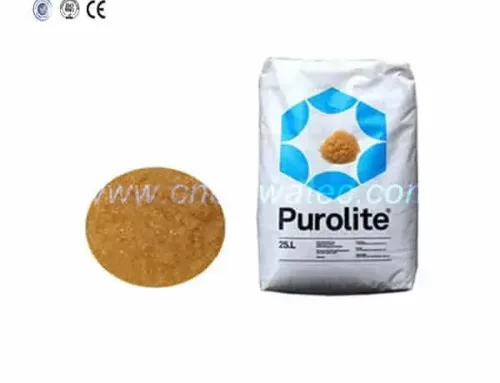
Different resin formulations have different exchange capabilities.
Requirements for Sodium Ion Exchangers in Boilers
- Crosslinking degree: ≥ 7%
A higher crosslinking degree enhances mechanical strength and resistance to oxidation, improving long-term exchange performance.
Conclusion
The exchange capacity of a fully automatic sodium ion exchanger is influenced by numerous factors including flow rate, contact time, resin layer height, temperature, inlet salinity, regenerant quality and dosage, and resin characteristics. Optimizing these parameters is critical to deliver reliable softened water, extend resin lifespan, and reduce operating costs.
By following best practices and leveraging expert system design—such as CHIWATEC’s water softening systems—industrial facilities can maximize performance and efficiency in their softening operations.
FAQ (Frequently Asked Questions)
1. What is the ideal flow rate for a sodium ion exchanger?
Typically 20–30 m/h (China standard) or 4–10 gpm/ft² (U.S. standard), depending on system size and application.
2. Why is resin height important?
A resin bed ≥ 30 inches (762 mm) ensures even flow distribution and maximizes exchange efficiency.
3. How does water temperature affect ion exchange?
Higher temperature accelerates ion diffusion and improves both operating and regeneration performance.
4. What concentration of brine is best for regeneration?
Around 10% NaCl provides optimal regeneration efficiency without reducing contact time.
5. Does higher regenerant dosage always improve performance?
Only up to a point. Excessive dosage produces diminishing returns and increases operational cost.
6. How does inlet salinity impact effluent quality?
High Na⁺/K⁺ in the feedwater requires stronger regeneration to maintain low hardness levels.
7. What type of resin should be used?
For boiler applications, resin with at least 7% crosslinking is recommended for stability and capacity.
Xi’an CHIWATEC Water Treatment Technology is a high-tech enterprise specialized in various water processing devices. Aside from these individual products, which cover a number of types and series, we can also help with related comprehensive engineering projects. Thanks to our hard work and dedication upon our founding, we are now one of the fastest-developing water treatment equipment manufacturers in Western China.
Further reading:
FOLLOW US
Do you have a water treatment project we can help with
* Designing,machining,installing,commissioning, customize and one-stop service
 English
  Spanish
  Portuguese