

Softened Water Treatment Equipment: Ion Exchange Method for Water Softening 2026
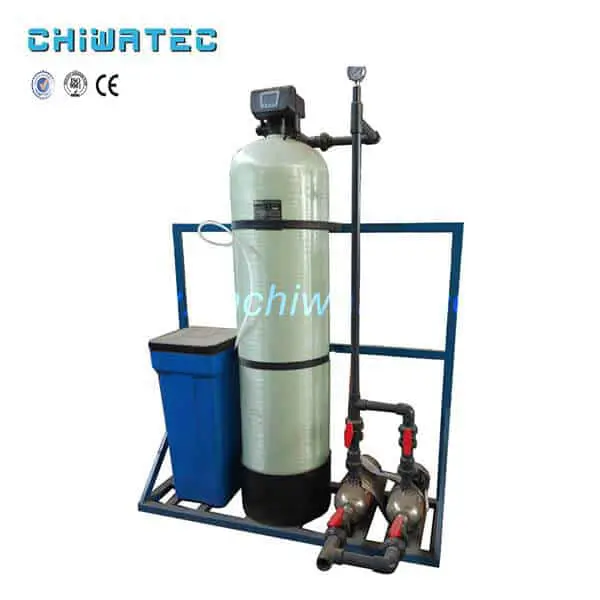
The ion exchange method is the most widely used technology for water softening and deionization worldwide. From residential water softeners that remove hardness-causing calcium and magnesium to industrial deionization systems producing ultrapure water, ion exchange for water softening relies on specially engineered spherical resin beads that exchange harmless ions for dissolved contaminants. This guide explains how ion exchange works for both hardness removal and deionization, the types of resins used, regeneration procedures, and how ion exchange integrates with other water purification technologies. CHIWATEC supplies complete softened water treatment equipment using advanced ion exchange technology.
Ion Exchange for Water Softening: How It Works
Ion exchange for water softening uses spherical ion exchange resin beads — typically sulfonated polystyrene-divinylbenzene copolymers — as the active medium. Raw water flows through a bed of these resin beads. The resin carries sodium ions (Na⁺) loosely bound to its functional sites. When hard water containing calcium (Ca²⁺) and magnesium (Mg²⁺) ions passes through, the resin preferentially exchanges two sodium ions for each calcium or magnesium ion: 2R-Na + Ca²⁺ → R₂-Ca + 2Na⁺. The calcium and magnesium remain attached to the resin while the released sodium ions pass into the effluent. The result is soft water with negligible hardness but slightly elevated sodium content.
Hard Water Softening: Sodium Ion Exchange Process
Hard water softening is the most common application of ion exchange for water softening. The process is typically used as a pre-treatment step before reverse osmosis (RO) systems and boiler feed water treatment to prevent scale formation on membranes and heat transfer surfaces.
| Parameter | Before Softening | After Softening |
| Calcium (Ca²⁺) | 50-150 mg/L | <1 mg/L |
| Magnesium (Mg²⁺) | 10-50 mg/L | <1 mg/L |
| Sodium (Na⁺) | Variable | Increases by equivalent of removed Ca²⁺ + Mg²⁺ |
| Total Hardness | 100-600 mg/L as CaCO₃ | <5 mg/L as CaCO₃ |
| pH | 6.5-8.5 | Unchanged |
| TDS | 200-800 mg/L | Unchanged |
The process is highly efficient — a properly sized water softener removes 99% or more of influent hardness. The softened water protects RO membranes from calcium carbonate scaling, prevents boiler tube scale, and improves the effectiveness of soaps and detergents in residential applications.
Deionization: Cation and Anion Exchange for Pure Water
While hardness removal uses sodium-form cation exchange resin, deionization (DI) requires both cation and anion exchange resins operating together to remove all dissolved ionic contaminants. The deionization process uses two types of resin:
- Cation exchange resin (H⁺ form) — Made from sulfonate-containing styrene-divinylbenzene copolymer. It exchanges all cations (Na⁺, Ca²⁺, Mg²⁺, Al³⁺, Fe²⁺, etc.) for hydrogen ions (H⁺). The released H⁺ ions combine with anions in the water to form corresponding acids.
- Anion exchange resin (OH⁻ form) — Made from quaternary ammonium-containing styrene-divinylbenzene copolymer. It exchanges all anions (Cl⁻, SO₄²⁻, NO₃⁻, HCO₃⁻, etc.) for hydroxide ions (OH⁻).
When the H⁺ from the cation resin combines with the OH⁻ from the anion resin, they form pure water: H⁺ + OH⁻ → H₂O. The net result is the complete removal of all dissolved ionic solids, producing water with resistivity approaching 18.2 MΩ·cm — the theoretical maximum for pure water.
Ion Exchange Resin Types and System Configurations
| Configuration | Description | Typical Effluent Quality | Best Application |
| Single-bed softener | Cation resin in Na⁺ form only | Hardness <5 mg/L | Hardness removal for boiler, RO pre-treatment |
| Two-bed DI (separate beds) | Cation column + Anion column in sequence | 0.1-1.0 μS/cm | General industrial pure water |
| Mixed-bed DI | Cation and anion resin mixed in one vessel | 0.055-0.1 μS/cm (18.2 MΩ·cm) | High-purity applications, semiconductor, pharmaceutical |
| Two-bed + mixed-bed polish | Two-bed followed by mixed-bed | 0.055 μS/cm (18.2 MΩ·cm) | Ultrapure water production |
The choice of configuration depends on the required product water quality. For simple hardness removal, a single sodium-form softener is sufficient. For deionization, two-bed systems provide good quality for most industrial applications, while mixed-bed polishing is required for the highest purity demands.
Regeneration of Ion Exchange Resins
When the resin’s exchange sites are fully occupied by removed ions, the resin is exhausted and must be regenerated. Regeneration reverses the exchange process by applying a concentrated regenerant solution:
- Sodium-form softener regeneration: Brine solution (10-12% NaCl) is passed through the resin bed. The high concentration of sodium ions displaces the accumulated calcium and magnesium: R₂-Ca + 2Na⁺ → 2R-Na + Ca²⁺. The calcium and magnesium are flushed to drain as brine waste.
- Cation DI resin regeneration: Diluted hydrochloric acid (HCl, 5-10%) or sulfuric acid (H₂SO₄) replaces accumulated cations with H⁺ ions.
- Anion DI resin regeneration: Sodium hydroxide solution (NaOH, 4-8%) replaces accumulated anions with OH⁻ ions.
The regeneration procedure is the mirror image of the purification process — concentrated regenerant is applied to drive off the removed ions and restore the resin to its active form. The efficiency of regeneration (how close to 100% of the resin capacity is restored) depends on contact time, regenerant concentration, temperature, and flow rate. Proper regeneration is essential for maintaining consistent treated water quality and minimizing operating costs.
Combining Ion Exchange with Other Treatment Methods
Ion exchange for water softening is most effective when integrated into a complete treatment train. Ion exchange excels at removing dissolved ionic contaminants but has limitations:
- Ion exchange does NOT remove — most organic compounds, microorganisms, suspended solids, or dissolved non-ionic contaminants.
- Microbial growth risk — Resin beds can serve as a growth medium for bacteria and microorganisms, which can attach to the resin and reproduce rapidly, potentially introducing endotoxins into the treated water.
- Recommended pre-treatment — Filtration (to remove suspended solids) and activated carbon (to remove chlorine and organic matter) should precede ion exchange.
- Recommended post-treatment — UV sterilization or microfiltration to control microbial growth; reverse osmosis may be used ahead of DI to reduce the ionic load on the resin, extending regeneration intervals.
When ion exchange is combined with reverse osmosis, filtration, and activated carbon adsorption in a well-designed treatment train, each technology addresses its specific strength: RO removes the bulk of dissolved solids, ion exchange polishes the remaining ions to trace levels, and filtration/carbon remove particles and organics that could foul the resin.
Frequently Asked Questions
What is the difference between a water softener and a deionizer?
A water softener uses sodium-form cation exchange resin to replace hardness ions (Ca²⁺, Mg²⁺) with sodium ions — the total dissolved solids (TDS) remain unchanged. A deionizer uses both cation and anion exchange resins to remove ALL dissolved ions — TDS is reduced to near zero. Softeners are for hardness removal; deionizers are for complete water purification.
How often does ion exchange resin need to be replaced?
Under normal operating conditions, ion exchange resin lasts 5-10 years for water softening and 3-5 years for deionization applications. Signs that replacement is needed include: irreversible fouling (iron, organic matter), resin degradation (broken beads, reduced capacity), and increasing pressure drop across the bed. Proper pre-treatment and regeneration significantly extend resin life.
Can ion exchange remove all contaminants from water?
No. Ion exchange effectively removes dissolved ionic contaminants (cations and anions) but does not remove non-ionic contaminants such as organic compounds, pesticides, pharmaceuticals, microorganisms, or suspended particles. A complete water purification system combines ion exchange with other technologies — typically filtration, activated carbon, reverse osmosis, and UV sterilization — to address the full range of contaminants.
What happens if resin is not regenerated on time?
If regeneration is delayed beyond the resin’s exhaustion point, hardness or ionic breakthrough occurs — the resin can no longer exchange, and untreated ions pass into the product water. In severe cases, the accumulated ions may precipitate within the resin bed, causing irreversible fouling. For deionizers, delayed regeneration also risks the “leakage” of weakly ionized species that the exhausted resin can no longer retain.
Is ion exchange environmentally friendly?
Ion exchange produces a concentrated waste stream during regeneration — brine waste from softeners and acid/caustic waste from deionizers. However, modern systems minimize waste through metered regeneration (regenerating only when needed based on actual water usage), counter-current regeneration (reducing chemical consumption by 30-50%), and brine recycling in softening systems. Compared to the environmental cost of scale damage in boilers and factories, the net environmental impact of properly operated ion exchange systems is positive.
Conclusion & Call to Action
Ion exchange for water softening remains the most practical and cost-effective technology for removing dissolved hardness and producing high-purity water across a vast range of applications. Whether you need simple hardness protection for a boiler or complete deionization for pharmaceutical or semiconductor manufacturing, understanding the principles of ion exchange — resin types, exchange mechanisms, regeneration procedures, and system configurations — is essential for selecting and operating the right system.
Need ion exchange for water softening equipment for your application? Contact CHIWATEC for professional guidance. Email us at [email protected] or [email protected] for a customized softened water treatment equipment recommendation.
Related Resources and Further Reading
Do you have a water treatment project we can help with
* Designing,machining,installing,commissioning, customize and one-stop service






 English
  Spanish
  Portuguese




