Softened Water Equipment Selection Criteria: Complete Guide to Choosing the Right Water Softener 2026
Choosing the wrong water softener can lead to hard water breakthrough, wasted salt, and costly system downtime. The global water softening equipment market was valued at USD 8.2 billion in 2024 and is projected to reach USD 14.6 billion by 2034 (CAGR 5.9%), driven by increasing demand for treated water in industrial and residential applications. The direct answer: the key softened water equipment selection criteria include feed water hardness (measured in mg/L or grains per gallon), required flow rate (m3/h), resin type and volume, regeneration method (timer vs. meter-initiated), and the specific application — industrial boiler feed, commercial HVAC, or residential use. CHIWATEC has been engineering customized water softening solutions for industrial and commercial applications worldwide, providing expert guidance on equipment selection and system design.
Understanding Water Hardness and Why Softening Is Needed
Water hardness is primarily caused by dissolved calcium (Ca2+) and magnesium (Mg2+) ions. When hard water is heated or evaporated, these ions form scale deposits that reduce heat transfer efficiency, clog pipes, and damage equipment. The US Geological Survey classifies water hardness as follows:
| Hardness Level | mg/L as CaCO3 | Grains per Gallon (gpg) | Typical Impact |
|---|---|---|---|
| Soft | 0-60 | 0-3.5 | Minimal scaling, acceptable for most uses |
| Moderately hard | 61-120 | 3.5-7.0 | Noticeable scaling in water heaters |
| Hard | 121-180 | 7.0-10.5 | Significant scale, equipment efficiency loss |
| Very hard | 180+ | 10.5+ | Severe scaling, requires immediate treatment |
Water softening using the ion exchange method removes these hardness ions by exchanging them with sodium ions (Na+) through a strong acid cation (SAC) resin bed. This process is the most widely adopted technology, accounting for over 85% of industrial water softening installations worldwide.
Softened Water Equipment Selection Criteria: Key Factors to Consider
Selecting the right softened water equipment requires evaluating multiple technical parameters. Each criterion directly impacts system performance, operating cost, and equipment lifespan. Below are the critical factors ranked by priority:
1. Feed Water Hardness and Quality Analysis
Before selecting any equipment, conduct a comprehensive water analysis. The raw water TDS, iron content, and hardness level determine the resin type, system size, and regeneration frequency. Feed water with iron concentrations above 0.3 mg/L requires pre-treatment or specialized resin to prevent iron fouling. Water with TDS exceeding 1500 mg/L may require reverse osmosis pre-treatment before softening for optimal resin performance.
2. Required Flow Rate and System Sizing
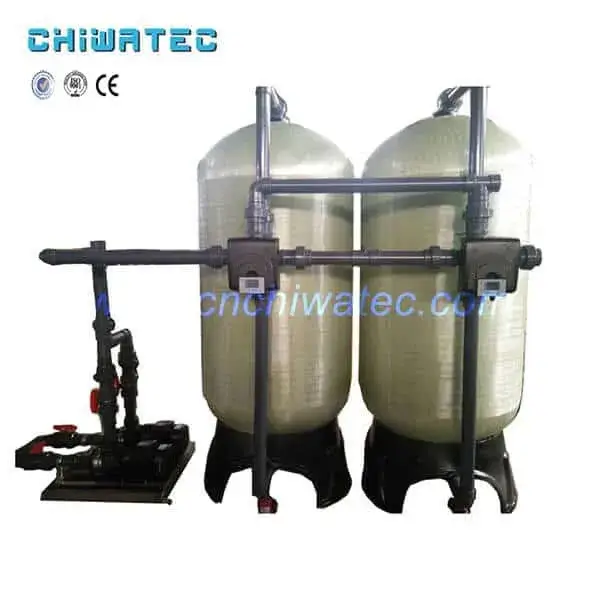
The service flow rate (m3/h) is the most critical sizing parameter. An undersized softener causes hardness leakage, while an oversized unit wastes capital on unnecessary capacity and resin volume. Standard sizing guidelines recommend a linear velocity of 20-30 m/h through the resin bed during service. For intermittent operation, a peak flow rate 20-30% above the average is acceptable. For industrial water softening equipment, continuous flow rates above 50 m3/h typically require twin-alternating systems.
3. Resin Type, Volume, and Exchange Capacity
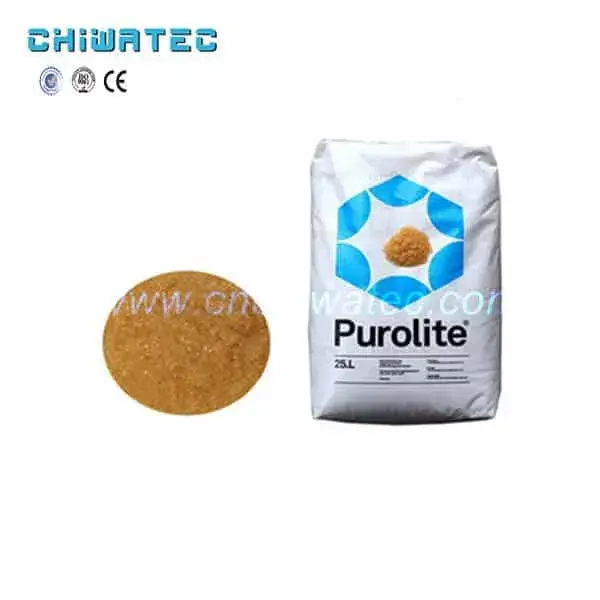
Strong acid cation (SAC) resin is the industry standard for water softening. The resin volume determines the total exchange capacity between regenerations. A typical SAC resin has an operating exchange capacity of 1.2-1.8 eq/L, meaning each liter of resin can remove 60-90 grams of hardness as CaCO3 before requiring regeneration. The resin layer height should be a minimum of 1.2 meters for consistent effluent quality, with 1.5 meters being the standard for industrial systems. Resin regeneration methods and preservation directly affect long-term system performance.
4. Regeneration Method: Timer vs. Meter-Initiated
Two primary regeneration control methods are available:
- Timer-initiated regeneration: Regenerates at preset time intervals (typically 2 AM daily). Simpler and lower initial cost, but wastes salt and water when actual water consumption is below the programmed cycle. Best suited for applications with consistent daily water usage.
- Meter-initiated regeneration (demand-initiated): Regenerates based on actual water volume treated. More efficient, reducing salt consumption by 20-35% and water waste by 15-25%. Recommended for variable-demand applications such as hotels, apartment buildings, and industrial operations with fluctuating production schedules.
For more details, review the working principle of softened water equipment to understand how regeneration cycles function.
5. Control Valve Type and Automation Level
The control valve is the mechanical heart of any water softening system. Options range from manual multi-port valves to fully automatic electronic controllers with remote monitoring capabilities. Full automation with pressure-based or flow-based regeneration initiation is recommended for industrial applications to minimize operator intervention. Fully automatic water softening equipment with standard workflow automation reduces labor costs and ensures consistent effluent quality.
6. Salt Quality and Brine System Design
The type and quality of salt used in regeneration directly affect system efficiency. Specialized salt for water softening equipment should be at least 99.5% pure NaCl. Solar salt, evaporated salt, and rock salt each have different dissolution rates and impurity levels. The brine tank volume should be sized to hold sufficient brine for at least one complete regeneration cycle, with a saturated brine concentration of approximately 26% NaCl at 25 degrees C.
Comparing Softened Water Equipment Types by Application
Different applications demand different system configurations. The table below summarizes the recommended equipment types for common use cases:
| Application | Recommended System Type | Key Specification |
|---|---|---|
| Residential | Single-tank, meter-initiated | 1-2 m3/h, 30,000-60,000 grain capacity |
| Commercial (hotels, hospitals) | Twin-alternating, fully automatic | 5-20 m3/h, continuous soft water supply |
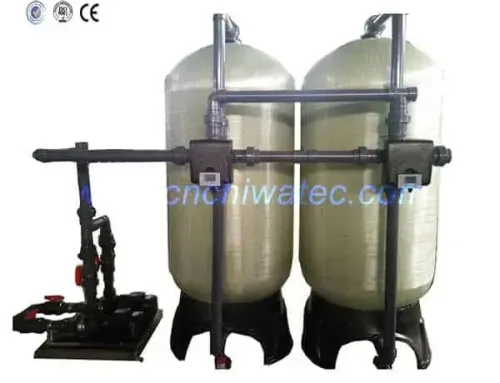
| Industrial boiler feed | Dual-vessel or multi-column | 20-100+ m3/h, < 0.03 mg/L hardness |
| HVAC/Chilled water | Single or twin, meter-initiated | 5-50 m3/h, < 2 mg/L hardness |
| Process water (food/beverage) | Twin-alternating with polishing | 10-80 m3/h, NSF/ANSI 61 certified |
Installation Requirements and Site Considerations
Proper installation planning prevents common operational issues. Key site requirements include:
- Floor drainage: Adequate floor drain capacity to handle backwash flow rates (typically 20-40 m/h during backwash cycle)
- Electrical supply: Stable 220V/50Hz or 110V/60Hz supply depending on control valve specifications
- Inlet water pressure: Minimum 2.5 bar (35 psi) for proper backwash and regeneration flow
- Temperature range: Feed water temperature between 4-40 degrees C to prevent resin degradation
- Pre-filtration: 50-100 micron sediment filter upstream to protect control valves from debris
Review the comprehensive guidelines for the use of softened water equipment for complete installation and operational protocols.
Common Mistakes in Softened Water Equipment Selection: What to Avoid
Avoiding these frequent selection errors can save 20-40% on total system lifecycle costs:
- Undersizing the system: Selecting based on average flow rather than peak demand leads to hardness leakage during high-usage periods
- Ignoring iron and manganese: Feed water with iron above 0.3 mg/L requires BIRM media or resin cleaner pre-treatment
- Choosing timer control for variable demand: Results in 20-35% excess salt and water consumption compared to meter-initiated systems
- Inadequate brine tank sizing: An undersized brine tank limits regeneration capacity and causes incomplete resin restoration
- Skipping water analysis: Installing equipment without comprehensive feed water testing is the leading cause of system mismatch
For additional guidance on the performance characteristics of water softening systems, refer to the complete technical specifications.
Frequently Asked Questions
Q1: What size water softener do I need for my application?
Calculate the required capacity by multiplying daily water consumption (m3/day) by feed water hardness (mg/L as CaCO3) and dividing by the resin exchange capacity (typically 60,000-90,000 grains per ft3 of resin). For a typical industrial application processing 100 m3/day at 300 mg/L hardness, a system with 500-700 liters of SAC resin is recommended, with a service flow rate matched to peak demand rather than average consumption.
Q2: Is meter-initiated regeneration worth the extra cost?
Yes. Meter-initiated (demand) regeneration typically adds 15-25% to the initial equipment cost but reduces salt consumption by 20-35% and water waste by 15-25% compared to timer-initiated systems. For applications with variable water usage, the payback period is typically 12-18 months through reduced salt and water costs alone.
Q3: Can I use table salt instead of specialized water softener salt?
Standard table salt contains anti-caking agents (e.g., yellow prussiate of soda, silicon dioxide) that can foul the resin bed and reduce exchange capacity over time. Specialized water softener salt (solar salt, evaporated salt, or pellet salt) is at least 99.5% pure NaCl without additives. Using appropriate salt extends resin life and maintains consistent softening performance.
Q4: How often should a water softener regenerate?
Regeneration frequency depends on water usage and hardness. For a meter-initiated system, regeneration occurs when the programmed water volume has been treated — typically every 2-7 days. For timer-initiated systems, daily regeneration is standard. The optimal frequency balances resin exchange capacity utilization (ideally 70-85%) against salt efficiency. Too-frequent regeneration wastes salt; too-infrequent regeneration risks hardness breakthrough.
Q5: What maintenance does softened water equipment require?
Routine maintenance includes weekly visual inspection of the brine tank salt level, monthly cleaning of the brine tank and salt grid, quarterly inspection of the control valve and injector, and annual resin replacement (typically 5-10% of total volume). The weekly, monthly, and yearly water softener maintenance schedule provides detailed procedures for each maintenance interval.
Conclusion & CTA
Selecting the right softened water equipment requires careful evaluation of feed water quality, flow rate requirements, resin capacity, regeneration method, and application-specific needs. By prioritizing these criteria and avoiding common sizing and control errors, operators can achieve 95%+ hardness removal efficiency, extend equipment service life to 10-15 years, and reduce total operating costs by 20-40%. CHIWATEC offers customized water softening systems engineered for industrial, commercial, and residential applications, with expert support from selection through commissioning. Contact our team at [email protected] or [email protected] (WhatsApp available) for personalized equipment selection assistance and system design consultation.
Related Resources and Further Reading
Do you have a water treatment project we can help with
* Designing,machining,installing,commissioning, customize and one-stop service

 English
  Spanish
  Portuguese