

Water Softener Usage Guide: How to Use and Maintain Softened Water Equipment 2026
This water softener usage guide provides comprehensive instructions for the correct operation, installation, and maintenance of softened water equipment. Proper usage ensures long-term efficient performance, maximizes resin exchange capacity, and prevents common issues such as microbial growth, mechanical failure, and water quality degradation. Whether you operate a steam boiler system, hot water exchanger, or industrial process application, following these guidelines will extend equipment service life and reduce operating costs.
Water Softener Usage Guide: Understanding Your Equipment
Softened water equipment uses ion exchange technology to remove hardness-causing calcium and magnesium ions from water. The core component is a vessel containing cation exchange resin beads, which are regenerated periodically using a sodium chloride (salt) solution. Modern softeners feature jet-type salt suction systems that eliminate the need for salt pumps, reducing energy consumption while maintaining high exchange efficiency.
Key performance characteristics of properly operated softened water equipment include high efficiency, low energy consumption, and economical operating costs. The reasonable overall design ensures that the resin’s exchange capacity is fully utilized during normal operation.
Common Applications of Softened Water Equipment
Softened water equipment can be widely applied across multiple industries and settings:
| Application Category | Specific Uses | Key Benefit |
| Boiler systems | Make-up water for steam boilers, hot water boilers | Prevents scale formation, improves heat transfer efficiency |
| HVAC and cooling | Exchangers, evaporative condensers, air conditioning systems | Reduces scaling and maintenance frequency |
| Industrial processes | Food and beverage, winemaking, laundry, printing and dyeing, chemical, pharmaceutical | Consistent water quality for product quality |
| Commercial facilities | Hotels, restaurants, office buildings, apartment complexes | Protects plumbing fixtures and equipment |
| Household use | Domestic water softening for whole-home protection | Extends appliance life, improves soap efficiency |
Each application requires proper sizing and configuration to match the specific water quality conditions and flow requirements of the system.
13 Essential Operating Guidelines for Softened Water Equipment
Follow these operating guidelines to ensure safe, efficient, and long-lasting performance of your softened water equipment:
| # | Guideline | Critical Detail |
| 1 | Verify raw water quality meets equipment requirements | General sodium ion exchange equipment requires specific influent conditions — check TDS, iron, and turbidity before operation |
| 2 | Install equipment indoors above freezing | Ambient temperature must be above 0°C to prevent resin freezing, component rusting, and electrical short circuits. Keep in a dry, clean location free from steam exposure. |
| 3 | Re-tighten all bolts after installation | Pay special attention to motor fixing bolts, switchboard wiring bolts (internal and external), and limit switch bolts. The switchboard housing must be properly grounded. |
| 4 | Do not loosen rotary valve lever bolts | The upper and lower bolts of the upper lever fixing block on the rotary valve must remain tight. Avoid striking the exchange column. |
| 5 | Do not adjust the time relay during operation | Adjust only during maintenance shutdowns. Always cut power when repairing or scrubbing equipment. Prevent water from entering the motor, switchboard, and limit switch. |
| 6 | Water and power supply must be simultaneous | Turn on water and power at the same time; turn off both when stopping operation to prevent dry running or electrical damage. |
| 7 | Keep equipment clean and lubricated | Maintain cleanliness at all times. Ensure refueling points have adequate oil. Keep hands and objects away from pulleys during operation. |
| 8 | Proper shutdown for extended non-use | Drain wastewater nylon pipe raised to exchange column level when out of use. For long-term shutdown, clean remaining salt solution from tank and valve body. Add lubricating oil to rotary valve and transmission parts. |
| 9 | Prevent microbial growth during summer/mildew season | Start the machine for one to two hours if shut down more than half a month during warm, humid weather to prevent microbial growth inside the resin tank. |
| 10 | Restart procedure after extended shutdown | Rotate the pulley by hand to turn the rotary valve several times before powering on. Return the drain pipe to its original position. |
| 11 | Annual equipment inspection and maintenance | Inspect salt tank upper and lower bottom plates. Check resin layer height — target fill rate is 85-90 percent. Add resin if below specification. |
| 12 | Switchboard installation flexibility | Switchboard and equipment body are pre-assembled but can be separated if conditions permit. Hang the distribution board in a fixed location. Verify wiring numbers are correctly connected. |
| 13 | Pre-treat water with high sediment content | Water with high sediment load must be precipitated before entering the softener to prevent fouling of the resin bed and distribution system. |
These guidelines are based on standard sodium ion exchange water treatment equipment specifications and have been validated through years of field operation.
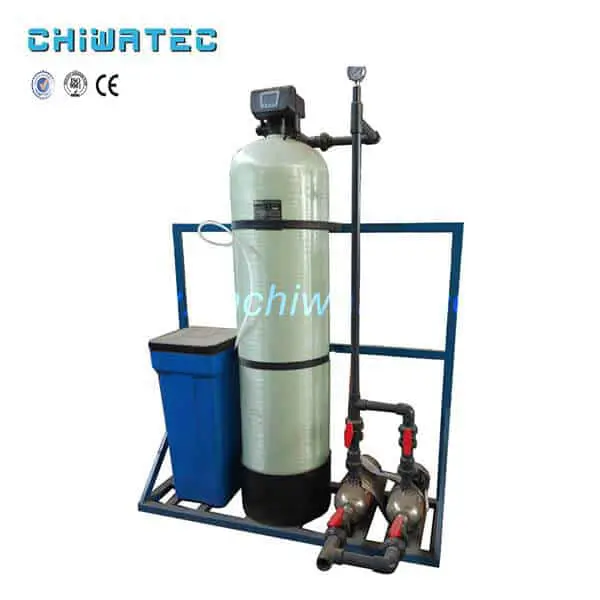
Installation Requirements and Best Practices
Proper installation is critical for the safe and efficient operation of softened water equipment. Follow these installation requirements:
| # | Installation Requirement | Rationale |
| 1 | Place equipment indoors to prevent freezing and sun exposure | Protects resin, electrical components, and mechanical parts from weather damage |
| 2 | Maintain 0.5 meters clearance around the equipment | Provides adequate space for routine maintenance and emergency access |
| 3 | Inlet water pressure must be 0.2-0.6 MPa | If pressure falls outside this range, install additional pressure regulation equipment |
| 4 | Configure a softened water storage tank with anti-corrosion lining | Prevents re-contamination of treated soft water. Size the tank based on usage requirements |
| 5 | No special foundation needed — install on level surface near drainage | Nearby ground should have a sewage channel for discharge water |
| 6 | Maintain saturated salt concentration in the brine tank | Solid salt level must remain above the brine solution level to ensure consistent regeneration |
| 7 | Flush all pipelines before connection | Removes debris and impurities that could block distribution systems or contaminate the resin |
Following these installation requirements prevents common startup problems and ensures the equipment operates within its design parameters from day one.
Water Softener Usage Guide: Maintenance and Long-Term Care
Proper maintenance is essential for maximizing the service life of your water softener usage guide equipment. Key maintenance practices include:
- Regular cleaning and lubrication — Keep the equipment clean at all times. Ensure all refueling points have adequate lubricating oil. Check rotary valve and transmission parts regularly.
- Extended shutdown procedures — For shutdowns exceeding half a month, raise the drain wastewater nylon pipe to the exchange column level. For long-term storage, clean residual salt solution from the salt tank and valve body, then apply lubricating oil to moving parts.
- Seasonal microbial prevention — During summer and mildew seasons, start the machine for one to two hours if idle for more than half a month to prevent mold and microbial growth inside the resin tank.
- Annual overhaul — Inspect the salt tank bottom plates, check resin layer height (target: 85-90 percent fill rate), and replenish resin as needed. Inspect and repair all mechanical and electrical components as necessary.
- Resin management — Monitor exchange capacity and replace resin when capacity drops below acceptable levels (typically every 3-5 years depending on water quality and operating conditions).
A well-maintained water softener can provide reliable service for 10-15 years with proper care, significantly reducing total cost of ownership.
Frequently Asked Questions
How often should I add salt to my water softener?
Check the brine tank monthly and maintain the salt level above the brine solution. The frequency of salt replenishment depends on water hardness and water consumption — typically every 4-8 weeks for average residential use and more frequently for industrial systems.
What water pressure is required for softened water equipment?
The inlet water pressure should be between 0.2-0.6 MPa (approximately 29-87 psi). If your water pressure is below 0.2 MPa, a booster pump is recommended. If above 0.6 MPa, install a pressure-reducing valve to protect the equipment.
How do I restart a water softener after long-term shutdown?
First, rotate the pulley by hand to turn the rotary valve several times. Check that all drain pipes are in their correct positions. Ensure the brine tank contains salt and saturated brine solution. Then power on the equipment and verify normal operation through one complete regeneration cycle.
What should I do if my softened water equipment is idle for more than two weeks?
During shutdowns exceeding half a month in warm weather, start the machine for one to two hours to prevent microbial growth in the resin tank. For long-term storage, drain the salt solution, clean the valve body, and apply lubricating oil to all moving parts.
How much clearance is needed around a water softener for maintenance?
A minimum clearance of 0.5 meters should be maintained on all sides of the equipment for access during maintenance and inspection. Ensure the area has proper drainage and is free from steam, moisture, and extreme temperatures.
Conclusion and Call to Action
Following this water softener usage guide will help you operate, install, and maintain your softened water equipment for maximum efficiency and service life. The guidelines presented here — from proper installation with adequate clearance and water pressure to annual maintenance and extended shutdown procedures — are based on established sodium ion exchange technology and field-proven best practices.
CHIWATEC is a high-tech enterprise specialized in various water processing devices, including water softening equipment, resin selection, and comprehensive water treatment engineering projects. Our team can help you select, install, and maintain the right softener system for your application.
Contact us today to discuss your water softening requirements:
Email: [email protected]
Email: [email protected]
Related Resources and Further Reading
- Water Softening Equipment Working Process: Step-by-Step Ion Exchange and Regeneration 2026
- Working Principle and Common Water Quality Problems of Softened Water Equipment
- Water Softening Equipment Installation Requirements and Guide 2026
- Water Softener Maintenance Schedule: Weekly, Monthly, and Annual Care Guide 2026
- Browse Water Softening Systems — Product Range
Do you have a water treatment project we can help with
* Designing,machining,installing,commissioning, customize and one-stop service






 English
  Spanish
  Portuguese




