

Automatic Water Softener Selection: Complete Guide to Choosing the Right System for Your Application
Selecting the wrong automatic water softener can lead to inadequate treated water quality, frequent regeneration cycles, excessive salt and water consumption, and premature equipment failure. Whether you need softened water for a steam boiler, cooling tower, process water system, or commercial building, a systematic automatic water softener selection process is essential to match the system specifications to your actual requirements. In this guide, CHIWATEC walks through every critical factor — from application type and water hardness to flow rate, tank configuration, and controller features.
Automatic Water Softener Selection: Key Factors to Consider
A successful automatic water softener selection process requires evaluating six key parameters before choosing a specific model. Each factor influences the final system size, configuration, and cost. Below is a summary of the decision framework:
| Selection Factor | What to Evaluate | Impact on Selection |
|---|---|---|
| Application type | Heating, cooling, boiler, process, or other | Determines water quality target and system material |
| Water consumption pattern | Running time, hourly usage, peak demand | Defines tank size and regeneration frequency |
| Source water hardness | Total hardness in mg/L or gpg | Controls resin volume and periodic capacity |
| Required flow rate | Peak flow in m³/h or GPM | Determines valve size and pipe connections |
| Periodic water production | Tons between regenerations | Confirms resin and tank sizing |
| Continuity requirement | Single or dual tank configuration | Single tank (intermittent) vs. dual/multi (continuous) |
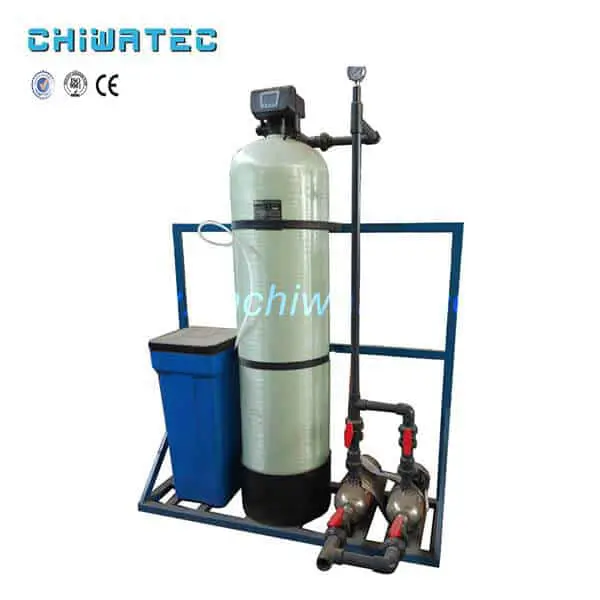
Step 1: Identify Your Application and Water Use Requirements
The first question to answer is: what type of system or process will the softened water serve? Different applications have distinct water quality requirements and operating patterns:
- Heating systems — Softened water for heating circuits prevents scale formation in boilers, radiators, and heat exchangers. The key requirement is low hardness to prevent limescale deposition at elevated temperatures.
- Cooling water make-up — Cooling towers and evaporative condensers consume large volumes of water. Softened make-up water reduces scaling on fill media and extends the cycles of concentration, lowering chemical treatment costs.
- Process water — Manufacturing processes in food processing, textiles, pharmaceuticals, and electronics require consistent water quality. The softener must be sized to handle production shifts and peak demand periods.
- Steam boilers — Boiler feed water requires the highest level of hardness removal to prevent tube scaling, which reduces heat transfer efficiency and can lead to tube failure. Multi-bed or dual-tank systems are often recommended for critical boiler applications.
- Steel smelting and chemical industries — Heavy industrial applications may require softened water in large volumes with specific quality parameters beyond standard hardness removal.
Document the application type, the number of hours per day the system operates, and the average vs. peak water consumption. This information directly determines the tank size and regeneration frequency.
Step 2: Measure Source Water Hardness and Quality
The total hardness of the source water is the single most important parameter in automatic water softener selection. Hardness is typically expressed as:
- mg/L as CaCO&sub3; (milligrams per liter of calcium carbonate equivalent) — Common measurement for municipal and well water testing
- gpg (grains per gallon) — Common in North America (1 gpg = 17.1 mg/L as CaCO&sub3;)
- mmol/L (millimoles per liter) — Used in some international standards
The water source type also matters:
- Municipal tap water — Usually has moderate and stable hardness (50–200 mg/L as CaCO&sub3;)
- Groundwater — Hardness varies widely by region, from 100–500 mg/L or higher
- Surface water — Hardness fluctuates seasonally and may contain higher suspended solids that require additional pretreatment
If the raw water hardness is high, the periodic water production capacity of the softener decreases proportionally, leading to more frequent regeneration cycles and reduced resin lifespan. When high hardness is anticipated, increase the resin volume by selecting an oversized model to maintain acceptable regeneration intervals.
Step 3: Determine Required Flow Rate and System Capacity
The required soft water flow rate (expressed in tons per hour or GPM) is determined by the maximum simultaneous demand of the equipment being served. This parameter drives the selection of the control valve size and tank diameter:
| Flow Rate | Recommended Valve Size | Typical Application |
|---|---|---|
| 0.5–2 m³/h | 3/4” – 1” | Small commercial, household |
| 2–5 m³/h | 1” – 1.5” | Medium commercial, light industrial |
| 5–15 m³/h | 1.5” – 2” | Industrial boiler, process water |
| 15–50 m³/h | 2” – 3” or multi-valve | Large industrial, multi-tank systems |
Always size for the peak flow rate, not the average. If the softener is undersized for peak demand, hardness breakthrough will occur during high-usage periods, compromising downstream equipment.
Step 4: Calculate Periodic Water Production
After selecting the softener model based on application, flow rate, and hardness, the next step is to calculate the theoretical periodic water production — the total volume of softened water the system can deliver between regeneration cycles. This is determined by:
- Resin exchange capacity — Typically 1.0–1.5 eq/L (equivalent per liter) for standard cation exchange resin, depending on resin grade and regeneration level
- Resin volume — The total volume of resin in the tank, in liters or cubic feet
- Feed water hardness — The measured total hardness in mg/L or eq/L
Periodic production (tons) = (Resin volume in L × Exchange capacity in eq/L) / (Feed water hardness in eq/L)
If the calculated periodic water production is insufficient for the expected consumption between regenerations, a larger tank with more resin or a higher-exchange-capacity resin should be selected. The regeneration frequency should ideally be 1–3 times per week for commercial systems, and never more than once per day.
Step 5: Decide Between Single and Dual Tank Systems
Your requirement for continuous vs. intermittent water supply determines whether a single-tank or dual/multi-tank configuration is appropriate:
- Single-tank (single-valve single-tank) — Suitable when softened water is not required during regeneration. The system softens water until resin capacity is exhausted, then regenerates. During regeneration (typically 60–90 minutes), no softened water is produced. If the application can tolerate this interruption, a single-tank system is the most economical choice.
- Dual-tank (dual-valve dual-tank, one-use-one-backup) — Provides continuous softened water supply. While one tank is producing softened water, the other is either regenerating or on standby. When the active tank reaches its capacity, the system automatically switches to the standby tank. This configuration is recommended for steam boilers, 24/7 production processes, and facilities that cannot tolerate any interruption in water supply.
- Multi-tank parallel systems — Used for high-capacity applications where multiple tanks operate simultaneously with staggered regeneration cycles. Centralized controllers manage the sequential regeneration to maintain continuous supply even during peak demand.
For most boiler and continuous process applications, dual-tank one-use-one-backup systems are the industry standard.
Step 6: Consider Additional Features and Controller Options
Modern automatic water softeners offer various controller features that affect selection:
- Time-controlled vs. flow-controlled regeneration — Time control initiates regeneration at a set interval (e.g., every 3 days at 2 AM). Flow control initiates regeneration based on actual water usage, which is more efficient for variable demand patterns.
- Microprocessor vs. mechanical timer — Microprocessor controllers offer more programming flexibility, diagnostic displays, and power outage memory retention. Mechanical timers are simpler and more rugged for harsh industrial environments.
- Remote monitoring and alarms — Advanced controllers support remote communication, enabling operators to monitor system status, receive alerts for low salt or regeneration failures, and track water usage data.
- Corrosion-resistant materials — For applications with aggressive water chemistry or harsh ambient conditions, select a softener with corrosion-resistant valve bodies (e.g., Noryl, glass-filled polypropylene) and appropriately coated tanks.
Frequently Asked Questions (FAQ)
How do I know what size water softener I need?
Size your softener based on three factors: feed water hardness (gpg or mg/L), daily water consumption (gallons or liters per day), and desired regeneration frequency (typically 1–3 times per week). Multiply hardness by daily consumption, then divide by the resin exchange capacity to determine required resin volume.
Can I use a residential water softener for commercial applications?
Residential softeners are designed for intermittent use and lower flow rates. For commercial or industrial applications, use a properly sized commercial-grade softener with a larger valve, higher flow capacity, and more durable construction to handle continuous operation.
What is the best regeneration frequency for a water softener?
For most commercial systems, regeneration every 2–4 days is optimal. Regenerating too frequently wastes salt and water, while waiting too long risks hardness breakthrough. Flow-controlled regeneration automatically adjusts to actual water usage for the best balance.
Do I need a dual-tank water softener?
Dual-tank systems are necessary when you require continuous softened water supply 24/7. If your facility can tolerate a 60–90 minute regeneration period during low-usage times (e.g., overnight), a single-tank system with proper sizing is sufficient and more economical.
How much salt does an automatic water softener use?
Salt consumption depends on resin volume and regeneration settings. Typical consumption is 6–15 lbs (2.7–6.8 kg) of salt per cubic foot of resin per regeneration. Flow-controlled systems optimize salt usage by regenerating only when needed.
Conclusion & Call to Action
A systematic automatic water softener selection process — evaluating application requirements, source water hardness, flow rate, periodic capacity, tank configuration, and controller features — ensures you invest in a system that delivers reliable, cost-effective softened water for years to come. CHIWATEC offers a comprehensive range of automatic water softening systems, from single-tank units to multi-tank configurations with advanced microprocessor controllers. Contact our team for expert sizing assistance and product recommendations: [email protected] or [email protected].
Related Resources and Further Reading
Do you have a water treatment project we can help with
* Designing,machining,installing,commissioning, customize and one-stop service






 English
  Spanish
  Portuguese




