

Water Softening Equipment Working Process: Step-by-Step Ion Exchange and Regeneration 2026
Hard water containing calcium and magnesium ions causes scale buildup in pipes, boilers, and industrial equipment, leading to reduced efficiency and costly maintenance. The water softening equipment working process uses ion exchange technology to remove hardness ions, delivering soft water that protects your system and extends equipment life. CHIWATEC specializes in designing and manufacturing high-performance water softening systems for residential, commercial, and industrial applications worldwide.
Understanding the Water Softening Equipment Working Process
The water softening equipment working process relies on sodium ion exchange — a proven chemical reaction where hard water passes through a bed of cation exchange resin. Calcium (Ca²⁺) and magnesium (Mg²⁺) ions in the water are exchanged for sodium (Na⁺) ions on the resin beads, effectively removing scale-forming minerals. This cycle continues until the resin becomes saturated with hardness ions, at which point regeneration restores its exchange capacity. The entire process is fully automatic in modern systems, requiring minimal operator intervention while delivering consistent soft water output at flow rates from 1 to 100+ m³/h depending on system size.
Key Components of Water Softening Equipment
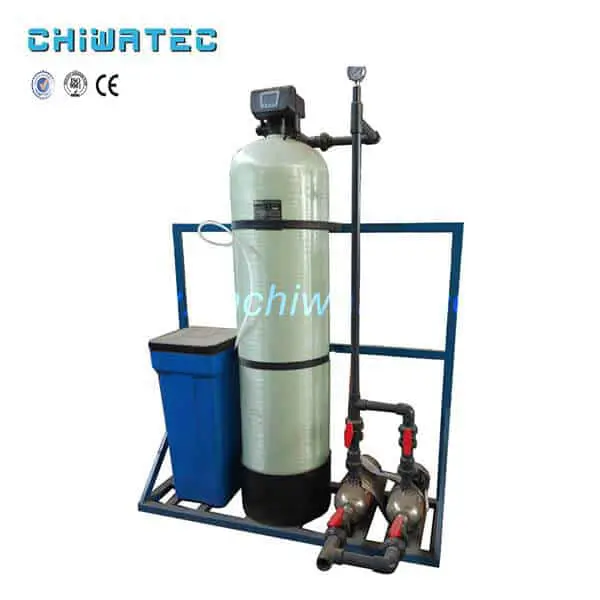
A complete water softening system consists of several critical components that work together to achieve efficient softening. The resin tank houses the ion exchange resin bed, typically containing 25 to 500 liters of strong acid cation resin. The brine tank stores sodium chloride solution for regeneration. The control valve — whether time-clock, meter-initiated, or manual — manages the service and regeneration cycles. Additional components include the distribution system at the tank bottom, the riser tube for water collection, and the bypass valve for maintenance accessibility. Understanding these parts helps operators maintain optimal performance throughout the water softening equipment working process.
Step 1: The Ion Exchange Reaction in Detail
During the service cycle, raw water enters the top of the resin tank and flows downward through the resin bed. The exchange follows this chemical equation: 2RNa + Ca²⁺ → R₂Ca + 2Na⁺ (and similarly for Mg²⁺). The resin preferentially adsorbs divalent hardness ions over monovalent sodium ions, effectively removing hardness from the water. Typical operating parameters include a service flow rate of 20-40 m/h (linear velocity), operating pressure of 2-5 bar, and water temperature of 2-50 °C. The effluent hardness is typically reduced from 200-500 mg/L as CaCO₃ to below 10 mg/L as CaCO₃, achieving over 95% hardness removal efficiency.
Step 2: The Regeneration Cycle in Five Stages
Once the resin reaches its exchange capacity limit (usually after treating 200-600 bed volumes of water depending on raw water hardness), regeneration begins automatically. The regeneration cycle consists of five distinct stages:
- Backwash (10-15 min): Water flows upward through the resin bed at 10-15 m/h to remove suspended solids, redistribute the resin, and eliminate channeling.
- Brine draw (30-60 min): Concentrated NaCl solution (8-12% salinity) is drawn from the brine tank through the resin bed at a slow flow rate of 2-5 m/h, displacing Ca²⁺ and Mg²⁺ ions with Na⁺.
- Slow rinse (30-45 min): Fresh water continues at the same slow rate to push brine through the entire bed and complete the exchange.
- Fast rinse (10-15 min): Water flows at service velocity (15-25 m/h) to flush residual brine and hardness ions from the system.
- Brine tank refill (10-20 min): A controlled volume of water enters the brine tank to dissolve salt for the next regeneration cycle.
The total regeneration cycle typically takes 90-135 minutes, and salt consumption ranges from 80-240 grams per liter of resin depending on the desired degree of regeneration.
Step 3: Service and Regeneration Control Methods
Modern water softening equipment uses either time-clock or meter-initiated control strategies. Time-clock controllers regenerate at preset intervals (e.g., every 2-7 days) regardless of water usage — suitable for applications with consistent daily consumption. Meter-initiated controllers track actual water usage and regenerate only when a preset volume has been treated, typically saving 20-30% in salt and water consumption compared to time-clock systems. Demand-initiated regeneration with twin alternating tanks allows continuous soft water supply by having one tank in service while the other regenerates, essential for hospitals, boiler plants, and manufacturing facilities with 24/7 operation requirements.
Key Performance Parameters and Design Factors
Several parameters determine the efficiency and sizing of the water softening equipment working process. Resin exchange capacity typically ranges from 1.0 to 2.0 eq/L (equivalents per liter) for standard gel-type cation resins. The recommended salt dose is 80-240 g/L of resin, with higher doses achieving greater regeneration efficiency at the cost of increased operating expense. Water hardness, daily flow rate, and peak flow demand dictate the system size — for example, a system treating 300 mg/L hardness at 10 m³/h for 12 hours daily requires approximately 200-300 liters of resin. Dual-bed or triplex configurations are recommended for systems with flow demands exceeding 50 m³/h or where uninterrupted soft water is critical.
Common Applications and Installation Requirements
Water softening equipment serves diverse industries including boiler feed water treatment (reducing blowdown from 8-12% to 3-5%), commercial laundries and dishwashers (extending equipment life by 30-50%), food and beverage production (improving product consistency), and HVAC systems (preventing scale in cooling towers and heat exchangers). Installation requirements include a level concrete or steel base rated for the filled weight of the system, adequate drainage for backwash and regeneration wastewater (typically 5-10% of treated flow), and electrical supply for the control valve (110-240 V, 50/60 Hz). The system should be installed upstream of any reverse osmosis unit or deionizer to protect membranes from scaling.
Frequently Asked Questions (FAQ)
How does the ion exchange resin remove hardness from water?
The resin beads contain sulfonic acid functional groups bonded with sodium ions. When hard water passes through, calcium and magnesium ions displace sodium from these active sites because divalent ions have higher affinity for the resin than monovalent sodium ions. This selective exchange continues until the resin is saturated, at which point regeneration is required.
How often should a water softener regenerate?
Regeneration frequency depends on raw water hardness, daily water consumption, and resin volume. For a typical household with 250 mg/L hardness and 400 liters daily consumption, regeneration occurs every 3-7 days. For industrial systems, meter-initiated controllers optimize regeneration frequency based on actual throughput, typically every 1-3 days.
What salt type is recommended for resin regeneration?
High-purity evaporated salt (99.5%+ NaCl) or solar salt is recommended, with pellet, block, or granular forms all suitable. Rock salt contains insoluble impurities that can foul the resin bed over time. Salt consumption ranges from 80-240 grams per liter of resin per regeneration cycle.
Can water softening equipment handle hot water?
Standard cation exchange resin operates effectively at temperatures up to 50 °C. For higher temperature applications (up to 120 °C), specially formulated high-temperature resins are available. However, the brine solution should not exceed 40 °C to prevent resin degradation during regeneration.
What is the lifespan of ion exchange resin in a water softener?
With proper maintenance and regular regeneration, high-quality cation exchange resin lasts 5-10 years in most applications. Gradual fouling by iron, manganese, or organic matter can reduce lifespan. Periodic resin cleaning with resin cleaner or citric acid solution helps maintain capacity and extends service life.
Conclusion & Call to Action
The water softening equipment working process — from ion exchange to regeneration — is a reliable, cost-effective solution for eliminating hardness-related problems in residential, commercial, and industrial water systems. CHIWATEC offers a full range of water softening systems with FLECK, AUTOTROL, and proprietary control valves, customized to your specific water quality and flow requirements. Contact our team today for a free system evaluation and quotation. Email us at [email protected] or [email protected] — we look forward to helping you achieve optimal water quality.
Related Resources and Further Reading
- Ion Exchange Method in Water Softening: Principles and Technology
- A Comparison Between Traditional Water Softeners and Fully Automatic Water Softeners
- Softened Water Treatment Equipment 2026: Complete Guide to Water Softener Systems & Benefits
- Boiler Water Softening Equipment Process: Complete Guide to 5-Step Flow and Regeneration 2026
- Water Softening Systems and Equipment — View Our Complete Product Line
Do you have a water treatment project we can help with
* Designing,machining,installing,commissioning, customize and one-stop service






 English
  Spanish
  Portuguese




