

Why Does Reverse Osmosis Water Treatment Technology Need Pretreatment and What Are the Commonly Used Pretreatment Processes? 2026
Reverse osmosis (RO) water treatment technology achieves a desalination rate exceeding 98%, making it one of the most effective water purification methods available. However, the RO membrane is extremely sensitive to feed water quality — suspended solids, colloids, organic matter, free chlorine, and hardness ions can all cause irreversible damage, fouling, or scaling. This is why pretreatment processes are indispensable before RO membrane treatment. Proper pretreatment protects the membrane from physical scratching, chemical oxidation, and biological fouling, ensuring stable water production, extended membrane life, and reduced operating costs. CHIWATEC provides complete RO systems with integrated pretreatment solutions tailored to diverse water sources and industrial applications.
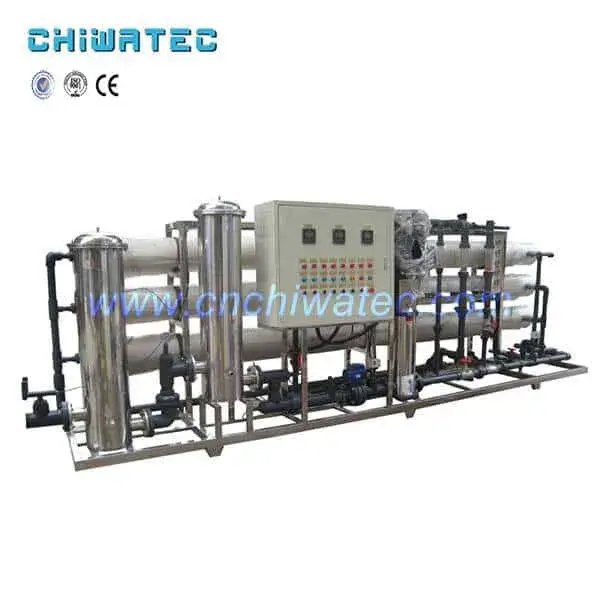
Why Reverse Osmosis Water Treatment Technology Needs Pretreatment Processes
The RO membrane’s desalination layer is approximately 10 microns thick — extraordinarily thin and vulnerable. Without adequate pretreatment processes, the following issues rapidly degrade membrane performance:
| Issue | Impact on RO Membrane | Typical Cause |
| Particulate fouling | Scratches the desalination skin layer, reduces salt rejection | Suspended solids above 5 microns in raw water |
| Colloidal fouling | Blocks membrane pores, decreases water production | Colloidal silica, iron, manganese in feed water |
| Scaling | Insoluble salt crystals form on membrane surface | Ca2+, Mg2+, Ba2+, Sr2+ at elevated concentration |
| Chlorine oxidation | Oxidizes membrane polymer structure, destroys rejection | Free chlorine above 0.1 ppm in feed water |
| Biological fouling | Biofilm blocks membrane surface, increases pressure drop | Microorganisms, bacteria in untreated water |
| Organic fouling | Dissolves membrane material, alters separation properties | TOC above 2 mg/L in surface water sources |
Industry data shows that proper pretreatment can extend RO membrane life from 2 years to 5+ years and reduce cleaning frequency by 60-80%, significantly lowering total cost of ownership. Every RO system — whether for seawater desalination, brackish water, or municipal tap water — requires site-specific pretreatment processes designed around the raw water analysis.
Key Objectives of RO Pretreatment
The primary goals of any RO pretreatment system include:
- Suspended solids removal — Reduce SDI (Silt Density Index) below 5, ideally below 3, to prevent particulate fouling
- Colloid destabilization and removal — Coagulate and filter out sub-micron colloidal particles
- Free chlorine elimination — Reduce residual chlorine to below 0.1 ppm to prevent membrane oxidation
- Hardness management — Prevent calcium and magnesium scaling through softening or antiscalant dosing
- Microbial control — Minimize biological growth potential in the membrane element
- Temperature and pH adjustment — Maintain optimal operating conditions for consistent flux and rejection
Modern RO pretreatment systems increasingly incorporate real-time monitoring of SDI, turbidity, and chlorine levels to automate dosing and backwash cycles, improving reliability while reducing chemical consumption by 15-25% compared to manual operation. Selecting the right combination of pretreatment processes for each objective is the key to long-term RO system success.
Coagulation and Sedimentation in RO Pretreatment
Coagulation is used when raw water contains fine suspended colloids that will not settle naturally under gravity. A coagulant (typically aluminum sulfate, ferric chloride, or polyaluminum chloride) is added to the raw water, forming destabilized flocs that aggregate into larger, settleable particles. These flocs are then removed in a sedimentation tank or clarifier before entering the media filters. Coagulation is essential when raw water suspended solids exceed 20 mg/L or iron content exceeds 0.3 mg/L. By removing colloidal particles at the front end, coagulation significantly reduces the fouling load on downstream multi-media filters and extends their service cycles, making it a critical step in comprehensive pretreatment processes for challenging water sources.
Multi-Media Filtration for Suspended Solids Removal
The multi-media filter is a cornerstone of RO pretreatment, typically using graded layers of anthracite, sand, and garnet to trap particles of varying sizes. The coarse top layer retains larger suspended solids while finer bottom layers capture smaller particles, achieving a filtration precision of 10-25 microns. A properly designed multi-media filter operating at 8-15 m/h filtration velocity can reduce feed water turbidity from 20 NTU to below 1 NTU and lower SDI to under 5, meeting the basic influent requirements for downstream RO membranes.
| Media Layer | Particle Size | Layer Height | Primary Function |
| Anthracite | 0.8-1.8 mm | 400-600 mm | Coarse filtration, traps larger particles |
| Silica sand | 0.4-0.8 mm | 300-500 mm | Medium filtration, captures intermediate fines |
| Garnet | 0.2-0.4 mm | 100-200 mm | Fine polishing, removes sub-micron particles |
Backwashing is typically performed every 12-24 hours of operation using air-scour combined with reverse water flow, restoring filtration capacity without media replacement.
Activated Carbon Filtration for Chlorine and Organic Removal
The activated carbon filter serves two critical functions in RO pretreatment: removing free chlorine to protect the thin-film composite (TFC) membrane from oxidative degradation, and adsorbing organic compounds including humic acids, pesticides, and industrial contaminants that could foul or dissolve the membrane material. RO membranes require feed water residual chlorine below 0.1 ppm — activated carbon achieves this reliably while also reducing TOC levels. For surface water sources with organic content exceeding 2 mg/L TOC, activated carbon adsorption is not optional but mandatory for sustainable RO operation. Due to its simple operation, low investment cost, and highly effective treatment, activated carbon filtration remains one of the most widely used pretreatment processes in municipal and industrial RO systems worldwide.
Precision Filtration as Final Protection Before the RO Membrane
Also known as the security filter or cartridge filter, this 5-micron absolute filtration stage is installed immediately before the high-pressure pump and RO membranes. Its purpose is to intercept any particles larger than 5 microns that may have passed through or been generated by upstream equipment (e.g., media filter breakage, coagulant carryover). Given that the RO membrane’s desalination layer is only 10 microns thick, even a single large particle accelerated by the high-pressure pump can scratch the membrane surface and cause irreversible loss of salt rejection. A 5-micron cartridge filter is therefore mandatory in every RO pretreatment train. Cartridge filters should be replaced when the pressure differential reaches 10-15 psi (0.7-1.0 bar), typically every 1-3 months depending on feed water quality.
Softening and Antiscalant Treatment for Scale Control
Hardness ions (calcium and magnesium) can precipitate as carbonate or sulfate scales on the RO membrane surface, permanently reducing water production and increasing energy consumption. Two approaches are commonly used for scale management:
- Ion exchange softening — Removes Ca2+ and Mg2+ completely using cation exchange resin. Advantages: zero scaling risk in the RO. Disadvantages: higher equipment cost, requires periodic resin regeneration with brine, and does not prevent silica scaling.
- Antiscalant dosing — Chemical scale inhibitors are injected into the feed water to delay crystal nucleation and growth, keeping hardness ions in solution beyond their natural saturation limit. Advantages: lower capital cost, simple automation, and effective against silica scaling. Disadvantages: calcium and magnesium still pass through to the brine stream.
For large two-stage RO systems and high-recovery designs (75-85% recovery), antiscalant dosing is the preferred approach due to its lower operating cost and ability to handle variable feed water chemistry. Both methods are proven pretreatment processes when applied correctly based on water analysis.
Temperature and pH Adjustment for Optimal RO Performance
RO membrane performance is temperature-dependent — water production drops by 3-5% for every 1 degree C decrease in feed water temperature below the design point (typically 25 degrees C). When raw water temperatures fall below 5 degrees C, membrane manufacturers void their warranty due to the risk of physical damage to the membrane structure. A heat exchanger or inline heater maintains feed water temperature in the 15-30 degrees C range for consistent flux. Additionally, pH adjustment is used to optimize membrane performance — most thin-film composite RO membranes operate best in the pH 6-8 range, and proper pH control also prevents calcium carbonate scaling at the concentrate side. These supporting pretreatment processes are particularly important in cold climate regions and industrial applications with fluctuating feed chemistry.
How to Select the Right Pretreatment Combination
The optimal set of pretreatment processes depends on the specific raw water analysis and system requirements:
| Water Source | Recommended Pretreatment Train | Key Design Parameter |
| Municipal tap water | Multi-media filter, Activated carbon, 5 micron cartridge, RO | Chlorine removal, SDI below 3 |
| Surface water (river/lake) | Coagulation, Sedimentation, Multi-media, Activated carbon, 5 micron, RO | TOC removal, turbidity below 1 NTU |
| Groundwater (hard) | Multi-media filter, Softening or Antiscalant, 5 micron, RO | Hardness management, iron removal |
| Seawater | Dissolved air flotation, Multi-media, Cartridge, SWRO | SDI below 3, algae removal |
| Wastewater reuse | UF/MBR, Antiscalant, 5 micron, RO | SDI below 3, biofouling control |
Recent advances in automated pretreatment control — including adaptive coagulant dosing based on streaming current detection and real-time SDI monitoring — have improved system reliability by 30-40% while reducing chemical waste. When designing or upgrading an RO system, a comprehensive raw water quality analysis should always be conducted first to select the appropriate pretreatment processes and avoid costly membrane replacements.
Frequently Asked Questions
What is the most critical pretreatment process for RO systems?
The most critical step depends on the feed water source, but multimedia filtration combined with activated carbon filtration is fundamental for nearly all RO applications. Multimedia filtration removes suspended solids and reduces SDI, while activated carbon protects the RO membrane from chlorine oxidation and organic fouling. For hard water sources, softening or antiscalant dosing becomes equally critical to prevent scaling.
Can RO operate without pretreatment?
In practice, RO membranes cannot operate without some form of pretreatment for any water source except high-purity feed water. Even municipal tap water contains chlorine (which oxidizes TFC membranes), residual particles, and hardness ions that cause rapid fouling. Operating without proper pretreatment typically reduces membrane life from 3-5 years to less than 6 months and may void the manufacturer’s warranty.
How often should RO pretreatment filters be replaced?
Multi-media filters require backwashing every 12-24 hours of operation, with media replacement every 3-5 years depending on wear. Activated carbon filters typically need carbon replacement every 6-12 months once chlorine breakthrough is detected. Cartridge (security) filters should be replaced when the pressure differential reaches 10-15 psi (0.7-1.0 bar), typically every 1-3 months depending on feed water quality.
What is the difference between pretreatment and post-treatment?
Pretreatment occurs before the RO membrane to protect it from damage and fouling, while post-treatment conditions the permeate water after RO for its intended use — for example, pH adjustment, remineralization, or UV sterilization for drinking water, or EDI/ion exchange polishing for ultrapure water applications.
How does pretreatment affect RO operating costs?
Proper pretreatment reduces overall system operating costs by 40-60% through extended membrane life, reduced cleaning chemical consumption, lower energy costs from maintained flux, and decreased downtime. The pretreatment system typically accounts for 15-25% of total RO system capital cost but delivers the highest ROI through reliability improvements.
Conclusion and Call to Action
Pretreatment processes are not optional in reverse osmosis water treatment — they are the foundation of reliable, cost-effective membrane operation. From basic multi-media filtration and activated carbon adsorption to advanced antiscalant dosing and temperature control, a properly designed pretreatment train protects the RO membrane from fouling, scaling, chlorine damage, and biological growth, extending membrane life from 2 years to over 5 years while maintaining consistent water quality. Whether you are designing a new RO system, upgrading an existing plant, or troubleshooting performance issues, selecting the right combination of pretreatment processes based on raw water analysis is the single most impactful decision for long-term system success.
Xi’an CHIWATEC Water Treatment Technology is a high-tech enterprise specialized in designing and manufacturing complete water treatment systems, including fully integrated RO units with customized pretreatment tailored to your water source. Our engineering team provides one-stop service from raw water analysis through system design, installation, commissioning, and ongoing support across a wide range of industrial applications. For a free consultation on your RO pretreatment needs, contact us at [email protected] or [email protected].
Do you have a water treatment project we can help with
* Designing,machining,installing,commissioning, customize and one-stop service






 English
  Spanish
  Portuguese




