Introduction of Water Softener Product Features
Modern water softeners play a crucial role in removing hardness ions—primarily calcium and magnesium—from industrial and commercial water systems. A high-quality water softener ensures stable soft water output, reduces scaling, improves equipment lifespan, and enhances system efficiency.
This article introduces the core product features, structure, and performance advantages of advanced water softener systems widely used in industrial boilers, heat exchangers, and HVAC systems.
1. Advanced Control System with Mature Technology
The water softener utilizes a sophisticated, field-proven control system that is easy to operate and highly reliable.
For example, the Flexco boiler water softener controller uses a lead-free brass valve body, fully compliant with food-grade hygiene standards.
Additionally, the internal Teflon coating provides excellent corrosion resistance, ensuring long-term durability and preventing internal wear.
These features make the equipment suitable for:
- Industrial boilers
- Heat exchangers
- Heating system make-up water
- Central air conditioning make-up water
- General industrial soft water applications
2. Multiple Control Types to Meet Various Application Needs
To adapt to different industrial environments, water softeners are available in several control types:
Time-based Control
Regenerates based on preset time intervals for consistent performance.
Flow-based Control
Automatically regenerates when a preset volume of water has been treated, maximizing efficiency and cost savings.
Multi-tank Control
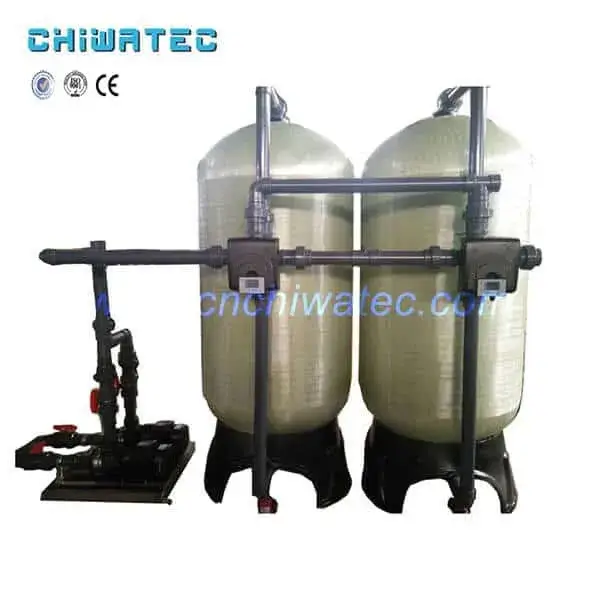
Allows alternating or parallel operation for continuous soft water supply—ideal for 24-hour applications.
Tank Body Material Options
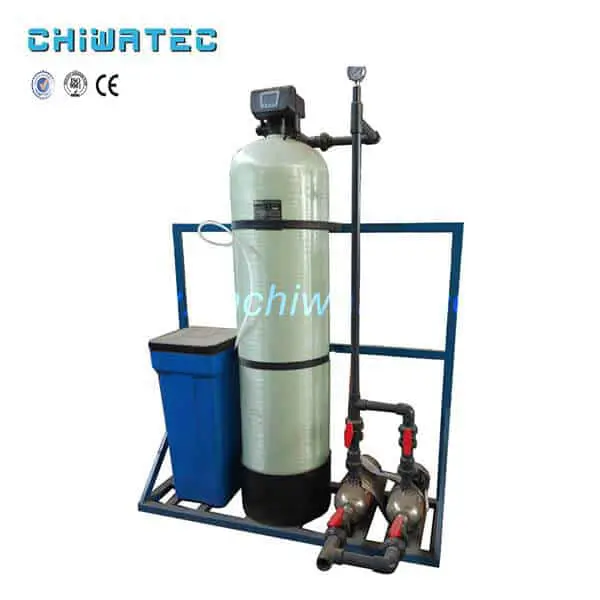
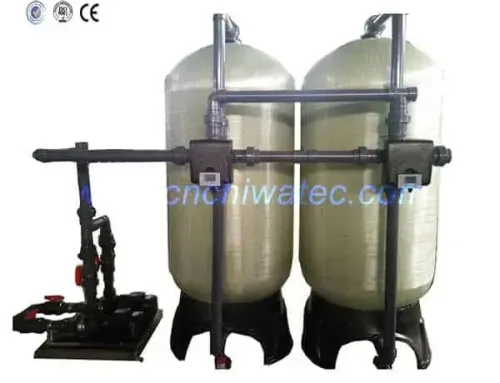
- Premium FRP (glass-fiber reinforced plastic)
- Stainless steel
- Carbon steel with anti-corrosion lining
Users can choose according to corrosion resistance, working environment, and budget.
3. High Degree of Automation
Fully Automated Softening Cycle
The system automatically completes:
- Water supply
- Backwashing
- Salt absorption
- Slow rinse
- Fast rinse
- Water refill
Automatic Resin Regeneration
Driven by a time-synchronized motor and programmed control system, the entire ion exchange and regeneration process is fully automated.
Users only need to periodically add salt to the brine tank—no complex operations required.
4. High Efficiency, Low Consumption, and Labor Savings
High Exchange Efficiency
The optimized internal design ensures maximum utilization of resin exchange capacity for effective hardness removal.
Labor-Saving Operation
No need for dedicated operators—installation is simple, and the equipment can be used the same day.
Water-Saving Performance
Softening efficiency exceeds 98%, significantly reducing wastewater production.
Energy Saving
The equipment uses a siphon-based regeneration system—no salt pump required.
Power consumption is only 1% of typical soft water equipment.
5. Compact Structure, Small Footprint
The system requires only minimal space for the main tank and salt tank.
Its compact design reduces pipeline and valve layout, lowering construction investment and simplifying installation.
6. Safe, Non-Toxic Materials for Food-Grade Applications
The lead-free brass valve body makes the system especially suitable for:
- Food processing plants
- Beverage production
- Pharmaceutical industries
- Purified water and RO pre-treatment lines
All materials in contact with water are safe, hygienic, and corrosion-resistant.
7. Low-Maintenance Design with Long Lifespan
The control valve is designed for durability and ease of maintenance.
Users can easily adjust regeneration cycles and settings based on actual water usage and hardness levels.
Tank Body Reliability
Every tank undergoes strict:
- Pressure testing
- Corrosion resistance checks
- Quality inspection
Available in stainless steel or FRP, the tank prevents resin contamination and ensures stable, long-term operation of the water softening system.
Conclusion
Water softeners are indispensable in modern industrial and commercial water treatment. Their advanced control systems, fully automated operation, high efficiency, and use of food-grade materials make them highly reliable for applications such as boilers, HVAC, and manufacturing.
By choosing the appropriate control type, tank material, and configuration, users can significantly reduce scale formation, lower operating costs, and extend the lifespan of downstream equipment.
A well-designed soft water system ensures safe, stable, and economical production for many years.
FAQ
1. Where are water softeners commonly used?
They are widely used in boilers, heating systems, heat exchangers, central air conditioning, and industrial manufacturing.
2. How often should the water softener regenerate?
This depends on the control mode. Flow-based systems regenerate based on actual water usage, while time-based systems regenerate at preset intervals.
3. What materials are available for the tank body?
FRP, stainless steel, or carbon steel with an anti-corrosion lining are available depending on the application.
4. Is the equipment suitable for food or beverage production?
Yes. The lead-free brass valve body and corrosion-resistant materials fully comply with food-grade hygiene requirements.
5. What makes this softener energy-efficient?
Its siphon-based regeneration eliminates the need for a salt pump, reducing power consumption by up to 99%.
Xi’an CHIWATEC Water Treatment Technology is a high-tech enterprise specialized in various water processing devices. Aside from these individual products, which cover a number of types and series, we can also help with related comprehensive engineering projects. Thanks to our hard work and dedication upon our founding, we are now one of the fastest-developing water treatment equipment manufacturers in Western China.
Further reading:
- Introduction to the advantages of automatic water softeners, water softeners, and water softening equipment
- The maintenance of the water softener should be carried out on a weekly, monthly, and yearly basis?
- How to select water softener and boiler softening equipment?
- Automatic water softener 100-150L per hour
- Notes on the selection of automatic water softeners
FOLLOW US
Do you have a water treatment project we can help with
* Designing,machining,installing,commissioning, customize and one-stop service
 English
  Spanish
  Portuguese