

RO System Pretreatment and Design (Part 2): Particles, Colloids, Microorganisms, Iron, and Oil Removal 2026
This second installment of our RO system pretreatment design series addresses the specific challenges posed by surface water containing particles and colloids, bacterial and microbiological contamination, municipal water quality issues, trace oil and grease, and reduced-state water containing iron, manganese, and hydrogen sulfide. Each of these conditions requires specialized China reverse osmosis system pretreatment design approaches to ensure reliable membrane protection and consistent system performance. CHIWATEC engineers custom RO pretreatment solutions for challenging water sources across China and international markets. This is Part 2 of a two-part series — see Part 1 for RO system pretreatment for insoluble inorganic salts, silica, metal oxides, and natural organic matter.
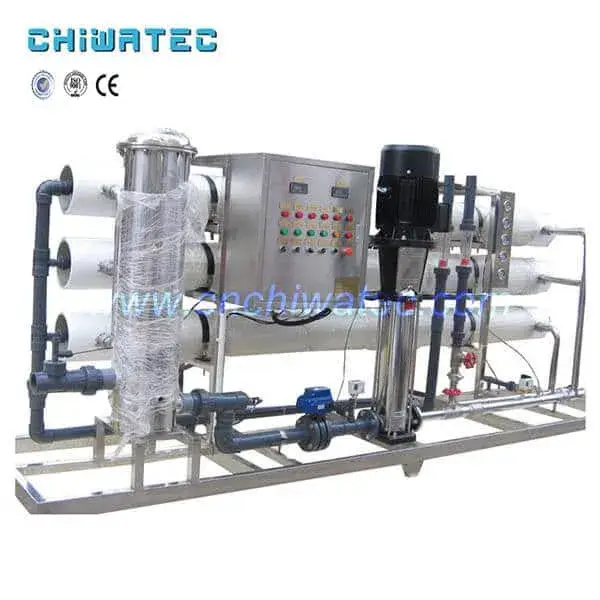
China Reverse Osmosis System Pretreatment for Surface Water with Particles and Colloids
Surface water sources — rivers, lakes, and reservoirs — typically contain significant concentrations of suspended particles and colloidal matter that must be removed before RO membrane treatment. RO membranes do not allow particulate matter larger than 5 microns to enter, as these particles can scratch the ultra-thin barrier layer of the membrane during system operation, leading to increased salt permeability and reduced desalination rate. Effective China reverse osmosis system pretreatment design for particle-laden surface water employs several strategies:
- Lime pre-softening with sodium aluminate — A lime pre-softening process with a small amount of sodium aluminate added to the clarifier significantly increases clarification efficiency by promoting floc formation and settling
- Coagulation and flocculation before media filtration — Adding coagulant or coagulant aid followed by sedimentation and clarification before multi-media or fine sand filtration improves solid-liquid separation and reduces filter loading
- Microfiltration or ultrafiltration pretreatment — Installing MF (0.1-0.2 micron) or UF membranes before the RO system provides absolute barrier removal of particles and colloids, achieving SDI below 2 regardless of feed water quality fluctuations
For surface water with high seasonal turbidity variation (from below 5 NTU in dry season to over 100 NTU in rainy season), a combination of coagulation, settling, and media filtration followed by UF provides the most reliable pretreatment performance.
Comparison of Pretreatment Approaches for Different Water Sources
The table below summarizes the recommended China reverse osmosis system pretreatment approaches for each water quality scenario covered in this Part 2 guide:
| Water Source Challenge | Primary Pretreatment Method | Secondary/Polishing |
| Surface water with particles/colloids | Coagulation + sedimentation + media filtration | MF or UF membranes for SDI below 2 |
| Bacteria and microorganisms | Non-oxidizing biocide or UV disinfection | UF membranes; system design optimization |
| Municipal water with chlorine | Activated carbon or sodium bisulfite dosing | Flocculant-scale inhibitor compatibility check |
| Oil and grease above 0.1 ppm | Oil-water separation or chemical coagulation | Activated carbon or UF membrane |
| Reduced groundwater with Fe/Mn/H2S | Aeration + greensand filtration or degasification | UF membranes; pH control for iron solubility |
In practice, many raw water sources present multiple challenges simultaneously. A comprehensive water analysis is essential before designing the pretreatment train.
Design for Bacteria and Microorganisms in Raw Water
Bacterial and microbiological contamination can cause rapid biofouling of RO membranes, leading to increased feed pressure, reduced permeate flow, and irreversible membrane damage. The RO system typically requires the total bacterial count in raw water to be controlled below 10,000 CFU/mL. Several approaches are used in China reverse osmosis system pretreatment design for biological control:
| Method | How It Works | Best Application |
| Non-oxidizing biocides | Intermittent dosing of permitted bactericides such as MBC881, MBC2881 (ARGO, USA) or equivalent | Ongoing microbial control during operation |
| UV disinfection | Ultraviolet light at 254 nm wavelength disrupts microorganism DNA | Chemical-free disinfection before RO; no residual handling |
| Microfiltration/UF | Physical barrier removes bacteria and protozoa completely | Surface water with high biological loading |
| Copper sulfate dosing | 0.1 ppm copper sulfate controls algae and microorganism growth | Lakes, rivers, and seawater intake treatment |
| System design optimization | Minimize water flow dead zones, avoid low-point water accumulation, add drain valves at low sections | All RO systems — prevents microorganism breeding grounds |
For systems treating surface water with high biological activity, a multi-barrier approach combining UV or biocide dosing with UF membrane pretreatment provides the highest level of biofouling protection.
Design for Municipal Tap Water with Poor Quality
Municipal tap water and self-provided water sources present two important challenges for RO pretreatment: residual free chlorine and flocculant compatibility with scale inhibitors.
Free Chlorine Removal
Free chlorine in municipal water can degrade the aromatic polyamide active layer of RO membranes, causing irreversible performance loss. Two approaches are used: activated carbon adsorption filters (common in small RO systems) or reducing agent metering using sodium bisulfite (SBS) (preferred in large systems). SBS dosing requires accurate metering to ensure complete chlorine neutralization without overdosing, which can support biological growth.
Flocculant and Scale Inhibitor Compatibility
Water treatment plants using surface water sources commonly add cationic flocculants for coagulation. When this water is used as RO feed, compatibility between the residual flocculant and the selected scale inhibitor is critical. If the raw water has been treated with cationic flocculants, anionic scale inhibitors must be avoided — their reaction can form colloidal precipitates that foul the RO membrane surface. Reputable chemical manufacturers provide compatible product pairs: for example, MPT150 flocculant from ARGO Scientific is compatible with their MDC-150 scale inhibitor, ensuring safe combined use.
Design for Trace Oil and Grease in Raw Water
Oil and grease cannot be tolerated in RO feed water. Even trace concentrations can cause chemical degradation of the aromatic polyamide membrane active layer, leading to irreversible performance loss. Additionally, oil adhesion on the membrane surface makes it easier for other pollutants to attach, compounding fouling problems. When the oil and grease content in the feed water exceeds 0.1 ppm, removal is mandatory before the RO system. Depending on the specific conditions, one or more of the following methods should be applied:
- Oil-water separation — Gravity separation or coalescing plate separators for free oil removal
- Chemical coagulation — Destabilizes emulsified oil droplets for removal by sedimentation or flotation
- Activated carbon adsorption — Effectively removes dissolved and emulsified oil to below detection limits
- Ultrafiltration membrane separation — Provides absolute barrier for emulsified oil droplets with molecular weight cut-off below oil molecule size
For industrial wastewater or recycled water sources with oil contamination risk, online oil-in-water monitoring should be installed to trigger automatic system shutdown if oil breakthrough is detected, protecting downstream RO membranes.
Design for Reduced-State Water with Iron, Manganese, and Hydrogen Sulfide
Groundwater sources in a reduced (anoxic) state containing ferrous iron (Fe2+), manganese (Mn2+), hydrogen sulfide (H2S), and ammonia salts present one of the most challenging conditions for China reverse osmosis system pretreatment design.
Iron and Manganese Control
When raw water in a reduced state is exposed to oxygen during pretreatment, ferrous iron and manganese ions oxidize to insoluble hydroxide sols. Although coagulation, sedimentation, and media filtration can remove these compounds, iron fouling of RO membranes remains a common problem in practice. Through years of engineering practice, the following safe limits have been established:
| Raw Water Condition | Safe Iron Limit in RO Feed |
| pH below 6.0, dissolved oxygen below 0.5 ppm | Up to 4.0 ppm Fe (iron fouling unlikely) |
| pH 6.0-7.0, dissolved oxygen 0.5-5.0 ppm | Below 0.5 ppm Fe |
| pH above 7.7, dissolved oxygen above 5.0 ppm | Only 0.05 ppm Fe — extreme sensitivity |
An important design caution: when treating iron-containing groundwater in a reduced state, chlorination processes should not be used. The colloidal iron formed during chlorination is extremely difficult to remove and causes severe RO membrane fouling. Instead, aeration followed by manganese greensand filtration or UF membrane filtration is preferred for iron removal from reduced groundwater.
Hydrogen Sulfide Removal
Hydrogen sulfide in groundwater can be removed by chlorination and oxidation, but the effectiveness depends on pH. At pH below 6.4, chlorine converts H2S to sulfuric acid, which remains dissolved. At pH above 6.4, approximately 50% of H2S is oxidized to colloidal sulfur — which is extremely difficult to remove and causes significant membrane fouling. Alternative removal methods include:
- Degasification or air stripping — Removes most H2S before the RO system by transferring H2S gas from water to air
- Sulfaclean technology — Extracts H2S from the water stream without converting it to other sulfides, producing no soluble by-products and requiring no chemical additives. The removal effect is excellent, and the process is very safe for RO systems.
In 2025-2026, catalytic oxidation media and biological filtration methods are also gaining adoption for H2S removal from RO feed water, offering lower operating costs than chemical oxidation approaches.
Frequently Asked Questions
What is the best pretreatment for surface water with high turbidity?
A multi-barrier approach combining coagulation, sedimentation, multi-media filtration, and ultrafiltration (UF) provides the most reliable pretreatment for high-turbidity surface water. UF membranes provide an absolute barrier for particles, achieving SDI consistently below 2 regardless of feed turbidity fluctuations from seasonal changes.
Why must cationic flocculants and anionic scale inhibitors be kept separate?
Cationic flocculants carry positive charges that attract negatively charged particles for coagulation. Anionic scale inhibitors carry negative charges. When mixed, they react electrostatically to form insoluble colloidal precipitates that deposit on the RO membrane surface, causing irreversible fouling. Always verify chemical compatibility when selecting pretreatment and RO chemicals from different manufacturers.
Can UV disinfection alone control biofouling in RO systems?
UV disinfection is effective at inactivating planktonic (free-swimming) bacteria in the feed water, but it does not prevent biofilm formation on membrane surfaces. For complete biofouling control, UV should be combined with periodic non-oxidizing biocide dosing and system design optimization (eliminating dead zones, ensuring complete drainage during shutdown).
What is the maximum allowable oil content in RO feed water?
Oil and grease should not exceed 0.1 ppm in RO feed water. Above this level, oil can chemically degrade the aromatic polyamide membrane active layer and promote adhesion of other foulants. Oil-water separation, chemical coagulation, activated carbon, or UF membrane pretreatment should be applied when oil is detected above this threshold.
How does pH affect iron fouling in RO pretreatment?
pH is the most critical factor affecting iron fouling. At low pH (below 6.0), iron remains soluble even at relatively high concentrations (up to 4 ppm). As pH increases above 7.0, iron rapidly oxidizes and precipitates. At pH above 7.7 with high dissolved oxygen, the safe iron limit drops to just 0.05 ppm — 80 times lower than at low pH. This extreme sensitivity makes pH control essential for iron-containing groundwater sources.
Conclusion and Call to Action
Successful China reverse osmosis system pretreatment design for challenging water sources requires understanding the specific contaminant challenges and selecting the right combination of treatment technologies. From particle and colloid removal using coagulation and UF membranes, to biological control through biocides and UV disinfection, to municipal water quality management, oil and grease protection, and iron/manganese/H2S handling — each scenario demands a carefully engineered pretreatment solution. Part 2 of this series demonstrates that with proper pretreatment design, even the most challenging raw water sources can be reliably treated by RO systems.
Xi’an CHIWATEC Water Treatment Technology is a high-tech enterprise specialized in designing and manufacturing complete water treatment systems, including custom-engineered RO pretreatment trains for challenging water sources across China and internationally. Our engineering team provides one-stop service from raw water analysis through system design, installation, commissioning, and ongoing support. For expert guidance on your RO system pretreatment design, contact us at [email protected] or [email protected].
Related Resources
- RO System Pretreatment and Design (Part 1): Insoluble Salts, Silica, Metal Oxides, Organic Matter 2026
- What Is Water Pretreatment: Methods and Processes 2026
- Classification of Pollutants in RO Pretreatment Systems
- Why RO Needs Pretreatment: Complete Guide 2026
- RO Water Treatment Systems — Browse CHIWATEC Products
Do you have a water treatment project we can help with
* Designing,machining,installing,commissioning, customize and one-stop service






 English
  Spanish
  Portuguese




