

Standard Work Flow of Softened Water Equipment: Complete Guide to the 5-Step Process 2026
Water softening is one of the most essential pretreatment processes in industrial and commercial water treatment, protecting boilers, cooling towers, and process equipment from damaging calcium and magnesium scale deposits. The standard work flow of softened water equipment consists of five core processes: work (water production), backwashing, salt absorption (regeneration), slow flushing (replacement), and fast flushing. Understanding this complete 5-step cycle is fundamental for operators, maintenance engineers, and facility managers who rely on consistent soft water quality for their operations. CHIWATEC manufactures a full range of water softening systems, from compact household units to high-flow industrial skids, all built around this proven 5-step ion exchange workflow.
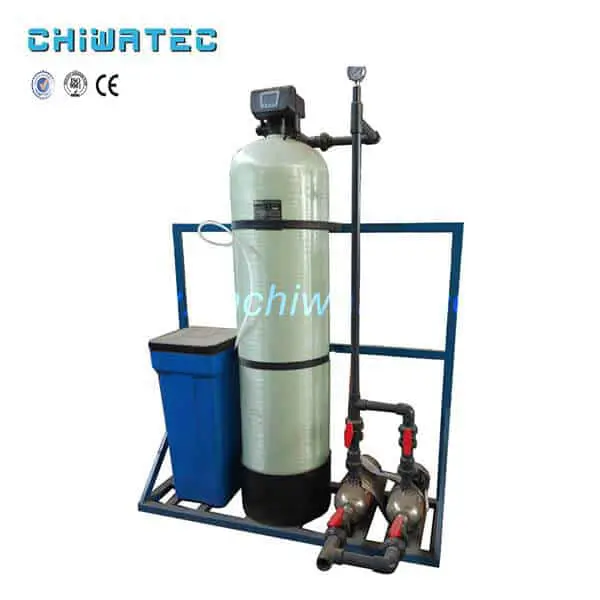
Understanding the Standard Work Flow of Softened Water Equipment
All ion exchange water softeners operate on the same fundamental principle: sodium-form cation exchange resin beads attract and bind calcium (Ca2+) and magnesium (Mg2+) ions from the water, releasing sodium (Na+) ions in exchange. Over time, the resin becomes saturated with hardness ions and must be regenerated to restore its softening capacity. The standard work flow of softened water equipment comprises five sequential processes that together ensure continuous soft water production and reliable resin regeneration. While the specific control system may vary between manual, semi-automatic, and fully automatic designs, the underlying 5-step cycle remains consistent across all sodium ion exchange softeners. Fully automatic systems add a brine re-injection step for precise salt metering.
| Step | Process Name | Duration | Flow Direction |
| 1 | Work (Water Production) | Variable (hours-days) | Downward through resin |
| 2 | Backwashing | 5-15 minutes | Upward (bottom to top) |
| 3 | Salt Absorption (Regeneration) | ~30 minutes | Downward (slow) |
| 4 | Slow Flush (Replacement) | ~30 minutes | Downward (slow) |
| 5 | Fast Flush | 5-15 minutes | Downward (service flow) |
Step 1: Work (Water Production Phase)
During the work cycle, raw water flows downward through the resin bed in the pressure vessel. The cation exchange resin removes calcium and magnesium ions, releasing sodium ions and producing softened water with hardness typically reduced to below 1 mg/L as CaCO3. The duration of this phase depends on the resin volume, raw water hardness, and service flow rate. For example, a typical industrial softener with 100 liters of resin treating water at 200 mg/L hardness can produce approximately 30,000 liters of soft water before regeneration is required — corresponding to roughly 8-24 hours of continuous operation depending on flow demand. As the resin absorbs hardness ions, the softening capacity gradually depletes, eventually reaching the point where regeneration is triggered, either by a preset volume meter (meter-initiated regeneration) or a timer (time-initiated regeneration).
Step 2: Backwashing the Resin Bed
Before regeneration can begin, the resin bed must be cleaned through backwashing. During the work cycle, the resin bed acts as a mechanical filter, trapping suspended solids, colloidal particles, and debris from the raw water on the upper surface of the bed. Over time, these accumulated particles reduce water flow and prevent effective contact between the brine solution and the resin beads during regeneration. The backwash process directs water upward from the bottom of the resin tank through the bed and out through the top drain, expanding the bed volume by 30-50% and flushing trapped particles away. Typical backwash duration is 5-15 minutes at a flow rate sufficient to expand but not fluidize the entire bed — approximately 10-15 m/h for standard cation resin. Proper backwashing ensures that the resin surface is fully exposed for the subsequent regeneration step.
Step 3: Salt Absorption (Regeneration)
Salt absorption is the core regeneration step where the resin’s softening capacity is restored. A concentrated brine solution (typically 8-12% sodium chloride) is drawn from a brine tank and injected into the resin vessel. The brine flows slowly downward through the resin bed, displacing the accumulated calcium and magnesium ions from the resin exchange sites and replacing them with sodium ions. The chemical reaction follows the principle of mass action — the high concentration of sodium ions in the brine drives the exchange, forcing hardness ions into the waste stream.
The regeneration efficiency depends on several factors:
- Brine concentration — Optimal range is 8-12% NaCl; lower concentrations waste salt, higher concentrations risk resin damage
- Contact time — Slow flow through the resin (approximately 30 minutes) ensures complete ion exchange; soaking alone is less effective than flow-through regeneration
- Salt dosage — Typical industrial softeners use 100-240 grams of salt per liter of resin for complete regeneration
- Brine quality — Salt should be pellet or solar-grade with minimum 99.5% NaCl purity; iron content should be below 0.01% to prevent resin fouling
Traditional manual systems use a salt pump to inject brine, while modern fully automatic softeners employ a venturi injector that draws brine through the pressure differential created by service water flow. The injector method is simpler, more reliable, and requires less maintenance than pump-based systems.
Step 4: Slow Flush (Replacement/Displacement)
After the brine has passed through the resin bed, a significant concentration of calcium and magnesium ions remains in the resin vessel. The slow flush (also called displacement or replacement) step uses raw water at the same slow flow rate as the salt absorption step to gradually push the spent brine and displaced hardness ions out of the resin bed. This slow flow is critical — at high flow rates, the water would bypass the resin channels without fully displacing the brine, leaving residual hardness on the exchange sites.
During the slow flush, ion exchange continues as the remaining calcium and magnesium ions on the functional groups of the resin are replaced by sodium from the residual brine. In practice, this step is often considered the most important part of the regeneration process because it completes the ion exchange that the salt absorption step began. The slow flush duration typically matches the salt absorption time at approximately 30 minutes. Using the slow flush flow rate ensures that the effluent reaches the target hardness level before returning to service.
Step 5: Fast Flush and Return to Service
The final step in the standard softened water equipment workflow is the fast flush, also called rapid rinse or service rinse. Raw water is directed through the resin bed at a flow rate close to the normal service flow rate to thoroughly rinse any remaining brine, chloride, and displaced hardness ions from the vessel. This step typically lasts 5-15 minutes, during which the effluent quality is monitored. At the end of the fast flush cycle, the water must meet the target soft water specification (typically below 17.1 mg/L or 1 grain per gallon of hardness). The equipment then returns to the work phase, ready to produce soft water again.
Some modern softeners incorporate an additional brine re-injection step after regeneration in fully automatic systems. This pre-wets the resin bed with a small volume of fresh brine before the next service cycle, ensuring immediate softening capacity when the system returns to service.
Fully Automatic vs. Manual Softening Systems
While the 5-step regeneration cycle is identical in principle, the control method differs significantly between manual and automatic systems:
| Feature | Manual Softener | Automatic Softener |
| Regeneration initiation | Operator manually rotates valve | Timer or flow meter triggers automatically |
| Brine injection | Salt pump required | Venturi injector (no pump needed) |
| Step duration control | Operator estimates timing | Programmable controller with exact timing |
| Labor requirement | High — operator must be present | Minimal — self-regenerating |
| Salt efficiency | Variable, depends on operator | Consistent, optimized with counter-current options |
| Typical application | Small-scale, low-flow systems | Industrial, high-flow, critical applications |
Fully automatic systems also support dual-alternating configurations (twin-tank or duplex) where one tank is in service while the other regenerates, ensuring uninterrupted soft water supply 24/7. In 2025-2026, smart softeners with IoT connectivity enable remote monitoring of salt levels, flow rates, and regeneration status, reducing service calls by 30-50% compared to manual inspection schedules.
Frequently Asked Questions
How long does each step in the softener regeneration cycle take?
The work phase varies from hours to days depending on water usage. Backwashing takes 5-15 minutes, salt absorption approximately 30 minutes, slow flush approximately 30 minutes, and fast flush 5-15 minutes. The total regeneration cycle typically lasts 70-90 minutes plus the brine refill time for the salt tank.
Can softened water equipment operate during regeneration?
Single-tank softeners cannot produce soft water during regeneration — the system must be bypassed or taken offline. For continuous soft water supply, twin-tank (duplex) or multi-column configurations are used, where one tank is in service while the other regenerates. Meter-initiated regeneration on the active tank ensures uninterrupted flow.
What happens if the slow flush time is too short?
Insufficient slow flush time leaves residual brine and displaced hardness ions in the resin bed. When the system returns to service, the initial effluent will contain elevated chloride levels and may have hardness above acceptable limits. In severe cases, the resin may not be fully regenerated, gradually reducing softening capacity over consecutive cycles.
How often should the resin bed be backwashed?
The resin bed is backwashed at the beginning of every regeneration cycle, so the backwash frequency equals the regeneration frequency. If the raw water has high suspended solids content (above 5 mg/L), additional intermediate backwashing between regeneration cycles may be necessary to prevent bed clogging and channeling.
What is the typical salt consumption per regeneration?
Salt consumption depends on resin volume and raw water hardness. A typical guideline is 100-240 grams of salt per liter of resin per regeneration. For an industrial softener treating water at 300 mg/L hardness, this translates to approximately 2-4 kg of salt per regeneration. Using high-purity pellet salt (minimum 99.5% NaCl) improves regeneration efficiency and reduces brine tank maintenance.
Conclusion and Call to Action
The standard work flow of softened water equipment — work, backwashing, salt absorption, slow flush, and fast flush — is a proven 5-step cycle that has been the foundation of ion exchange water softening for decades. Proper understanding and control of each step ensures optimal resin regeneration, consistent soft water quality, and extended equipment life. Whether you operate a single manual softener or a multi-tank fully automatic system, mastering the 5-step regeneration workflow is essential for reliable, cost-effective water softening.
Xi’an CHIWATEC Water Treatment Technology is a high-tech enterprise specialized in designing and manufacturing complete water treatment systems, including manual, semi-automatic, and fully automatic water softeners with timer, meter, or smart IoT control options. Our engineering team provides one-stop service from water analysis through system design, installation, commissioning, and ongoing support. For expert guidance on selecting the right softened water equipment for your application, contact us at [email protected] or [email protected].
Do you have a water treatment project we can help with
* Designing,machining,installing,commissioning, customize and one-stop service






 English
  Spanish
  Portuguese




