

Boiler Water Softening Equipment: Configuration, Control Technology, and Selection Guide 2026
Steam boilers in industrial production require high-quality feedwater to prevent scale formation, maintain thermal efficiency, and ensure long-term operational reliability. Properly configured boiler water softening equipment removes hardness minerals — calcium and magnesium — before they can deposit on boiler tubes and heat exchange surfaces. CHIWATEC offers a complete range of boiler water softening equipment designed for power plants, industrial facilities, and commercial applications. This guide covers system configuration, combination options, control technology, and key selection factors.
Why Boilers Require Water Softening Equipment
Hard water in boiler feedwater causes several serious problems that affect both performance and safety:
| Problem | Cause | Impact |
| Scale formation | Calcium and magnesium precipitate on heat transfer surfaces | Reduced heat transfer efficiency, increased fuel consumption by 10–20% |
| Tube overheating | Scale acts as insulation, preventing heat dissipation | Localized overheating leading to tube failure and boiler shutdown |
| Corrosion | Dissolved gases and minerals attack boiler metal | Reduced equipment life, increased maintenance costs |
| Carryover | Foaming caused by dissolved solids in boiler water | Contaminated steam, damage to downstream equipment |
| Reduced efficiency | Scale deposits and poor water quality | Higher operating costs, increased energy consumption |
Ion exchange water softeners remove hardness ions before water enters the boiler, protecting the entire steam system from scale-related damage and efficiency loss.
Boiler Water Softening Equipment: System Configuration Options
Modern boiler water softening equipment is available in several configuration options to match different capacity requirements, space constraints, and operational preferences:
Single-Tank Configuration
Ideal for smaller boiler systems with intermittent operation. The single tank contains ion exchange resin that softens water until exhaustion, then enters regeneration mode. During regeneration (typically 60–90 minutes), softened water is supplied from a storage tank, or the boiler operates on bypass.
Duplex (Twin-Tank) Configuration
Two tanks operate in parallel — one provides softened water while the other is in standby or regeneration. When the active tank exhausts its capacity, the system automatically switches to the standby tank, ensuring uninterrupted supply of softened water. This is the most common configuration for continuous boiler operation.
Multi-Tank Configuration
For large industrial boiler systems with high flow rates, three or more tanks can be configured in parallel. This provides redundancy and allows the system to handle peak demand periods while individual tanks regenerate on a staggered schedule.
Additional Pretreatment Components
To achieve optimal water quality for boiler feedwater, the softening system is often combined with additional pretreatment components:
- Multimedia filter — Removes suspended solids, sediment, and turbidity before the softener, protecting resin from fouling
- Activated carbon filter — Removes chlorine and organic compounds that can degrade ion exchange resin
- Iron removal filter — Essential when raw water contains elevated iron or manganese levels
- Cartridge (security) filter — Final 5-micron filtration to prevent any particles from reaching downstream equipment
Each configuration can be customized with manual or automatic control valves, depending on the operator’s preference and the criticality of continuous water supply.
Compact Design and Space Efficiency
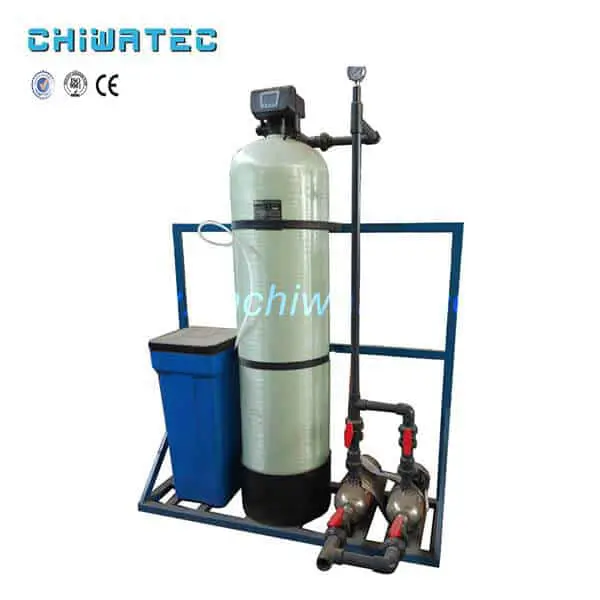
Industrial boiler rooms often have limited floor space. Modern boiler water softening equipment is designed with a compact footprint, combining multiple treatment stages into skid-mounted or cabinet-style units. Benefits of compact design include:
- Small floor area — Space-saving layouts fit into tight boiler room configurations
- Structural stability — Sturdy frame mounts ensure safe operation in industrial environments
- Simplified installation — Pre-piped and pre-wired skids reduce on-site installation time
- Reduced civil works — Minimal foundation preparation compared to field-erected systems
- Lower total cost — Savings in installation, piping, and building modifications
Control Technology for Automated Operation
Advanced control technology is a key feature of modern boiler water softening equipment. Programmable logic controllers (PLCs) or timer-based control valves manage the entire softening and regeneration cycle automatically:
- Flow-initiated regeneration — Regeneration starts based on actual water usage, not a fixed timer, optimizing resin efficiency and salt consumption
- Time-clock regeneration — Regenerates at a preset time (typically during low-demand nighttime hours)
- Manual override — Allows operator-initiated regeneration for maintenance or emergency situations
- Alarm and notification — Alerts operators when salt level is low, regeneration fails, or water quality deteriorates
- Remote monitoring — SCADA-compatible interfaces for centralized boiler plant control
The best equipment uses advanced program control technology that runs accurately and reliably without manual intervention, ensuring the ion exchange resin operates at maximum exchange efficiency.
Key Selection Factors for Boiler Water Softening Equipment
When selecting the appropriate boiler water softening equipment, consider these critical factors:
- Feedwater hardness — Determine raw water hardness (mg/L as CaCO₃) to calculate resin capacity requirements
- Boiler steam output — Match the softener flow rate to the boiler’s maximum continuous rating
- Operating hours — Continuous operation requires duplex or multi-tank configuration; intermittent operation may use single-tank with storage
- Regeneration method — Counter-current regeneration uses less salt and produces higher quality water than co-current
- Space constraints — Measure available floor area and headroom for equipment installation
- Control preference — Choose between flow-initiated, time-clock, or manual control based on operator availability
- Future expansion — Consider whether additional capacity may be needed as boiler load increases
Frequently Asked Questions
What is the difference between single-tank and duplex softener configurations?
Single-tank systems provide softened water until the resin is exhausted, then regenerate during which time no softened water is produced. Duplex systems have two tanks that alternate — one provides softened water while the other regenerates or stands by — ensuring continuous 24/7 supply of softened water for uninterrupted boiler operation.
How often does boiler water softening equipment regenerate?
Regeneration frequency depends on raw water hardness, daily water consumption, and resin capacity. A typical system for a medium-hardness water supply (200–300 mg/L) with a 10-ton/hour boiler may regenerate every 2–4 days. Flow-initiated controllers optimize this frequency based on actual usage.
Can a water softener be combined with other pretreatment equipment?
Yes. For optimal boiler feedwater quality, a multimedia filter is commonly installed upstream of the softener to remove suspended solids. An activated carbon filter removes chlorine that can damage resin. An iron removal filter is recommended if raw water iron exceeds 0.3 mg/L.
What type of control system is best for boiler water softening?
Flow-initiated regeneration control is recommended for boilers with variable or unpredictable demand, as it optimizes salt and water usage. Time-clock control works well for facilities with consistent daily operation patterns. For remote or unattended boiler plants, SCADA-compatible controllers with alarm notification are essential.
How do compact softener designs save installation costs?
Compact, skid-mounted units arrive pre-assembled with all components piped and wired. Installation requires only connection to the raw water supply, softened water outlet, and drain. Compared to field-erected systems, this reduces installation time by 50–70% and eliminates the need for extensive on-site fabrication.
Conclusion and Call to Action
Selecting the right boiler water softening equipment is essential for protecting steam boilers from scale damage, maintaining thermal efficiency, and ensuring reliable long-term operation. With options ranging from single-tank to multi-tank configurations, manual to fully automatic controls, and compact skid-mounted designs, there is a solution for every boiler application — from small commercial steam generators to large industrial power plant systems.
For expert assistance in configuring and selecting boiler water softening equipment for your facility, contact CHIWATEC: email [email protected] or [email protected]. Our team provides complete support from water analysis to system design and commissioning.
Related Resources and Further Reading
Do you have a water treatment project we can help with
* Designing,machining,installing,commissioning, customize and one-stop service






 English
  Spanish
  Portuguese




