

Steam Boiler Water Softening Equipment Selection: Complete Guide to Choosing the Right System 2026
Steam boilers require high-quality feed water to operate efficiently and reliably. Without proper water treatment, hardness minerals (calcium and magnesium) precipitate as scale on boiler tubes and heat transfer surfaces, causing reduced thermal efficiency, increased fuel consumption, tube overheating, and eventual boiler failure. The steam boiler water softening equipment selection process involves evaluating boiler parameters, feed water quality, flow requirements, and system configuration to choose the optimal softening solution. CHIWATEC provides complete boiler water softening systems designed to meet ASME, GB/T 1576, and international boiler water quality standards.
Why Steam Boilers Need Water Softening Equipment
Boiler scale is one of the most costly problems in industrial steam generation. Even a thin 1 mm layer of calcium carbonate scale reduces heat transfer by 7-10%, forcing the boiler to burn more fuel to maintain the same steam output. At 3 mm of scale, fuel consumption increases by 20-25%, and tube metal temperatures rise dangerously, accelerating creep and failure. The steam boiler water softening equipment selection directly determines scale prevention effectiveness. Required feed water hardness for most industrial boilers is below 0.03 mmol/L (approximately 3 mg/L as CaCO₃), while for high-pressure boilers exceeding 6 MPa, hardness must be below 0.005 mmol/L (0.5 mg/L as CaCO₃).
Key Factors in Steam Boiler Water Softening Equipment Selection
Selecting the correct steam boiler water softening equipment requires evaluating multiple interconnected factors. The selection should be based on a comprehensive analysis of boiler operating parameters, water chemistry, and site conditions rather than a simple one-size-fits-all approach.
| Selection Factor | Required Data | Impact on Equipment Choice |
|---|---|---|
| Boiler steam capacity | Rated output (t/h or MW) | Determines total treated water flow requirement |
| Feed water hardness | Raw water analysis (mg/L as CaCO₃) | Calculates resin volume and regeneration frequency |
| Operating pressure | Design pressure (MPa) | Higher pressure requires lower hardness limits |
| Daily operating hours | Hours per day, days per year | Determines single vs dual-tank configuration |
| Available space | Floor area (m²) | Single tank vs skid-mounted multi-tank layout |
| Water source type | Municipal, well, or surface water | Additional pretreatment may be needed |
| Regeneration method | Salt availability, drain access | Timer vs meter-initiated control valve choice |
A proper selection process starts with a complete water quality analysis including hardness, alkalinity, pH, TDS, iron, silica, and suspended solids.
Criterion 1: Boiler Capacity and Flow Rate Calculation
The first step in steam boiler water softening equipment selection is determining the required treated water flow rate. For steam boilers, the softening system capacity must account for both the boiler feed rate and the blowdown loss. The calculation: Q_softener = Q_steam × (1 + BD/100) × SF, where Q_steam is the boiler steam output, BD is the blowdown rate (typically 3-12% of feed flow depending on feed water quality), and SF is a safety factor of 1.2-1.5. For example, a 10 t/h boiler with 5% blowdown requires a softener capacity of 10 × 1.05 × 1.3 = 13.65 t/h minimum. Critical applications should add a second standby unit to ensure uninterrupted operation during regeneration.
Criterion 2: Resin Volume and Exchange Capacity
The required resin volume determines the physical size of the softening system and its regeneration frequency. The calculation: V_resin = (Q × H × T) / (C × n), where Q is flow rate (m³/h), H is feed water hardness (mol/m³), T is desired service time between regenerations (hours), C is resin exchange capacity (typically 1.0-1.5 eq/L for standard gel-type cation resin), and n is the number of regenerations per cycle. For a typical 10 t/h boiler with 4 mmol/L hardness and a 24-hour service cycle, the required resin volume is approximately 300-400 liters. A taller, narrower tank provides better contact efficiency than a short, wide tank of the same volume.
Criterion 3: Single Tank vs Dual Tank Configuration
The choice between single-tank and dual-tank (twin alternating) configuration is one of the most important decisions in steam boiler water softening equipment selection:
- Single-tank (simplex): Suitable for boilers that can tolerate brief shutdown or reduced load during regeneration (90-135 minutes). Lower capital cost but requires scheduling regeneration during off-peak hours. Best for boilers operating less than 16 hours per day.
- Dual-tank (twin alternating): One tank in service while the other regenerates or stands by. Ensures continuous soft water supply — essential for boilers operating 24/7 in hospitals, power plants, and manufacturing facilities. Higher capital cost but provides uninterrupted protection against scale.
- Multi-tank (triplex/quad): For large boiler plants exceeding 50 t/h steam capacity or multiple boilers sharing a common water treatment system. Provides redundancy and load sharing.
For critical boiler applications, dual-tank alternating systems are strongly recommended to eliminate the risk of scale formation during regeneration downtime.
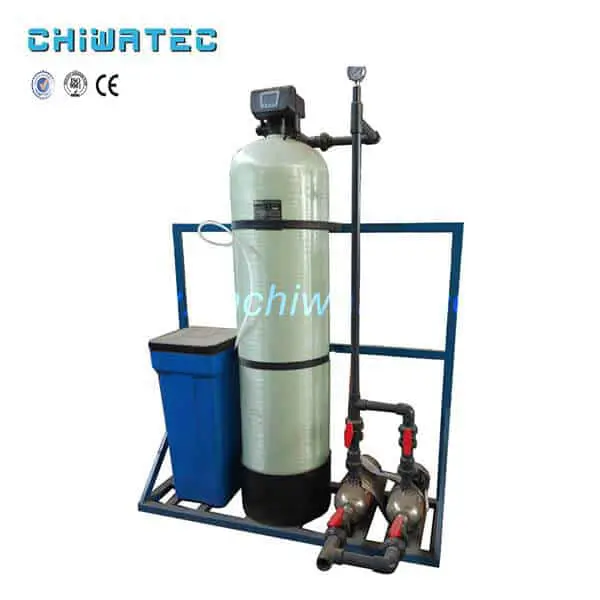
Criterion 4: Control Valve Technology — Timer vs Meter-Initiated
Modern control valves for boiler softening systems use either time-clock or meter-initiated regeneration. Time-clock controllers regenerate at preset intervals (e.g., every 24 or 48 hours) regardless of actual water usage — suitable when boiler load is consistent. Meter-initiated controllers track actual water volume treated and regenerate only when a preset volume has been processed, saving 20-30% in salt and water consumption. For boiler applications with variable steam demand, meter-initiated controls are strongly preferred. FLECK, AUTOTROL, and proprietary CHIWATEC control valves are available in both configurations, with options for remote monitoring and SCADA integration for large boiler plants.
Criterion 5: Regeneration System and Salt Storage
The regeneration system design affects both operating cost and reliability. Key considerations include salt storage capacity (typically sized for 2-4 weeks of consumption), brine concentration control (8-12% NaCl for optimal regeneration), and brine tank material (polyethylene or reinforced fiberglass for corrosion resistance). Salt consumption for boiler softeners ranges from 80-240 g per liter of resin per regeneration, with higher doses used when maximum hardness removal is required. For facilities with brine discharge restrictions, consider using potassium chloride (KCl) as an alternative regenerant, or installing a neutralization/ dilution system for regeneration wastewater.
Additional Pretreatment Considerations
Depending on raw water quality, the steam boiler water softening system may require additional pretreatment stages before the softener. For well water or surface water sources with high suspended solids (above 10 NTU), a multimedia filter should be installed upstream. For water containing iron above 0.3 mg/L, a greensand filter or aeration system is necessary to prevent iron fouling of the resin. For water with high organic content (TOC above 5 mg/L), an activated carbon filter removes organics that can foul the resin and cause foaming in the boiler. In some cases, a combination of softening followed by reverse osmosis is specified for high-pressure boilers requiring extremely low conductivity feed water.
Frequently Asked Questions (FAQ)
What size water softener do I need for my steam boiler?
The softener size is determined by boiler steam output, blowdown rate, feed water hardness, and desired regeneration frequency. As a rule of thumb, a boiler consuming 10 t/h of feed water with 4 mmol/L hardness requires approximately 300-400 liters of resin for 24-hour service cycles.
Can a single water softener serve multiple boilers?
Yes. A central softening system can supply multiple boilers if properly sized for the combined peak demand. A common header with isolation valves allows individual boiler maintenance without interrupting water supply. Include a bypass line with a water meter for emergency operation.
How often should boiler softener resin be replaced?
With proper operation and regular regeneration, cation exchange resin in boiler softening systems lasts 5-10 years. Gradual fouling by iron, organic matter, or oil can reduce lifespan. Annual resin sample analysis helps predict replacement timing.
What is the recommended outlet water hardness after softening?
For most industrial steam boilers, the softened water hardness should be below 0.03 mmol/L (approximately 3 mg/L as CaCO₃). For high-pressure boilers (above 6 MPa), hardness below 0.005 mmol/L (0.5 mg/L as CaCO₃) is required.
Conclusion & Call to Action
The steam boiler water softening equipment selection process — from boiler capacity calculation and resin volume sizing to tank configuration, control valve choice, and pretreatment requirements — determines the long-term reliability and operating cost of your steam system. Properly selected water softening equipment prevents scale, reduces fuel consumption by 10-25%, minimizes blowdown losses, and extends boiler life by 5-10 years. CHIWATEC offers a complete range of boiler water softening systems with capacities from 1 to 200 t/h, single or dual-tank configurations, and FLECK, AUTOTROL, or CHIWATEC control valves. Contact our engineering team for a free boiler feed water analysis and system recommendation. Email us at [email protected] or [email protected] for expert assistance.
Related Resources and Further Reading
- Boiler Water Softening Equipment Process: Complete Guide to 5-Step Flow and Regeneration 2026
- Selection Method of Steam Boiler Softening Water Equipment
- Industrial Water Softening Equipment: Complete Technical Guide to Ion Exchange Softening Systems 2026
- Boiler Softened Water Solutions: Complete Guide 2026
- Water Softening Systems for Boilers — View Our Complete Product Line
Do you have a water treatment project we can help with
* Designing,machining,installing,commissioning, customize and one-stop service






 English
  Spanish
  Portuguese




