RO Pure Water Equipment: Complete Guide to Reverse Osmosis Systems for High-Purity Water 2026
What makes reverse osmosis the leading technology for pure water production? RO pure water equipment is the most advanced and energy-efficient membrane separation technology available today, producing high-purity water from diverse water sources including seawater, brackish water, and freshwater. This comprehensive guide covers the principles, applications, and design of reverse osmosis pure water systems — from drinking water treatment to ultrapure water for pharmaceutical and electronics industries. CHIWATEC has been engineering industrial RO pure water equipment for over a decade, delivering reliable solutions for pure water production worldwide.
*Last Updated: March 2026 | Industry-Verified Technical Data*
Why This Guide Matters
Reverse osmosis technology is currently the most widely used desalination and water purification technology for the preparation of high-purity water. Its separation mechanism — operating at the molecular level without phase change — has made it the preferred choice for applications ranging from drinking water treatment to pharmaceutical Water for Injection (WFI) preparation. The global pure water equipment market, driven by RO technology, was valued at approximately USD 35.8 billion in 2025 and is projected to reach USD 63.2 billion by 2034, growing at a CAGR of 6.5% (Allied Market Research, 2025). With over 65% of installed desalination capacity worldwide using RO technology, understanding pure water equipment design and operation is essential knowledge for water treatment professionals across all sectors.
Key Industry Trends (2026 Update)
- Low-energy RO membranes: Advances in membrane chemistry have reduced RO energy consumption by 30-40% over the past decade, with some low-pressure brackish water elements operating at just 100-150 psi while maintaining 99.5% salt rejection.
- Smart pure water systems: IoT-enabled RO pure water equipment with real-time performance dashboards, automated normalization, and predictive maintenance algorithms is becoming standard in new industrial installations.
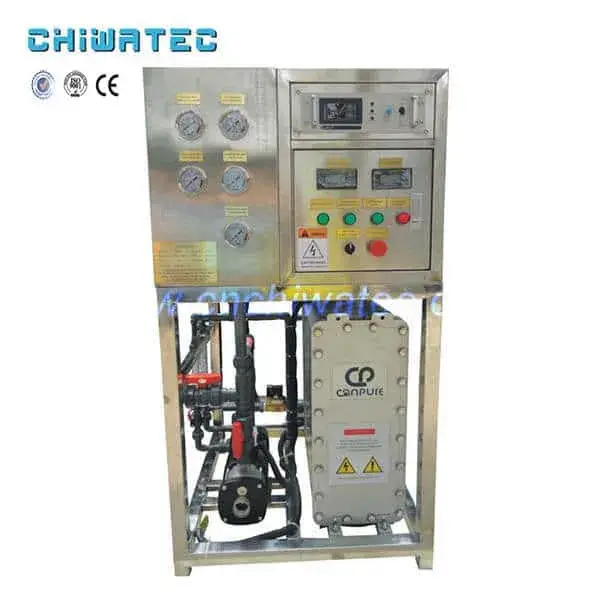
- Hybrid RO-EDI systems: The combination of RO with electrodeionization (EDI) has become the gold standard for pharmaceutical and electronics ultrapure water production, replacing traditional RO-mixed bed configurations.
- Containerized and packaged RO plants: Factory-built, containerized pure water equipment — delivered ready for installation in standard shipping containers — is growing rapidly for applications requiring rapid deployment and consistent quality.
1. What Is RO Pure Water Equipment and How Does It Work?
Definition and Core Technology
RO pure water equipment uses reverse osmosis membrane technology to remove dissolved salts, minerals, organic compounds, and microorganisms from water, producing purified water suitable for drinking, industrial processing, pharmaceutical manufacturing, and other applications requiring high water quality. The technology operates on the principle of applying external pressure greater than natural osmotic pressure to force water molecules through a semi-permeable membrane, while dissolved contaminants are retained and concentrated in the reject stream.
Reverse osmosis is currently the most advanced and energy-efficient membrane separation technology for pure water production. Because it operates at room temperature without phase change, it consumes significantly less energy than thermal distillation processes — typically 80-90% less energy for brackish water applications. For seawater desalination, modern RO plants with energy recovery devices achieve total energy consumption of 2.5-3.5 kWh/m3, compared to 10-20 kWh/m3 for thermal processes.
2. What Water Sources Can RO Pure Water Equipment Treat?
Feedwater Capabilities
RO pure water equipment is designed to treat diverse water sources, making it the most versatile water purification technology available:
- Seawater: High-salinity feedwater (35,000-45,000 ppm TDS) requiring high-pressure pumps (800-1,200 psi), specialized seawater membranes, and energy recovery devices. Single-pass SWRO achieves 99.5-99.8% salt rejection.
- Brackish water: Salinity range of 1,000-15,000 ppm TDS. Brackish water RO systems operate at 150-400 psi and achieve 75-85% recovery with 98-99.5% salt rejection.
- Freshwater (surface and ground): Low TDS (100-1,000 ppm) feedwater from rivers, reservoirs, and wells. Low-pressure RO elements operating at 100-200 psi with high recovery rates (80-90%).
- Municipal water: Already treated water requiring polishing for specific applications. Standard RO with minimal pretreatment.
- Wastewater effluent: Tertiary treated municipal or industrial effluent for water reuse applications. Requires robust pretreatment including UF or MBR before RO.
3. What Is the Process Flow of a Typical RO Pure Water System?
Standard RO System Process Flow
A complete RO pure water system consists of several stages in sequence, each serving a specific function:
- Feedwater intake and storage: Raw water is collected and stored in a feed tank with level control to ensure consistent supply to the RO system.
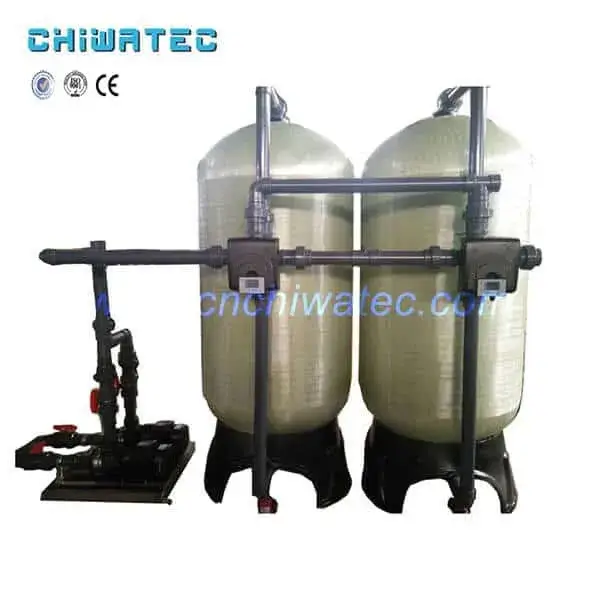
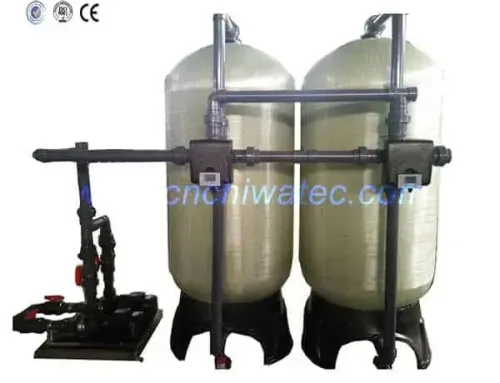
- Pretreatment system: Removal of suspended solids (multi-media filtration), chlorine and organic compounds (activated carbon filtration), and final polishing (5-micron cartridge filtration). Antiscalant dosing prevents mineral scaling on membrane surfaces.
- High-pressure pumping: The feedwater is pressurized to the required operating pressure using a high-pressure pump (centrifugal for brackish water, multistage for seawater).
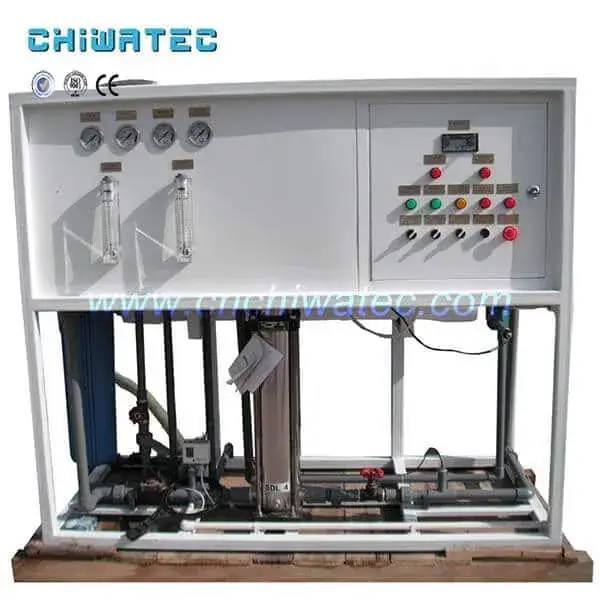
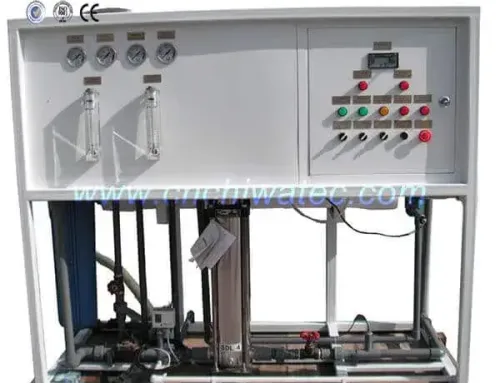
- RO membrane array: Pressurized water flows through spiral-wound membrane elements arranged in pressure vessels, typically in a 2:1 or 3:2 staged array configuration to optimize recovery and cross-flow velocity.
- Permeate collection and post-treatment: Purified water (permeate) is collected for use or further polishing. Post-treatment may include pH adjustment, remineralization, UV sterilization, or additional polishing steps.
- Concentrate management: The reject stream containing concentrated salts is discharged or further processed (brine concentration, zero-liquid discharge).
4. What Are the Main Applications of RO Pure Water Equipment?
Diverse Application Areas
Reverse osmosis technology is usually used across a remarkably broad range of applications:
- Drinking water production: Municipal water treatment plants use RO for brackish water desalination, fluoride/nitrate/arsenic removal, and taste/odor improvement. RO is increasingly deployed in water-stressed regions for sustainable drinking water supply.
- Seawater desalination: Large-scale SWRO plants produce fresh water from seawater for municipal and industrial supply. The largest SWRO plants now produce 500,000-600,000 m3/day, serving millions of people.
- Water softening treatment: RO can replace or supplement ion exchange softeners for hardness removal, particularly where sodium addition from softeners is undesirable.
- Wastewater treatment and reuse: RO is the final polishing step in advanced wastewater treatment trains, producing high-quality effluent suitable for industrial reuse, irrigation, or indirect potable reuse.
- Pharmaceutical pure water: RO is the essential first stage in USP purified water and Water for Injection (WFI) production systems, removing 95-99% of feedwater contaminants.
- Boiler feedwater treatment: RO produces high-purity feedwater for industrial and power plant boilers, preventing scale formation and corrosion in steam generation systems.
- Food and beverage processing: Process water, ingredient water, bottle washing water — RO ensures consistent water quality for food safety and product quality.
- Electronics and semiconductor manufacturing: Ultrapure water (18.2 Mohm-cm) for wafer rinsing and chemical dilution, produced by double-pass RO with EDI polishing.
5. What Is the History and Development of RO Membrane Technology?
Milestones in RO Technology Evolution
Over the past 30 years, reverse osmosis, electrodialysis, ultrafiltration, and membrane filtration have advanced from laboratory curiosities to mainstream industrial technologies. The key milestones in RO development include:
- 1960s: Discovery of asymmetric cellulose acetate membranes by Loeb and Sourirajan at UCLA — the first practical RO membrane achieving reasonable flux and salt rejection.
- 1970s: First commercial RO desalination plants established. Cellulose acetate membranes dominate, but have limited pH range (4-7) and chlorine tolerance.
- 1980s: John Cadotte at FilmTec (now Dow FilmTec / Dupont Water Solutions) invents thin-film composite (TFC) polyamide membrane — the breakthrough that made modern RO possible, with 10x higher flux and >99% salt rejection.
- 1990s: Spiral-wound element design becomes standard. SWRO plants reach capacities of 100,000 m3/day. Energy recovery devices reduce seawater desalination energy from 8-10 kWh/m3 to 4-5 kWh/m3.
- 2000s: Low-pressure RO membranes reduce operating pressure by 30-40%. Nanofiltration membranes emerge for selective separation. SWRO energy consumption drops to 3-4 kWh/m3.
- 2010s: High-rejection RO membranes achieve 99.8%+ salt rejection. Advanced energy recovery (pressure exchangers) reduces SWRO energy to 2.5-3.0 kWh/m3. RO becomes economically competitive with thermal processes for most applications.
- 2020s: AI-optimized RO systems, anti-fouling membrane coatings, and integrated RO-EDI systems represent the current state of the art. Next-generation materials (graphene oxide, aquaporin) are in commercial demonstration.
6. What Are the Key Design Parameters for RO Pure Water Equipment?
Critical Design Specifications
Designing an effective RO pure water system requires careful consideration of several key parameters:
- Feedwater characterization: Complete water analysis is essential — TDS, temperature, pH, SDI, hardness, alkalinity, silica, iron, manganese, chlorine, TOC, and specific contaminants. Feedwater quality determines membrane type, pretreatment requirements, and system design limits.
- Design flux rate: Standard design: 10-15 GFD (17-25 LMH) for brackish water, 8-12 GFD (14-20 LMH) for seawater. Higher flux reduces membrane area but increases fouling rate.
- System recovery: Target recovery depends on feedwater scaling potential. Brackish water: 75-85% recovery (two-stage). Seawater: 40-50% recovery (limited by osmotic pressure).
- Staging and array configuration: Standard two-stage arrays: 2:1 ratio (e.g., 12 pressure vessels in stage 1, 6 in stage 2). Three-stage arrays for higher recovery: 2:1:1 ratio.
- Membrane element selection: Choose membrane type based on application: low-pressure brackish water, standard brackish water, high-rejection seawater, or fouling-resistant elements for challenging feedwaters.
7. What Post-Treatment Is Required for RO Pure Water?
Post-Treatment Options
Depending on the intended use, RO permeate may require additional treatment steps to meet specific water quality requirements:
- pH adjustment and remineralization: RO permeate is slightly acidic (pH 5.5-6.5) and has very low alkalinity. For drinking water, pH is adjusted to 7.0-8.5 and essential minerals (calcium, magnesium) are added for corrosion control and health benefits.
- UV sterilization: Ultraviolet treatment (254 nm wavelength) provides effective disinfection of any bacteria that may have passed through the RO membranes or entered from downstream piping.
- Electrodeionization (EDI): For ultrapure water applications, EDI polishes RO permeate to 16-18.2 Mohm-cm resistivity, removing residual ions to part-per-trillion levels.
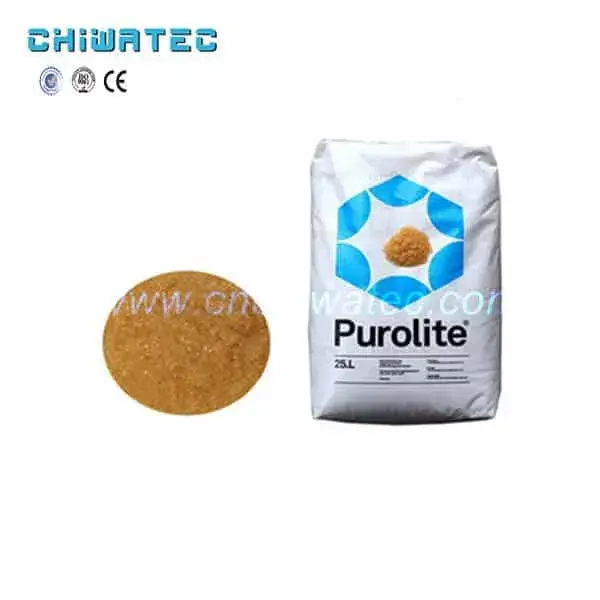
- Mixed-bed polishing: Traditional polishing method using mixed cation and anion exchange resins after RO, achieving <0.1 microS/cm conductivity. Increasingly replaced by EDI in new installations.
- Degasification: Removal of dissolved CO2 and O2 through membrane degassing or vacuum degasification, required for boiler feedwater and some pharmaceutical applications.
- Ozonation: For pharmaceutical WFI systems, ozone is used for continuous sanitization of the distribution loop, with UV destruction at point-of-use.
8. How Does RO Compare with Other Desalination Technologies?
Technology Comparison
RO is currently the most widely used desalination technology in the preparation of high-purity water. A comparison with alternative technologies reveals its advantages:
- RO vs. Thermal distillation (MSF/MED): RO consumes 80-90% less energy (2.5-4.0 vs. 10-20 kWh/m3), requires 50-70% less footprint, operates at ambient temperature (no thermal degradation of materials), and has lower capital and operating costs. Thermal processes still have advantages for very high-salinity feedwater (>60,000 ppm TDS) and for cogeneration plants with waste heat.
- RO vs. Electrodialysis (ED/EDR): RO is more energy-efficient for higher-salinity feedwater and removes uncharged contaminants (silica, organic compounds) that ED cannot. ED is preferred for low-TDS applications (500-5,000 ppm) where membrane scaling is a concern.
- RO vs. Nanofiltration (NF): NF has lower salt rejection (50-90%) and lower operating pressure (70-150 psi) than RO, making it suitable for selective removal of divalent ions (hardness) while passing monovalent ions. RO is preferred when maximum salt removal is required.
- RO vs. Ion exchange: RO has lower operating costs for high-TDS feedwater (no chemical regeneration), continuous operation (no regeneration downtime), and lower labor requirements. Ion exchange remains viable for low-TDS polishing applications.
9. How to Operate and Maintain RO Pure Water Equipment?
Operational Best Practices
Proper operation and maintenance are essential for maximizing RO system performance and membrane life:
- Start-up procedures: Always flush membranes with permeate or low-TDS water before start-up to remove any chemical preservation solution. Gradually increase pressure at a rate not exceeding 10 psi per minute to prevent hydraulic shock.
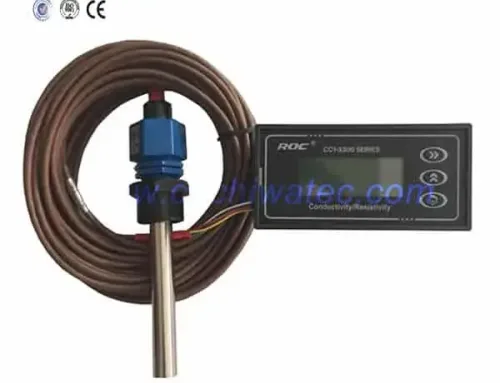
- Daily monitoring: Record feed, permeate, and concentrate flow rates; feed and permeate conductivity; feed, interstage, and concentrate pressures; and feedwater temperature. Normalize all data to standard conditions.
- Cleaning triggers: Clean when normalized permeate flow drops by 10-15%, normalized salt passage increases by 10-15%, or normalized differential pressure increases by 15-20% from baseline.
- Shutdown procedures: On extended shutdown (>48 hours), flush membranes with permeate and preserve with 1% sodium metabisulfite solution to prevent biological growth. For cold-weather shutdown, use 20% propylene glycol solution as antifreeze.
- Record keeping: Maintain logs of operating data, cleaning events (date, chemicals used, procedure, results), membrane replacement dates, and feedwater quality changes. Trend analysis of cleaning intervals and performance recovery provides early warning of system degradation.
10. What Factors Affect the Cost of RO Pure Water Systems?
Cost Components and Optimization
The total cost of RO pure water equipment includes both capital expenditure (CAPEX) and operating expenditure (OPEX):
- Capital costs: Equipment cost depends on system capacity (USD 300-800 per m3/day for large systems, USD 1,000-3,000 per m3/day for small systems), feedwater salinity (seawater systems cost 2-3x more than brackish water systems), and automation level.
- Energy costs (30-50% of OPEX): The largest operating expense. Brackish water RO: USD 0.05-0.15 per m3. Seawater RO with ERD: USD 0.20-0.40 per m3. Energy optimization through proper membrane selection and ERD can reduce costs by 20-40%.
- Membrane replacement (10-20% of OPEX): Membrane life of 5-7 years for well-maintained systems. Replacement cost: USD 30-80 per 8-inch element.
- Chemical costs (5-10% of OPEX): Antiscalants, cleaning chemicals, and pretreatment chemicals. Annual cost: USD 0.02-0.05 per m3 for typical systems.
- Labor and maintenance (15-25% of OPEX): Operator labor, instrument calibration, preventive maintenance.
For custom-designed RO pure water equipment optimized for your specific feedwater conditions and production requirements, CHIWATEC provides complete engineering, manufacturing, and after-sales support. In the past three decades, reverse osmosis has entered industrial application on a massive scale, and CHIWATEC has been at the forefront of delivering reliable, cost-effective pure water solutions to clients worldwide.
Conclusion
Reverse osmosis pure water equipment has transformed the global water treatment landscape, becoming the most widely used desalination and purification technology for high-purity water preparation. Its advantages — operating at room temperature without phase change, molecular-level separation, energy efficiency, modular design, and broad application range — have made it the technology of choice for applications from drinking water production to pharmaceutical WFI preparation. As membrane technology continues to advance toward higher rejection, lower energy consumption, and greater fouling resistance, RO pure water equipment will remain the cornerstone of modern water purification for decades to come. Proper system design, operation, and maintenance are essential for maximizing the substantial economic and performance benefits that RO technology offers.
Contact CHIWATEC today at [email protected] or [email protected] (WhatsApp: +86 18292684865) for professional guidance on selecting and configuring the right RO pure water equipment for your specific water treatment requirements.
Frequently Asked Questions
Q1: What is the difference between RO pure water and distilled water?
RO pure water is produced by membrane separation at room temperature, while distilled water is produced by evaporation and condensation at high temperature. Both achieve high purity, but RO water typically has 0.5-10 microS/cm conductivity (depending on feedwater and system design), while distilled water has 2-10 microS/cm. RO is significantly more energy-efficient (80-90% less energy) and can be produced continuously without the batch limitations of distillation. However, distillation may be preferred for applications requiring removal of low-molecular-weight organic compounds or certain volatile contaminants that RO membranes may not fully reject.
Q2: Can RO pure water equipment remove all contaminants?
No, RO membranes are highly effective but do not remove 100% of all contaminants. Typical rejection rates: dissolved salts (99.0-99.8%), bacteria and viruses (99.9%+), organic compounds (90-99% depending on molecular weight), heavy metals (95-99%), and pesticides (90-99%). However, some low-molecular-weight organic compounds (<100 Da), dissolved gases (CO2, H2S, NH3), and boron can pass through RO membranes with lower rejection. For complete contaminant removal, RO is typically combined with UV oxidation, activated carbon, and EDI or mixed-bed polishing.
Q3: How often should RO membranes in pure water systems be replaced?
Under optimal operating conditions with proper pretreatment and maintenance, RO membranes in pure water systems typically last 5-7 years for brackish water applications and 3-5 years for seawater applications. Factors that reduce membrane life include: inadequate pretreatment (the most common cause), infrequent or ineffective cleaning, chlorine or oxidant exposure, operating at elevated temperature, and frequent start-stop cycling. Performance monitoring (normalized flow, rejection, dp) should be used to determine when replacement is actually needed rather than relying on calendar-based replacement schedules.
Q4: What is the ideal feedwater temperature for RO pure water systems?
The ideal operating temperature for most RO systems is 20-28 degrees C. Within this range, membranes achieve their rated performance. Temperature affects both permeate flow (increases by approximately 3% per degree C) and salt rejection (rejection improves slightly at higher temperature up to about 35 degrees C). At temperatures below 15 degrees C, water viscosity increases significantly, reducing permeate flow — a 10 degree C drop from 25 to 15 degrees C reduces production by approximately 15-20% at constant pressure. At temperatures above 40 degrees C, membrane degradation accelerates and should be avoided.
Q5: How much water does an RO pure water system waste?
RO systems do not “waste” water — they produce both purified water (permeate) and a concentrated brine stream (concentrate). The ratio of permeate to feedwater is called recovery. Standard recovery rates: brackish water RO 75-85% (wastes 15-25% as brine), seawater RO 40-50% (wastes 50-60% as brine), and low-pressure RO 65-80% (wastes 20-35%). Modern high-recovery RO systems can achieve 90-95% recovery using brine recovery stages, brine concentrators, or by recycling concentrate through additional RO stages. The concentrate stream is not “waste” in many applications — it can be used for cooling tower makeup, landscape irrigation, or further processed for salt recovery.
Related Resources and Further Reading
- Reverse Osmosis Equipment Working Principle: Complete Guide to RO Systems 2026 — Foundational guide to RO system components, operating principles, and performance parameters
- Water Pretreatment Filter System: Complete Guide to RO Pretreatment Equipment and Applications 2026 — Essential pretreatment requirements for reliable RO pure water system operation
- Main Process Flow Description of Reverse Osmosis Pure Water Equipment — Detailed breakdown of RO system process flow, from feedwater intake to permeate output
- Advanced Water Purification System: Process Principles and Flow Diagram — Comprehensive analysis of advanced water purification technology and system design
- CHIWATEC RO Water Treatment System Products — Browse our complete range of industrial RO pure water equipment for various applications
Do you have a water treatment project we can help with
* Designing,machining,installing,commissioning, customize and one-stop service

 English
  Spanish
  Portuguese