

Coating Electroplating Pure Water Process: Complete Guide to RO and Ion Exchange Methods 2026
Coating and electroplating operations demand high-purity water to prevent surface defects, poor adhesion, and contamination of plating baths. The coating electroplating pure water process typically relies on reverse osmosis (RO) combined with ion exchange or electrodeionization (EDI) to achieve the required resistivity of 0.1-18.2 MΩ·cm depending on the application. This guide compares traditional ion exchange and modern RO-EDI methods for coating electroplating pure water systems, helping you select the right technology for your production line. CHIWATEC provides customized pure water equipment engineered for coating and electroplating facilities.
Why Pure Water Quality Is Critical for Coating and Electroplating
Water quality directly affects coating and electroplating results. Impurities in process water cause:
- Poor adhesion — Dissolved minerals and organic compounds interfere with the bond between coating and substrate
- Surface defects — Particles and colloids create pinholes, craters, and orange peel effects in applied coatings
- Bath contamination — In electroplating, calcium, magnesium, and chloride ions accumulate in plating baths, reducing deposition quality
- Spots and streaks — Hard water minerals leave visible residues after rinsing and drying
Key Water Quality Parameters for Coating Electroplating Pure Water
| Parameter | General Rinsing | Critical Coating/Plating |
|---|---|---|
| Resistivity | 0.1-1 MΩ·cm | 1-18.2 MΩ·cm |
| Conductivity | ≤10 μS/cm | ≤1 μS/cm |
| Total Dissolved Solids | ≤5 ppm | ≤0.5 ppm |
| Hardness | ≤5 ppm | ≤1 ppm |
| Silica (SiO₂) | ≤1 ppm | ≤0.1 ppm |
| Particle size | ≤5 μm | ≤0.2 μm |
Traditional Ion Exchange Method for Coating and Electroplating Pure Water
The traditional approach uses ion exchange resin columns to remove dissolved ions. The classic flow sequence is:
Tap Water → Multimedia Filter → Activated Carbon Filter → Water Softener → Intermediate Tank → Low-Pressure Pump → Precision Filter → Cation Resin Bed → Anion Resin Bed → Mixed Resin Bed → Microporous Filter → Point of Use
Drawbacks: Ion exchange resins require periodic chemical regeneration with HCl and NaOH, which increases operating costs, involves hazardous chemical handling, and generates acidic and alkaline wastewater.
Modern RO Plus EDI Method for Coating and Electroplating Pure Water
Modern coating electroplating pure water systems incorporate reverse osmosis as the primary desalination step, followed by electrodeionization (EDI) for final polishing:
Tap Water → Pretreatment → Low-Pressure RO → Intermediate Tank → EDI Module → UV Sterilizer → Precision Filter → Point of Use
Advantages: No chemical regeneration, 30-50% lower operating cost, continuous operation with no downtime, 75-85% water recovery, and compact footprint.
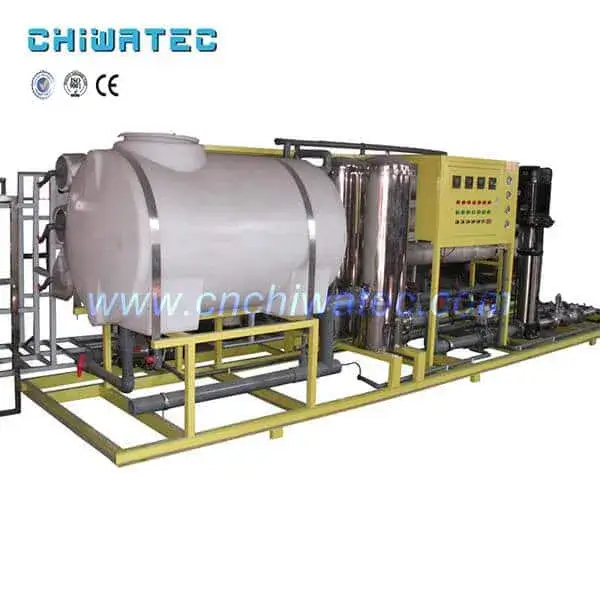
Coating Electroplating Pure Water Process: Ion Exchange vs Reverse Osmosis
| Factor | Ion Exchange Only | RO + EDI | RO + Mixed Bed |
|---|---|---|---|
| Capital cost | Low | Medium-High | Medium |
| Operating cost | High (chemicals) | Low | Medium |
| Water recovery | 60-70% | 75-85% | 70-80% |
| Effluent resistivity | 1-10 MΩ·cm | 16-18.2 MΩ·cm | 10-18.2 MΩ·cm |
| Chemical handling | Required | None | Required |
| Automation | Partial | Full PLC control | Partial |
Essential Equipment for Coating Electroplating Pure Water Systems
Key equipment includes multimedia filters, activated carbon filters, water softeners, reverse osmosis units, EDI modules, ion exchange columns, UV sterilizers, and precision filters. Each component plays a critical role in achieving the required water quality for coating and electroplating applications.
Frequently Asked Questions
What is the best coating electroplating pure water process for a small workshop?
For small-scale operations, the ion exchange process is often most cost-effective due to lower initial capital investment. A dual-bed deionizer with mixed bed polisher can produce 1-10 MΩ·cm water suitable for general rinsing. If throughput exceeds 2 m³/hour, consider upgrading to RO + EDI.
How often must ion exchange resins be regenerated?
For typical municipal water (200-400 ppm TDS), cation and anion beds require regeneration every 2-7 days. Mixed bed polishing resins regenerate every 1-4 weeks. Monitoring effluent conductivity is the best indicator.
Can I retrofit an existing ion exchange system to use RO plus EDI?
Yes. Adding an RO unit upstream of existing ion exchange extends regeneration intervals from days to months and reduces chemical consumption by 80-90%. For a full upgrade, replace resin vessels with EDI module stacks.
What resistivity does electroplating rinse water need?
Electroplating rinse water typically requires 0.1-1 MΩ·cm for general rinsing. For chromium and nickel plating with strict surface quality, 1-10 MΩ·cm is recommended. Paint and powder coating rinse operations need 0.5-5 MΩ·cm.
Conclusion & Call to Action
Selecting the right coating electroplating pure water process is essential for achieving consistent product quality and minimizing operating costs. CHIWATEC provides complete one-stop service: designing, machining, installing, commissioning, and customization for pure water systems in coating, electroplating, and surface finishing industries.
Email: [email protected] or [email protected]
Related Resources and Further Reading
Do you have a water treatment project we can help with
* Designing,machining,installing,commissioning, customize and one-stop service






 English
  Spanish
  Portuguese




