

Barreled Pure Water Equipment Process: Complete Guide to Bottled Water Production and Filtration 2026
The barreled pure water equipment process transforms raw water into high-quality bottled drinking water through a multi-stage treatment system. From mechanical filtration and activated carbon to reverse osmosis membranes and ultraviolet sterilization, each stage plays a critical role in ensuring product water meets purity and safety standards. CHIWATEC provides complete barreled pure water production lines — including pretreatment, RO systems, and filling equipment — for bottled water manufacturers worldwide.
Overview of the Barreled Pure Water Equipment Process
The barreled pure water equipment process follows a complete water treatment train designed to produce water that meets national drinking water standards (GB 19298-2014 for bottled water and GB 8537-2018 for natural mineral water). The full process chain is:
Raw water tank → Water pump → Quartz sand filter → Activated carbon filter → Precision filter → UV sterilizer → Pure water tank → Booster pump → Titanium rod filter → UV sterilizer → Filling equipment
Each stage serves a specific purpose in removing different types of contaminants — from suspended solids and organic matter to microorganisms and dissolved ions. The final product is a safe, clean, and great-tasting bottled water suitable for commercial distribution.
Stage 1: Raw Water Intake and Storage
The barreled pure water equipment process begins with the raw water intake. Raw water from municipal supply, well water, or surface water sources is stored in a raw water tank, which serves to buffer flow variations, allow preliminary settling of large particles, and provide a consistent feed water supply for downstream treatment stages. The tank is typically made of food-grade polyethylene or stainless steel and includes overflow and drain connections for maintenance.
Stage 2: Pretreatment — Quartz Sand Filtration and Activated Carbon
The pretreatment stage is essential for protecting downstream RO membranes and ensuring consistent treated water quality:
- Quartz sand filter: Removes suspended solids, sand, silt, rust, and colloidal particles from the raw water. This mechanical filtration reduces turbidity and protects downstream equipment from abrasive damage.
- Activated carbon filter: Adsorbs organic compounds, residual chlorine, chlorine byproducts, taste, and odor-causing substances. The carbon filter also removes some heavy metals and protects the RO membranes from chlorine oxidation damage.
- Water softening (optional): Some systems include a resin-based softener to remove calcium and magnesium ions, preventing scale formation on RO membranes and downstream equipment.
Proper pretreatment ensures that the treated water quality meets reverse osmosis host water intake requirements, which is critical for stable equipment operation and extended service life.
Stage 3: Precision Filtration and First-Stage UV Sterilization
After pretreatment, water passes through a precision filter (also called a security filter or cartridge filter) to trap any fine particles that may have passed through the earlier stages. The precision filter typically uses 5-micron melt-blown PP cartridges to provide a final barrier before the water enters the RO system.
The first UV sterilizer is placed after the precision filter to control microbial growth in the pre-RO water. Ultraviolet light at 254 nm wavelength inactivates bacteria, viruses, and other microorganisms without adding chemicals or creating disinfection byproducts. This helps prevent biofouling on the RO membranes downstream.
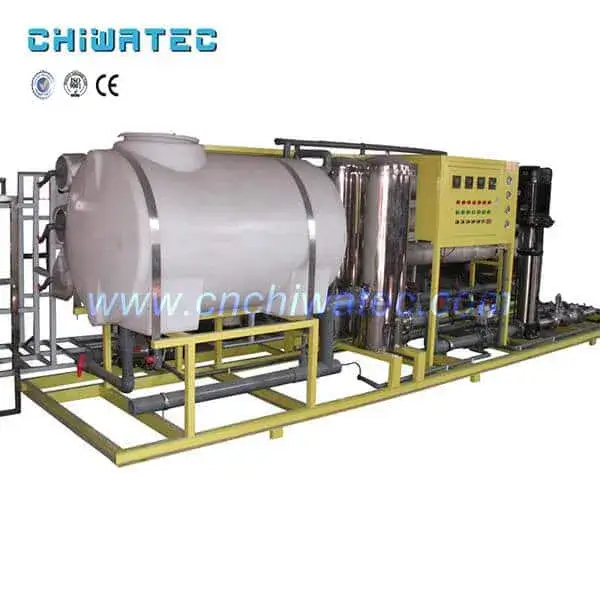
Stage 4: Reverse Osmosis (RO) Membrane Separation
The reverse osmosis (RO) host is the core of the barreled pure water equipment process. The RO system uses imported thin-film composite RO membrane elements with extremely high filtration precision (0.0001 microns). This stage effectively removes:
- Dissolved salts and minerals (up to 99% TDS rejection)
- Bacteria, viruses, and microbial contaminants
- Pyrogens and endotoxins
- Pesticides, herbicides, and organic chemicals
- Heavy metals (lead, arsenic, cadmium, mercury)
The RO system operates at moderate pressure (10-25 bar for brackish water, 55-85 bar for high-TDS feed water) and produces permeate water with conductivity typically below 10-20 microsiemens/cm. The purified water flows into a pure water storage tank for the next stage.
Stage 5: Post-Treatment and Final Polishing
After RO separation, the purified water undergoes final polishing before filling:
- Pure water storage tank: Holds the RO permeate before final processing. Typically made of stainless steel (304 or 316L) with sanitary design and UV or ozone protection to prevent recontamination.
- Booster pump: Provides consistent pressure to push water through the final polishing and filling systems.
- Titanium rod filter: A microporous titanium filter element provides final particulate removal, ensuring no particles larger than 0.2-0.5 microns enter the filling system.
- Second UV sterilizer: Final disinfection step immediately before filling, ensuring the bottled water is microbiologically safe.
Some systems may include an additional ozone injection stage for extended shelf-life preservation, particularly for larger bottled water (5-gallon/18.9-liter) applications.
Equipment Specifications for Barreled Water Production Lines
| Equipment | Function | Typical Specification |
|---|---|---|
| Quartz sand filter | Suspended solids removal | FRP tank, automatic control valve |
| Activated carbon filter | Chlorine and organic removal | Coconut shell GAC or CTO block |
| Precision filter | Fine particle barrier | 5-micron PP cartridge |
| UV sterilizer (dual) | Microbial inactivation | 254 nm, 30-50 mJ/cm2 UV dose |
| RO membrane system | Desalination and purification | Polyamide TFC membranes, 99% rejection |
| Titanium rod filter | Final particulate removal | 0.2-0.5 micron titanium filter |
| Filling equipment | Bottle washing, filling, capping | Automatic filling line, clean room design |
Frequently Asked Questions (FAQ)
What is the difference between barreled pure water and mineral water?
Barreled pure water is produced by removing virtually all dissolved solids through reverse osmosis, resulting in TDS below 10 mg/L. Mineral water, by contrast, comes from protected underground sources and retains natural minerals. Both must meet national food safety standards, but their mineral content and source requirements differ significantly.
How often should the filters in a barreled pure water system be replaced?
Quartz sand and activated carbon filters should be backwashed daily and the media replaced every 1-2 years. Precision filter cartridges (PP) should be replaced every 3-6 months. UV lamps should be replaced annually. RO membranes typically last 2-3 years with proper pretreatment. Titanium rod filters can be cleaned and reused for 1-2 years depending on water quality.
What water quality standards apply to barreled pure water?
Barreled pure water must comply with GB 19298-2014 in China (National Food Safety Standard for Packaged Drinking Water). Key parameters include: TDS below 10 mg/L, conductivity below 10 microsiemens/cm, pH 6.5-8.5, no detectable coliform bacteria, and nitrate levels below 10 mg/L. Export bottlers may need to meet WHO guidelines or destination country standards.
Why are two UV sterilizers used in the barreled pure water process?
The first UV sterilizer is placed before the RO system to control microbial growth in the pretreatment stage and prevent biofouling on RO membranes. The second UV sterilizer is placed immediately before filling to provide final disinfection after RO treatment and storage. This dual-UV approach ensures that the water entering the bottles has no viable microorganisms, maximizing product shelf life and safety.
Can barreled pure water equipment treat seawater or brackish water?
Yes, with modifications. For brackish water (TDS up to 10,000 mg/L), standard brackish water RO membranes with a booster pump are sufficient. For seawater (TDS 35,000-45,000 mg/L), the system requires high-pressure pumps (55-85 bar), seawater RO membranes, and energy recovery devices. Additional pretreatment such as media filtration and antiscalant dosing is essential for all feed water types.
Conclusion & Call to Action
The barreled pure water equipment process is a comprehensive multi-stage treatment system that transforms raw water into safe, high-quality bottled drinking water. From pretreatment filtration through reverse osmosis and UV sterilization, each stage is designed to remove specific contaminants and ensure product water meets stringent quality standards.
CHIWATEC offers complete barreled pure water production lines, including all pretreatment, RO, polishing, and filling equipment. For expert guidance on designing a bottled water production system for your facility, contact us at [email protected] or [email protected] for a customized water treatment solution.
Related Resources and Further Reading
Do you have a water treatment project we can help with
* Designing,machining,installing,commissioning, customize and one-stop service






 English
  Spanish
  Portuguese




