

Fleck Automatic Water Softener: Installation Guide, Operating Precautions and Essential Maintenance Tips
Installing a Fleck automatic water softener incorrectly is one of the most common causes of poor water quality, resin loss, and premature system failure. Whether you are a facility manager, installer, or homeowner, following the correct installation and startup procedures is essential to ensure your Fleck water softener delivers reliable, high-quality softened water from day one. In this guide, CHIWATEC covers all critical precautions for Fleck automatic water softener installation, resin filling, control valve mounting, programming, and ongoing maintenance.
What Is a Fleck Automatic Water Softener?
A Fleck automatic water softener is a brand-leading water treatment system that uses ion exchange technology to remove calcium and magnesium ions from hard water, replacing them with sodium ions to produce soft water. Fleck is one of the most recognized names in commercial and industrial water softening, known for its durable 5600, 5800, 2850, and 9000 series control valves. These systems feature automatic microprocessor-controlled regeneration cycles, eliminating the need for manual valve operation while ensuring consistent treated water quality.
Fleck water softeners are widely used in hotels, hospitals, food processing facilities, boiler feed water treatment, and commercial buildings where reliable soft water is essential for equipment protection and operational efficiency.
Installation Requirements and Site Preparation
Proper site preparation is the foundation of a successful Fleck automatic water softener installation. Pay attention to these critical requirements:
- Firm, level surface — The softener must be installed on a solid, horizontal floor capable of supporting the weight of the resin tank, brine tank, and water when full. Uneven surfaces can cause stress on the tank and control valve connections.
- Proximity to drainage — Locate the system near a floor drain or standpipe for backwash and regeneration discharge. The drain line should be properly vented and capable of handling the peak backwash flow rate (typically 5–15 GPM depending on tank size).
- Salt tank placement — Position the brine (salt) tank as close as possible to the resin tank to minimize the length of the salt absorption plastic tube. A shorter tube reduces suction resistance and ensures reliable brine draw during regeneration.
- Water supply requirements — Ensure adequate feed water pressure (minimum 25 psi for most Fleck valves, 40 psi recommended) and flow rate. If pressure is insufficient, a booster pump may be required.
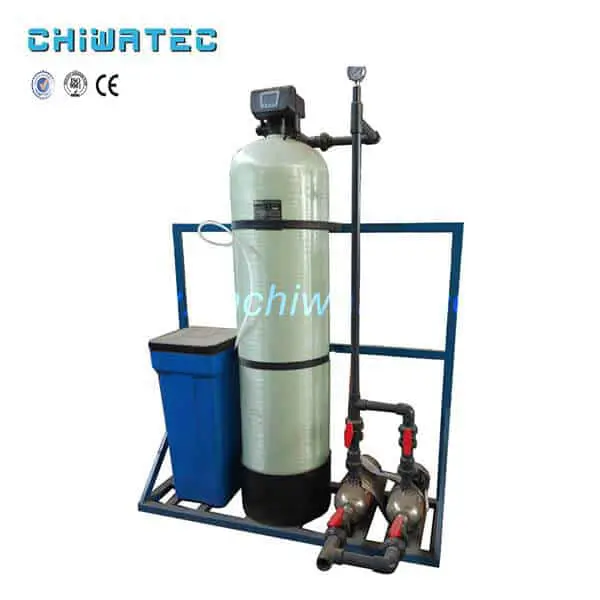
Resin Filling and Control Valve Installation
Correct resin loading and control valve mounting are critical steps that directly impact system performance:
- Resin filling — Use only high-quality cation exchange resin (standard or premium grade). Fill the resin tank with the approved quantity of resin as specified for your tank diameter and system capacity. Pre-soak the resin if recommended by the manufacturer to prevent air entrapment.
- Remove protective tape — The riser tube (distributor tube) comes with protective tape covering the top end. Remove this tape completely before installing the control valve. Any tape residue left on the riser can introduce contaminants into the system.
- Riser tube alignment — Align the upper end of the riser tube with the central socket at the bottom of the Fleck control valve body. Ensure the riser is fully seated before threading the valve onto the tank.
- Clockwise tightening — Carefully turn the control valve clockwise to thread it onto the tank neck. Verify throughout the process that the riser tube remains properly inserted into the valve body socket. Overtightening can crack the tank neck; hand-tighten plus a quarter turn with a strap wrench is usually sufficient.
- Connect piping and power — Following the installation schematic diagram provided with your Fleck valve, connect inlet, outlet, drain, and brine lines. Confirm that the electrical supply matches the controller voltage requirements before connecting power.
Proper Startup Procedure for Fleck Water Softeners
Starting up a Fleck automatic water softener requires a specific sequence to prevent damage and resin loss:
- Close the bypass valve — Before introducing water to the system, ensure the bypass valve is fully closed so water flows through the softener rather than bypassing it.
- Open the outlet control valve — Open the valve on the outlet (treated water) side of the softener to allow air to escape as the system fills.
- Slowly open the inlet control valve — This is the most critical step. Open the inlet valve very slowly to allow water to enter the tank gradually. Opening too quickly will cause the rapid influx of water and trapped air to fluidize the resin bed, potentially forcing resin beads out of the tank and into the downstream piping.
- Purge air from the system — Once water flows steadily from the outlet, allow the system to operate in service mode for several minutes to fully purge residual air. Air in the system can cause erratic valve operation and false flow meter readings.
- Initiate a manual regeneration — After initial fill and air purge, run a complete manual regeneration cycle (backwash → brine draw → rinse → refill) to condition the resin bed and flush any manufacturing residues from the system.
Programming and Controller Setup
After installation, the Fleck controller must be programmed for your specific water conditions. Follow these guidelines:
| Parameter | Setting Method | Notes |
|---|---|---|
| Time of day | Set via controller keypad | Ensure correct AM/PM for 12-hour models |
| Water hardness | Input feed water hardness in gpg or mg/L | Use laboratory test results for accuracy |
| System capacity | Enter resin volume in cubic feet or liters | Refer to resin tank specifications |
| Regeneration time | Set for low-usage period (e.g., 2:00 AM) | Ensures water availability during peak hours |
| Salt dosage | Program per manufacturer recommendation | Typically 6–15 lbs per cubic foot of resin |
After initial programming, monitor water quality frequently during the first week of operation. Adjust the regeneration settings if the treated water hardness exceeds the target level. Fine-tune the program until the system consistently produces water within specification.
Salt Management and Brine System Maintenance
Proper salt management is essential for reliable Fleck automatic water softener operation:
- Maintain adequate salt level — The brine tank must always contain enough regenerant (salt) for the next regeneration cycle. Check the salt level weekly and refill before it drops below one-quarter full. The salt tank automatically replenishes water after each regeneration, so only manual salt addition is required.
- Use appropriate salt type — Use only high-purity water softener salt (solar salt, evaporated salt, or pellet salt). Avoid rock salt, which contains insoluble impurities that can clog the brine valve and injector.
- Prevent salt bridging — High humidity can cause salt to form a hard crust (bridge) above the water level in the brine tank. If this occurs, gently break the bridge with a broom handle to restore proper brine make-up.
- Clean the brine tank annually — Once a year, empty and clean the brine tank to remove accumulated sediment and insoluble salt residues. This prevents injector fouling and ensures consistent brine concentration.
Common Installation Mistakes to Avoid
Even experienced installers can make errors when setting up a Fleck automatic water softener. Watch for these common pitfalls:
| Mistake | Consequence | Prevention |
|---|---|---|
| Opening inlet valve too fast | Resin loss from tank | Open inlet valve slowly over 30–60 seconds |
| Salt tube too long | Weak brine draw, poor regeneration | Keep brine tube as short as possible |
| Incorrect riser alignment | Valve damage, no softened water | Verify riser is seated before tightening valve |
| Insufficient salt in tank | Incomplete regeneration, hard water breakthrough | Check salt level weekly, refill promptly |
| Bypass valve not closed | Hard water bypasses softener | Verify bypass is fully closed before startup |
Frequently Asked Questions (FAQ)
How often should my Fleck water softener regenerate?
Regeneration frequency depends on water hardness and daily consumption. Most Fleck controllers offer either time-initiated regeneration (set to occur at a specific interval, e.g., every 3 days) or demand-initiated regeneration (triggered after a set volume of water has been treated). Demand-initiated is more efficient for variable usage patterns.
Why is there salt bridged in my brine tank?
Salt bridging is caused by high humidity and temperature fluctuations in the brine tank environment. To prevent bridging, use pellet or evaporated salt, keep the brine tank in a dry location, and break any crust formation as soon as it is noticed.
Can I install a Fleck water softener myself?
Basic plumbing skills are sufficient for installing a Fleck softener if the site is properly prepared and the instructions are followed carefully. However, for commercial and industrial installations with complex piping, electrical, or water quality requirements, professional installation is strongly recommended.
What size Fleck water softener do I need?
The required size depends on your water hardness level (in gpg or mg/L), daily water consumption, and desired regeneration frequency. A typical commercial system may require a 24×48 or 30×48 tank with 2.5–5.0 cubic feet of resin. Contact CHIWATEC for sizing assistance based on your specific parameters.
How long does a Fleck control valve last?
With proper installation, water quality, and maintenance, a Fleck control valve typically operates reliably for 10–15 years. Seals, spacers, and piston assemblies may need replacement every 3–5 years depending on water chemistry and usage.
Conclusion & Call to Action
Proper installation, startup, and maintenance of your Fleck automatic water softener are essential to maximize its performance, reliability, and service life. By following the precautions outlined in this guide — from site preparation and resin loading to careful startup and regular salt management — you can ensure your system delivers high-quality softened water for years to come. CHIWATEC is an authorized supplier of Fleck water softener systems, control valves, resin, and replacement parts. Contact our team for expert guidance on selecting, installing, and maintaining your Fleck water treatment equipment: [email protected] or [email protected].
Related Resources and Further Reading
- Softened Water Equipment Controller: Features and Guide to Automatic Systems
- Water Softener Control System, Valve, Resin Principle
- Multi-valve Controller in Water Treatment: Features, Functions, and Working Principles
- FLECK Centralized Control Valve: Performance Characteristics and Selection Guide
- Water Softening System Product Range » CHIWATEC
Do you have a water treatment project we can help with
* Designing,machining,installing,commissioning, customize and one-stop service






 English
  Spanish
  Portuguese




