Laundry Water Treatment Equipment: RO-Based Technology for Clean, Bright Laundry 2026
Commercial laundromats and laundry services face a constant challenge: tap water containing hardness minerals, chlorine, and dissolved solids leaves clothes looking dull and feeling stiff. Professional laundry water treatment equipment solves this problem by removing impurities and conditioning the water for optimal washing results. CHIWATEC provides complete RO-based laundry water treatment equipment designed to deliver soft, purified water that protects fabrics and enhances detergent performance. This guide covers the full system process, operation, monitoring, and maintenance.
Why Laundry Water Treatment Equipment Is Essential
Untreated tap water contains several contaminants that negatively affect laundry quality:
| Contaminant | Effect on Laundry | Solution |
| Calcium and magnesium (hardness) | White residue on dark fabrics, stiff texture, reduced detergent efficiency | Water softening or RO purification |
| Chlorine | Fabric discoloration, fading of colors, weakened fibers | Activated carbon filtration |
| Iron and manganese | Yellow or brown staining on white fabrics | Iron removal filtration + RO |
| Total dissolved solids (TDS) | Reduced detergent performance, dull appearance | Reverse osmosis |
| Suspended solids and turbidity | Embedded particles in fabric fibers | Sedimentation + multimedia filtration |
By removing these contaminants, laundry water treatment equipment ensures brighter whites, truer colors, softer fabrics, and up to 50% reduction in detergent usage.
Laundry Water Treatment Equipment Process Flow
The complete laundry water treatment equipment process follows a rigorous multi-stage sequence designed to produce high-purity water suitable for commercial laundry applications.
Stage 1: Raw Water Storage and Pressurization
Raw water — municipal tap water, well water, or groundwater — enters the raw water tank where initial settling of large particles occurs. A feed pump provides sufficient pressure to move water through the subsequent treatment stages.
Stage 2: Four-Stage Pretreatment System
The raw water undergoes four-stage pretreatment to remove suspended solids, impurities, and chlorine before reaching the RO membrane:
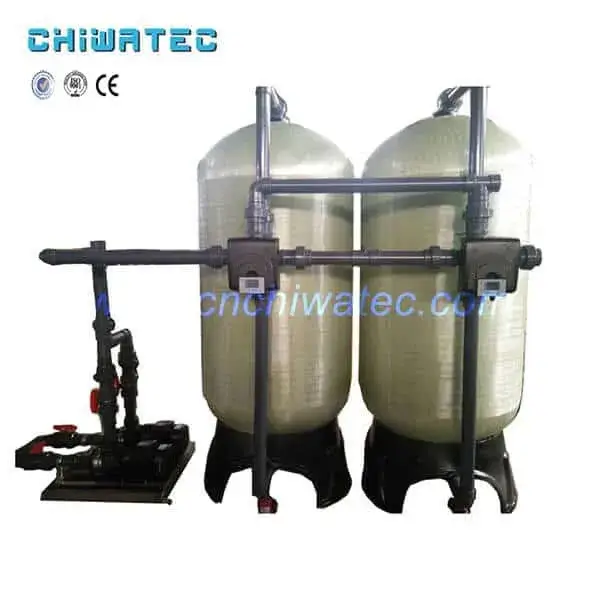
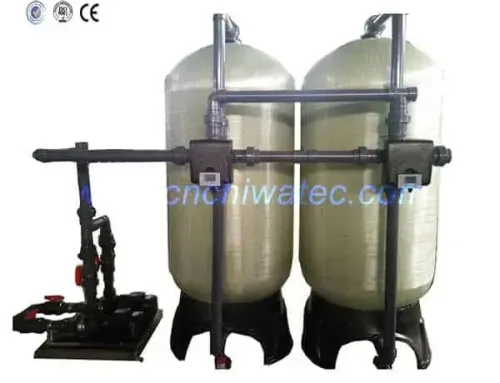
- Quartz sand filter — Removes larger suspended particles, sand, silt, and rust down to 20–40 microns
- Activated carbon filter — Adsorbs chlorine, organic compounds, taste, and odor
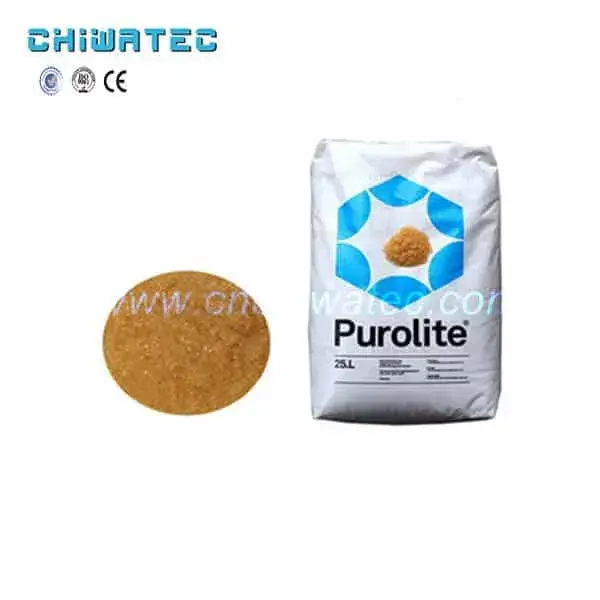
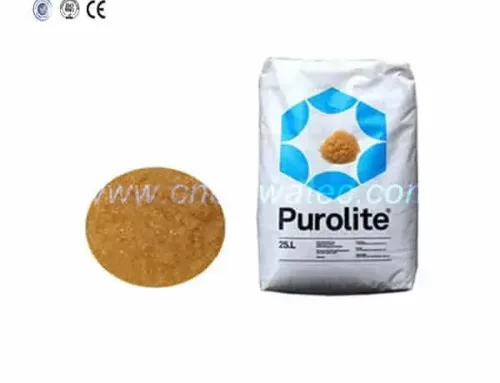
- Water softener (ion exchange resin) — Removes calcium and magnesium ions to prevent scale formation on RO membranes
- Security (cartridge) filter — 5-micron final polishing to protect RO membranes from any remaining particles
Stage 3: Reverse Osmosis (RO) Purification
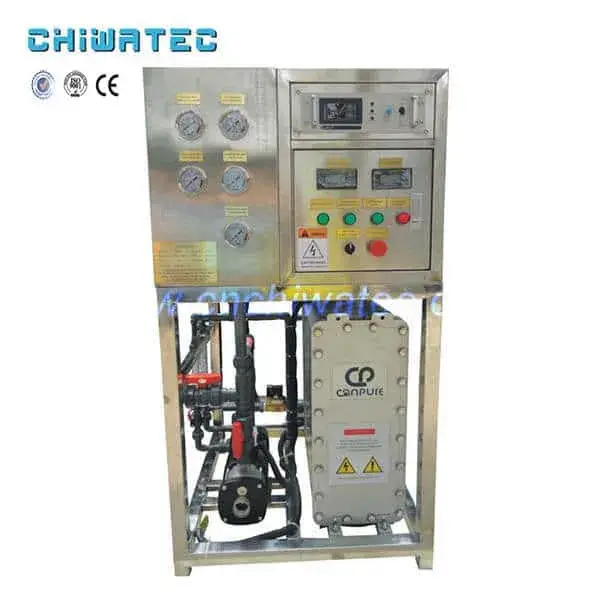
The pretreated water enters the RO membrane element, where it is forced through semi-permeable membranes at high pressure. The RO membrane rejects 97–99% of dissolved salts, heavy metals, bacteria, and viruses. The purified permeate water flows to the storage tank, while the concentrated reject water is discharged or collected for reuse.
Stage 4: Treated Water Storage and Distribution
Purified RO water is stored in a stainless steel tank and distributed to washing machines on demand. The water quality is continuously monitored to ensure consistent performance.
Easy Operation and Automation
Modern laundry water treatment equipment is designed for simple, one-touch operation. After initial installation and commissioning, the system operates automatically with minimal operator intervention:
- One-click start — Simple push-button operation for daily use
- Unattended automatic operation — PLC-controlled sequencing handles pretreatment backwashing, RO membrane flushing, and system shutdown
- Manual/automatic switching — Allows operator control during maintenance or troubleshooting
- Self-protection functions — Automatic shutoff on low inlet pressure, high pressure, or motor overload
- Safety features — Electric valves and high-pressure switches ensure operator and equipment safety during high-pressure RO operation
Real-Time Monitoring and Quality Control
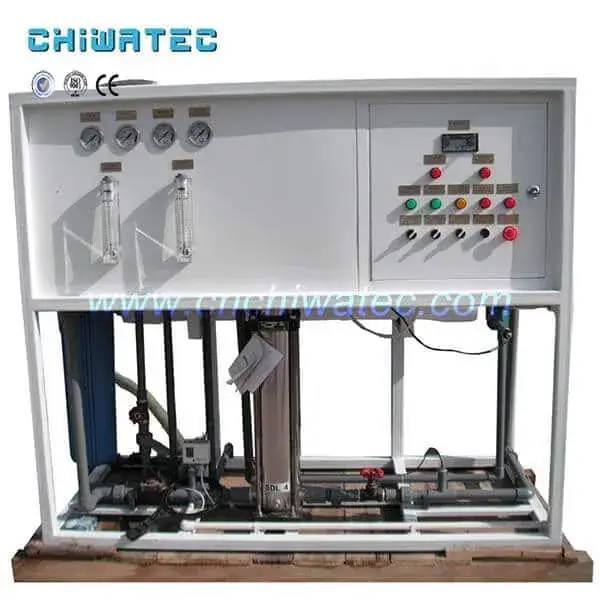
To ensure consistent water quality, the equipment is equipped with comprehensive monitoring instruments:
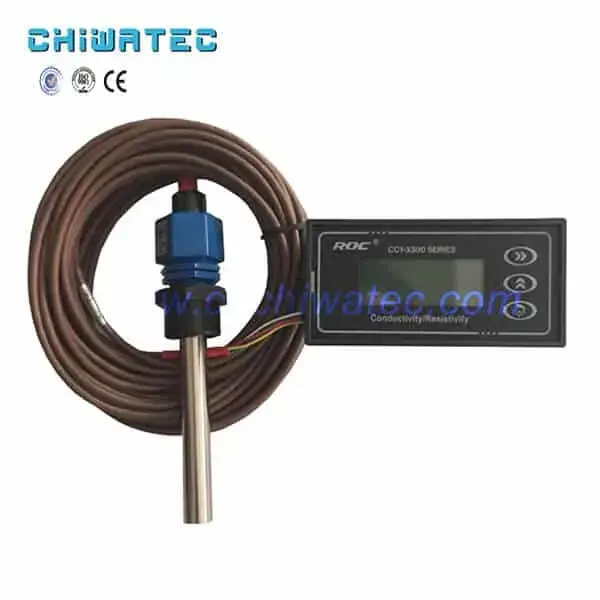
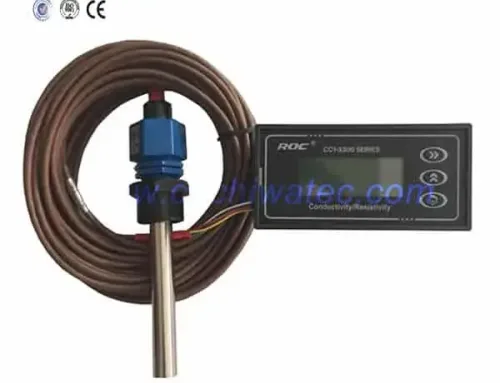
- Online conductivity meter — Continuously measures RO permeate quality (conductivity in μS/cm)
- Raw water conductivity monitoring — Tracks incoming water quality changes through the main water inlet pipe
- Fresh water flow meter — Monitors permeate production rate
- Concentrated water flow meter — Tracks reject water flow for recovery rate calculation
- Pressure gauges — Monitor inlet, pump discharge, and membrane operating pressures
All parameters are displayed on the control panel, making the equipment status clear at a glance. Operators can quickly identify changes in water quality or system performance and take corrective action before laundry quality is affected.
Maintenance and Long-Term Reliability
The long-term performance of laundry water treatment equipment depends on proper maintenance. Key maintenance tasks include:
| Component | Maintenance Task | Frequency |
| Quartz sand filter | Backwash to remove accumulated solids | Weekly (automatic) |
| Activated carbon filter | Backwash and replace media | Every 12–24 months |
| Water softener resin | Regenerate with brine solution | As needed (automatic) |
| Cartridge filter | Replace filter element | Every 3–6 months |
| RO membrane elements | Clean with chemical solution | Every 6–12 months |
| RO membrane elements | Replace | Every 2–5 years |
Well-maintained equipment can operate reliably for 10–15 years with minimal downtime, delivering consistent water quality that directly improves laundry results and customer satisfaction.
Frequently Asked Questions
Why do laundromats need water treatment equipment?
Tap water hardness and impurities leave residue on fabrics, making them feel stiff and look dull. Treated water removes these contaminants, resulting in brighter whites, softer fabrics, better detergent performance, and reduced wear on washing machines from scale buildup.
What is the typical capacity of laundry water treatment equipment?
Commercial systems range from 500 L/h to 10,000 L/h depending on laundry volume. A small laundromat may require 1,000–2,000 L/h, while industrial laundry facilities serving hotels or hospitals may need 5,000–10,000 L/h or more.
How much water does the RO system waste?
Standard RO systems produce 1 part purified water for every 1–2 parts concentrate (50–75% recovery). High-efficiency systems with recovery pumps can achieve 75–80% recovery. The concentrate water can be collected and reused for floor cleaning or landscape irrigation to minimize waste.
Can the equipment operate automatically without an operator?
Yes. Modern laundry water treatment equipment features PLC-controlled automatic operation with one-click start, automatic backwashing, RO membrane flushing, and self-diagnostic safety shutdown. The system can run unattended, requiring operator attention only for periodic maintenance.
How does treated water improve detergent performance?
Soft, purified water allows detergents to lather more effectively and rinse away completely. Hard water reacts with soap to form insoluble scum that deposits on fabrics. By eliminating calcium and magnesium ions, treated water reduces detergent usage by up to 50% while achieving cleaner, brighter results.
Conclusion and Call to Action
Professional laundry water treatment equipment is an essential investment for commercial laundromats seeking consistent, high-quality results. The RO-based process removes hardness, chlorine, dissolved solids, and impurities — delivering purified water that protects fabrics, enhances detergent performance, and keeps clothes looking bright and new after every wash. With automatic operation and comprehensive monitoring, the system runs reliably with minimal operator attention.
For customized laundry water treatment solutions tailored to your facility’s capacity and water quality requirements, contact CHIWATEC: email [email protected] or [email protected]. Our team provides complete support from water testing to system design, installation, and commissioning.
Do you have a water treatment project we can help with
* Designing,machining,installing,commissioning, customize and one-stop service
 English
  Spanish
  Portuguese