

Laundry Water Treatment Equipment Process: Complete Guide to RO Systems for Commercial Laundries 2026
Commercial laundries and laundry shops require high-quality water to achieve clean, bright, and soft laundry results. Raw tap water or well water contains hardness minerals (calcium, magnesium), iron, suspended solids, chlorine, and organic contaminants that leave residues on fabrics, cause yellowing, and reduce detergent effectiveness. The laundry water treatment equipment process uses reverse osmosis technology combined with pretreatment stages to remove these impurities, delivering purified water that protects fabrics and optimizes washing performance. CHIWATEC designs and manufactures complete RO-based water treatment systems specifically configured for commercial laundry, dry cleaning, and industrial fabric care operations.
Why Laundry Businesses Need Water Treatment Equipment
The quality of water used in commercial laundry directly affects washing results, chemical consumption, equipment life, and operating costs. Untreated hard water causes several problems in laundry operations:
| Problem | Effect on Laundry | Annual Cost Impact |
|---|---|---|
| Hard water scale | Graying, stiff fabric, reduced detergent efficiency | $500-2,000 in extra detergent |
| Iron and manganese | Yellow/brown staining on white fabrics | $200-1,000 in re-wash costs |
| Chlorine | Fabric discoloration, weakened fibers | $300-1,500 in fabric replacement |
| Suspended solids | Dirt residue on laundered items | $400-2,000 in poor quality claims |
Installing a dedicated laundry water treatment equipment process eliminates these issues at the source, ensuring every wash cycle produces consistently excellent results regardless of variations in incoming water quality.
Understanding the Laundry Water Treatment Equipment Process
The laundry water treatment equipment process typically consists of four main stages: raw water storage and precipitation, multi-stage pretreatment, reverse osmosis purification, and final polishing. The complete system is designed for fully automatic operation with minimal operator intervention. Raw water — whether municipal tap water, well water, or groundwater — first enters the raw water storage tank for initial settling of large particulates. A booster pump provides sufficient pressure to drive water through the entire treatment train. The system produces purified water with TDS below 20 mg/L, hardness below 1 mg/L, and turbidity below 0.1 NTU — ideal for premium laundry results.
Stage 1: Raw Water Storage and Sedimentation
The first stage in the laundry water treatment equipment process is raw water storage and initial sedimentation. A raw water tank of adequate capacity — typically sized for 2-4 hours of peak system flow — allows heavier suspended solids to settle by gravity. The tank also serves as a buffer to accommodate fluctuations in the municipal water supply pressure. For well water sources, an aeration system may be incorporated to oxidize dissolved iron and manganese, facilitating their removal in subsequent filtration stages. The retention time in the sedimentation tank is typically 30-60 minutes for effective solids settling.
Stage 2: Four-Stage Pretreatment System
The pretreatment section is critical to protecting the downstream RO membranes and ensuring reliable long-term operation. A typical four-stage pretreatment includes:
- Quartz sand filter: Removes suspended solids, sediment, and rust particles down to 20-50 microns. Backwash frequency: every 24-48 hours at 35-50 m/h flow rate for 10-15 minutes.
- Activated carbon filter: Removes residual chlorine, organic matter, taste, and odor. Chlorine must be reduced below 0.1 mg/L to prevent RO membrane oxidation. Carbon media replaced every 12-24 months.
- Water softener: Removes calcium and magnesium hardness through ion exchange to prevent scale formation on RO membranes. Effluent hardness below 5 mg/L as CaCO₃ is recommended.
- Security/cartridge filter (5 μm): Captures any remaining fine particles before the high-pressure pump. Cartridges replaced when pressure drop exceeds 0.5-1.0 bar.
This pretreatment train reduces SDI to below 3, ensuring RO membrane cleaning frequency of only 2-4 times per year.
Stage 3: Reverse Osmosis Purification System
The core of the laundry water treatment equipment process is the RO reverse osmosis system. Pretreated water enters the RO high-pressure pump, which pressurizes it to 10-15 bar (for brackish water) and delivers it to the RO membrane vessels. The RO membranes — typically thin-film composite polyamide spiral-wound elements — remove 95-99% of dissolved solids, including hardness ions, heavy metals, bacteria, and organic compounds. Key operating parameters for laundry RO systems include:
- System recovery: 50-75% depending on feed water TDS
- Salt rejection: 97-99% for standard brackish water membranes
- Permeate flow: Sized based on laundry throughput — typically 500-5,000 L/h for commercial laundries
- Operating pressure: 10-15 bar for brackish water, higher for higher TDS feed
The RO system is equipped with online conductivity monitoring for both feed and permeate water, allowing real-time calculation of desalination rate. Flow meters on permeate and concentrate lines enable operators to track recovery rate and detect membrane fouling trends.
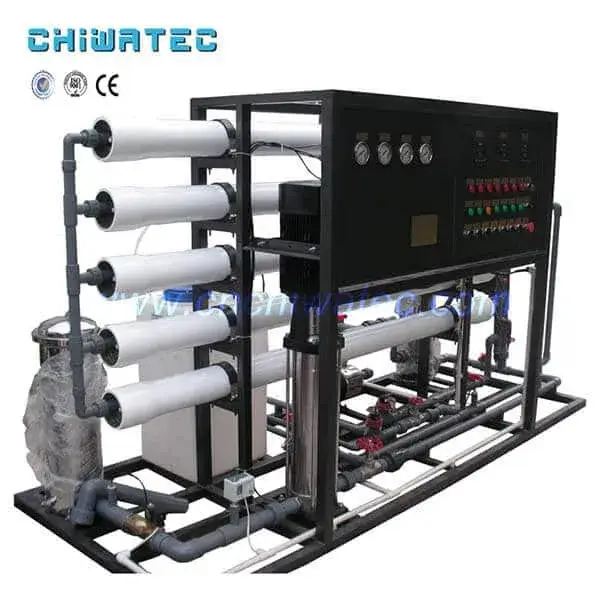
Stage 4: Final Polishing and UV Sterilization
After RO purification, the water passes through a final treatment stage that ensures the highest quality for laundry applications. An ultraviolet (UV) sterilizer with a 254 nm wavelength lamp destroys any remaining microorganisms — including bacteria and viruses that may have colonized downstream piping — achieving a 4-log (99.99%) reduction. A microporous membrane filter (0.2-0.45 μm) captures any residual particles or bacterial fragments. The resulting water has TDS below 20 mg/L, hardness below 1 mg/L, and bacterial counts below 1 CFU/mL. An online conductivity meter at the outlet continuously verifies water quality, with automatic diversion to drain if quality falls below setpoints.
System Automation and Monitoring Features
Modern laundry water treatment equipment is designed for simple, one-key operation with full automation. Key automation features include:
- Fully automatic PLC control: Manages all system functions including start-up, operation, standby, shutdown, and regeneration cycles
- Manual/automatic switching: Allows operators to switch between modes for maintenance and troubleshooting
- Self-protection systems: Electric valves and high-pressure switches protect the high-pressure pump, RO membrane modules, and membrane housings from damage
- Real-time parameter monitoring: Displays feed pressure, permeate flow, concentrate flow, conductivity, and temperature on a central touchscreen panel
- Remote monitoring capability: Optional SCADA or IoT-based monitoring for multi-site laundry operations
These features enable unattended operation, reducing labor costs while ensuring consistent water quality for every wash cycle.
Frequently Asked Questions (FAQ)
What water quality does a laundry RO system produce?
A well-designed laundry RO system produces water with TDS below 20 mg/L, hardness below 1 mg/L (as CaCO₃), turbidity below 0.1 NTU, and conductivity below 40 μS/cm. This water quality eliminates fabric staining, reduces detergent usage by 50-80%, and produces brighter, softer laundry.
How much does a laundry water treatment system cost to operate?
Operating costs for a commercial laundry RO system typically range from $0.20-0.60 per m³ of treated water, including electricity, membrane replacement, filter cartridges, and antiscalant chemicals. For a medium-sized laundry processing 500 kg/day, this adds approximately $5-15 per day to operating costs — offset by detergent savings of $15-40 per day.
How often do RO membranes in laundry systems need replacement?
With proper pretreatment (SDI below 3), RO membranes in laundry systems typically last 3-5 years. Membrane lifespan can be extended by regular cleaning (every 3-6 months), maintaining proper feed water quality, and avoiding chlorine exposure.
Can well water be used as feed for laundry RO systems?
Yes. The laundry water treatment equipment process is designed to handle well water and groundwater as feed sources. Additional pretreatment steps — including aeration, greensand filtration for iron removal, or antiscalant dosing — may be required depending on the specific well water analysis. CHIWATEC provides customized system designs based on site-specific water quality testing.
Conclusion & Call to Action
The laundry water treatment equipment process — from raw water storage and four-stage pretreatment through RO purification, UV sterilization, and final polishing — delivers the consistent, high-quality water that commercial laundries need to produce superior results while reducing chemical costs and equipment maintenance. CHIWATEC offers complete RO-based laundry water treatment systems with capacities from 500 to 10,000 L/h, fully automated controls, and optional remote monitoring. Contact our applications engineers for a water quality analysis and system recommendation tailored to your laundry operation. Email us at [email protected] or [email protected] for expert assistance.
Related Resources and Further Reading
- Laundry Water Treatment Equipment Technology
- Groundwater and Well Water Treatment Process: Complete Guide to Equipment and Systems
- RO Water Treatment System Components: Complete Guide to Equipment, Process Flow, and Specifications
- Reverse Osmosis Water Treatment System Composition: 2026 Complete Guide to RO Technology Features and Components
- RO Water Treatment Systems for Commercial and Industrial Applications — View Our Product Range
Do you have a water treatment project we can help with
* Designing,machining,installing,commissioning, customize and one-stop service






 English
  Spanish
  Portuguese




