Single-Stage Reverse Osmosis 500L/H: Complete Guide to RO-500L/H Ultra-Pure Water Equipment 2026
Looking for a reliable single-stage reverse osmosis 500L/H system for your commercial or light industrial water treatment needs? This comprehensive guide covers the RO-500L/H ultra-pure water equipment specifications, process flow, automation features, operational advantages, and maintenance requirements. Understanding the single-stage reverse osmosis 500L/H system’s capabilities and proper operation is essential for maximizing water quality, equipment longevity, and return on investment.
*Last Updated: May 2026 | Verified Technical Data
Why This Guide Matters
The global small-scale RO equipment market (100-1,000 L/H capacity) was valued at approximately USD 8.5 billion in 2024 and is projected to reach USD 14.8 billion by 2034. The 500 L/H capacity class represents a sweet spot serving restaurants, hotels, laboratories, beverage production lines, small manufacturing facilities, and commercial water vending operations. A properly selected and maintained single-stage reverse osmosis 500L/H system can deliver purified water at a cost of USD 0.01-0.03 per liter versus USD 0.50-1.00 for bottled alternatives, making the correct specification and operation of this equipment critical for business profitability.
Key Industry Trends (2026 Update)
- Compact single-stage systems gaining market share — The 200-1,000 L/H single-stage RO segment grew 12% year-over-year as small businesses prioritize affordable, low-maintenance water purification solutions over multi-stage or two-pass configurations.
- PLC automation becoming standard — Fully programmable logic controller (PLC)-controlled operation with automated flushing, low-pressure protection, and high-pressure cutoffs is now standard on 500L/H-class systems, reducing operator attention to less than 1 hour per day.
- Energy-efficient low-pressure membranes — New-generation low-energy RO membrane elements operating at 100-150 psi (versus traditional 200 psi) reduce specific energy consumption by 25-35% while maintaining 98% plus salt rejection.
- IoT-ready monitoring for small systems — Affordable IoT monitoring modules for 500L/H-class RO systems now enable remote TDS, flow rate, and pressure monitoring via smartphone apps, reducing unplanned downtime by 30%.
1. What Are the Key Specifications of the RO-500L/H Single-Stage Reverse Osmosis System?
System Performance Parameters
The RO-500L/H single-stage reverse osmosis 500L/H system delivers a rated water production capacity of 500 liters per hour at 25 degrees C feed water temperature with standard municipal tap water feed. The product water quality achieves conductivity below 15 microsiemens/cm, corresponding to a desalination rate exceeding 98%. The system is designed for raw water sourced from municipal tap water supplies and operates with a design boundary extending from the raw water storage tank inlet to the pure water storage tank outlet, encompassing all interconnecting pipelines, valves, instrumentation, and electronic controls.
Complete Technical Specifications
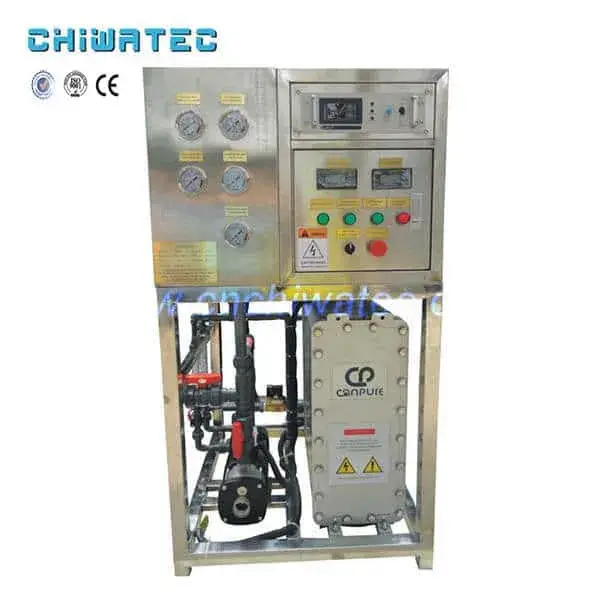
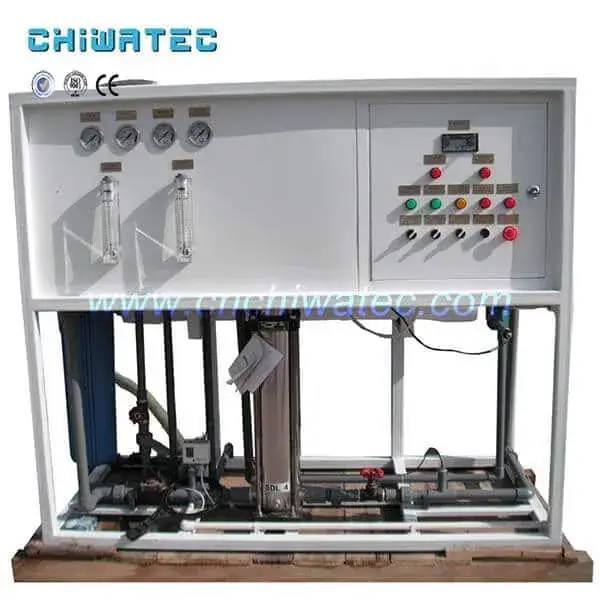
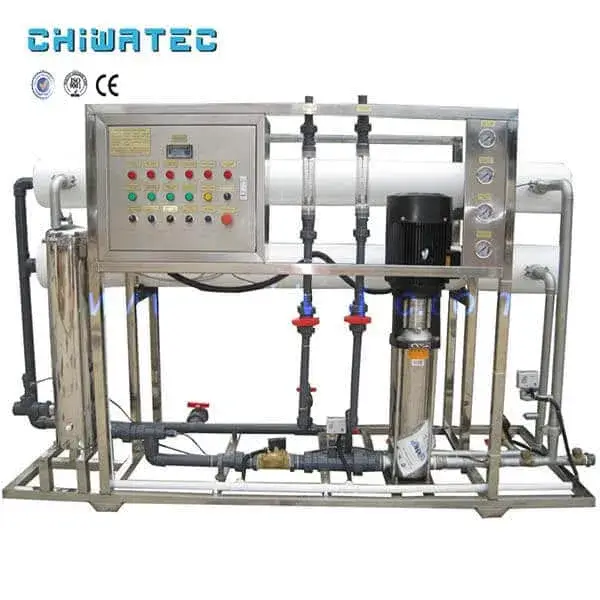
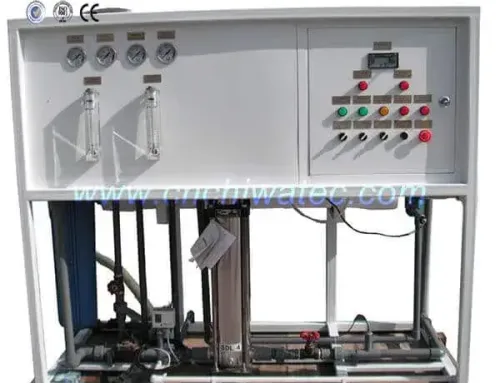
Key specifications include: water output of 500 L/H at 25 degrees C, product water conductivity below 15 microsiemens/cm with desalination rate exceeding 98%, raw water quality based on municipal tap water standards (TDS typically 200-500 mg/L), system design pressure of 150-200 psi (10-14 bar), and a comprehensive treatment train: raw water storage tank to water supply pump to multimedia filter to activated carbon filter to water softener to precision filter (5-micron) to high-pressure pump to single-stage RO membrane array to pure water storage tank. The complete system is mounted on a stainless steel skid with PLC-based automatic control. For a broader discussion of RO system improvements and design, refer to our article on improvements in reverse osmosis desalination technology.
2. What Is the Complete Technical Process Flow?
Pre-Treatment Stages
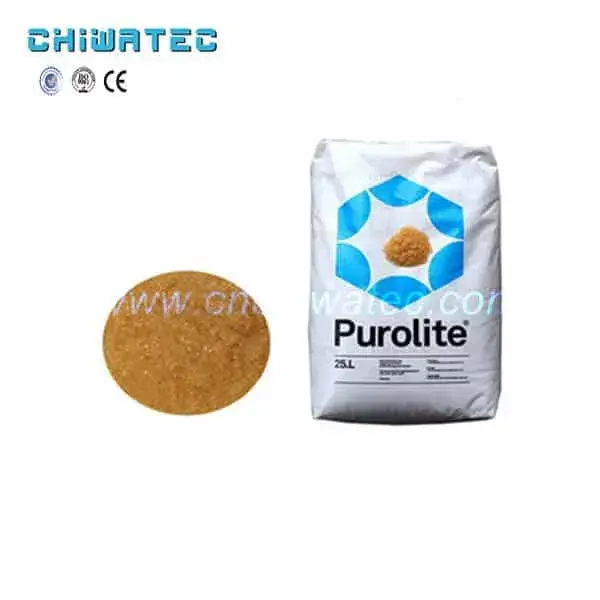
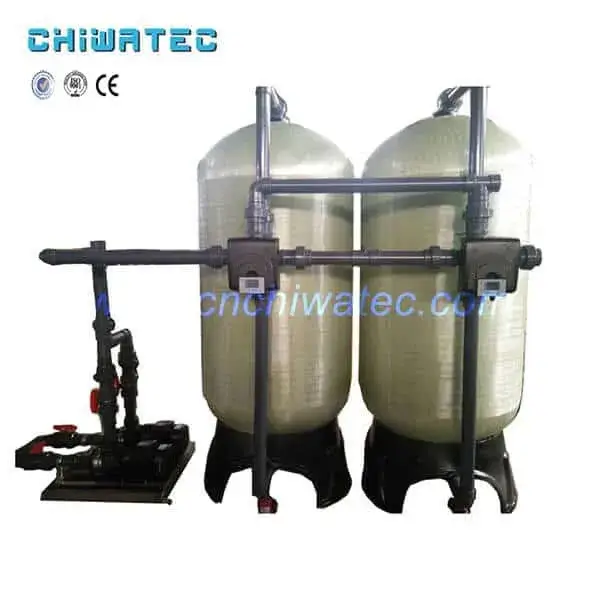
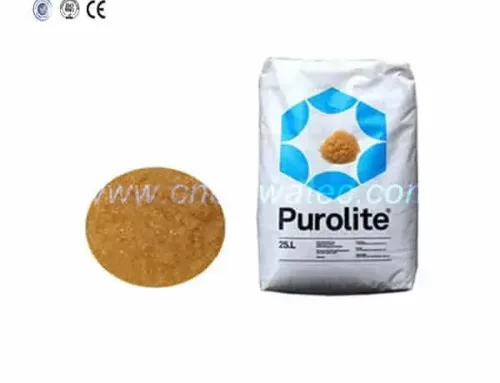
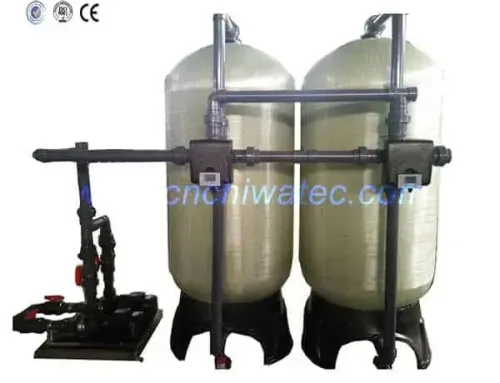
The single-stage reverse osmosis 500L/H system incorporates four essential pretreatment stages before the RO membrane: (1) multimedia filtration using graded quartz sand and anthracite media removes suspended solids and turbidity above 20 microns; (2) activated carbon filtration using coconut shell-based granular activated carbon removes free chlorine, chloramines, organic compounds, taste, and odor — critical for protecting thin-film composite RO membranes from chlorine oxidation; (3) water softening through sodium-form cation exchange resin removes calcium and magnesium hardness ions that would otherwise cause calcium carbonate and calcium sulfate scaling on membrane surfaces; and (4) precision security filtration using a 5-micron polypropylene melt-blown cartridge filter captures any remaining particulate matter before the high-pressure RO stage. For a comparative analysis of water treatment technologies, see our article on RO versus electrodialysis desalination effectiveness.
RO Membrane Separation Stage
After pretreatment, the high-pressure pump pressurizes the feed water to 150-200 psi and delivers it to the single-stage RO membrane array. The membrane elements — typically 4-inch by 40-inch (4040) or 2.5-inch by 40-inch (2540) format TFC polyamide spiral-wound elements — achieve 98% plus salt rejection through solution-diffusion transport across the semi-permeable membrane. The permeate (product water) flows to the pure water storage tank, while the concentrate (reject water) is discharged to drain. The recovery rate is typically 50-75% depending on feed water TDS and system configuration, meaning 500 L/H of product requires 670-1,000 L/H of feed water input.
3. What Process Characteristics Make the RO-500L/H System Effective?
Advanced Membrane Technology Integration
The RO-500L/H system incorporates advanced ultra-pure water manufacturing technology using low-energy TFC RO membrane elements. These membranes achieve the required desalination performance at lower operating pressures than conventional elements, reducing energy consumption and extending pump and seal life. The system is designed around the specific quality characteristics of the raw water source, with the pretreatment train configured to ensure that RO feed water consistently meets membrane manufacturer specifications for SDI (below 5), chlorine (below 0.1 ppm), and hardness (below 1 mg/L as CaCO3). Xi’an CHIWATEC selects membrane elements and system components based on site-specific feed water analysis to ensure reliable, long-term performance.
Brand-Component Reliability
The system specification emphasizes the use of branded, high-quality components throughout: the high-pressure pump (typically a vertical multi-stage centrifugal pump from Grundfos, CNP, or equivalent), RO membrane elements (FilmTec, Hydranautics, or Vontron), and control components (Siemens, Omron, or Schneider Electric PLC). This component selection strategy ensures system reliability, availability of replacement parts, and consistent performance over the 15-20 year designed service life of the mechanical components. The use of low-energy RO membrane modules further reduces operational power consumption while maintaining high water output.
4. What Automation and Control Features Does the System Include?
PLC-Based Fully Automatic Operation
The single-stage reverse osmosis 500L/H system features PLC-based fully automatic control, enabling unattended 24-hour continuous operation. The control system manages all aspects of system operation: automatic start-up sequence (feed water valve opening, low-pressure flush, high-pressure pump start), normal operation monitoring (pressures, flows, conductivity), automatic membrane flush at shutdown (reducing scaling and fouling), and alarm management for out-of-spec conditions. The system can operate continuously without operator intervention, with the PLC automatically managing start-stop cycles based on the pure water storage tank level. For additional information on complete RO system design and requirements, see our guide on advantages of RO-ion exchange combined desalination treatment.
Comprehensive Safety Protection
The system incorporates multiple safety interlocks to protect equipment and prevent damage from operator error or abnormal conditions: low-pressure protection — if feed water supply is interrupted or insufficient, the system automatically stops the high-pressure pump to prevent cavitation damage; high-pressure protection — if the discharge pressure exceeds the setpoint, the system shuts down to prevent membrane and housing damage; motor over-temperature protection — thermal overload relays protect all motors from overheating due to overcurrent or single-phasing; and automatic restart — when feed water supply or storage tank level returns to normal, the system automatically resumes operation without manual intervention.
5. How Does the RO-500L/H System Compare with Other Capacity Classes?
500 L/H vs. 300 L/H Systems
The RO-500L/H system offers 67% more production capacity than the 300 L/H class (such as the LTLD-RO1000I) while requiring proportionally more floor space, higher electrical supply capacity, and larger pretreatment components. The 500 L/H class typically uses 4040 format membrane elements (same as 300 L/H systems) but may require three elements in a 2:1 array versus two elements for the 300 L/H system. Operating costs scale roughly linearly with capacity — a 500 L/H system at 8 hours/day consumes approximately 35-40 kWh versus 22 kWh for the 300 L/H system, with consumables costs approximately 60-70% higher. For applications requiring consistent 500 L/H or more, the system provides the best value in terms of per-liter equipment cost.
Single-Stage vs. Two-Stage Configurations
The single-stage configuration (one RO membrane pass) is the most common and cost-effective configuration for applications requiring product water conductivity below 15 microsiemens/cm from municipal tap water feed (200-500 mg/L TDS). Two-stage or two-pass RO configurations are typically specified when product water conductivity below 2 microsiemens/cm is required, or when the feed water TDS exceeds 1,000 mg/L. The single-stage configuration’s advantages include lower capital cost (typically 40-50% less than two-pass systems), simpler operation and maintenance, and higher water recovery per membrane pass.
6. What Specific Applications Does the RO-500L/H System Serve?
Commercial and Light Industrial Applications
The RO-500L/H system serves a wide range of applications including: restaurant and food service water for cooking, ice making, and beverage dispensing where consistent water quality affects taste and equipment longevity; hotel and hospitality purified water for guest drinking water, laundry, and kitchen operations; laboratory and research facility Type III reagent water (conductivity below 15 microsiemens/cm) complying with ASTM D1193-91 requirements; small-scale beverage production including bottled water, soft drinks, and juice concentrate dilution; and small manufacturing facilities requiring purified process water for washing, rinsing, and ingredient water. CHIWATEC provides application-specific system configurations for each of these sectors, with options for additional post-treatment (UV sterilization, ozone, or remineralization) as required. For specific application case studies, see our article on pure water equipment applications in alcohol and beverage production.
Medical and Pharmaceutical Applications
The system’s product water quality (conductivity below 15 microsiemens/cm) meets the requirements for several medical and pharmaceutical applications including: hemodialysis water preparation (with appropriate post-treatment including UV and endotoxin filtration per AAMI standards), medical device cleaning and rinsing water, laboratory reagent water for clinical diagnostic applications, and pharmaceutical process water for non-sterile applications (USP Purified Water quality with appropriate post-treatment). For pharmaceutical-grade applications requiring sterile or WFI-quality water, additional post-treatment stages including EDI and UV oxidation are recommended.
7. What Maintenance Does the RO-500L/H System Require?
Daily and Weekly Maintenance Schedule
Daily operator tasks for the single-stage reverse osmosis 500L/H system include: checking operating pressure (150-200 psi), verifying permeate flow rate (500 L/H plus or minus 10% at 25 degrees C), recording feed and permeate conductivity readings, and inspecting for leaks at all connections. Weekly tasks include: checking the water softener brine tank salt level, inspecting the multimedia filter backwash schedule, verifying the activated carbon filter pressure drop, and confirming the automatic membrane flush function operates correctly at system shutdown. For a comprehensive introduction to water treatment systems and their maintenance, see our introduction to water treatment equipment.
Monthly and Quarterly Maintenance
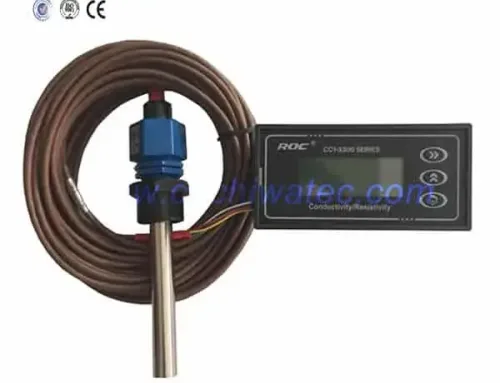
Monthly maintenance includes: replacing the 5-micron precision filter cartridge elements (typically at 10-15 psi DP increase), performing a full water softener regeneration cycle, calibrating the conductivity/TDS monitor, and checking high-pressure switch and low-pressure switch functionality. Quarterly maintenance includes: backwashing the multimedia filter and activated carbon filter, inspecting and cleaning the high-pressure pump inlet strainer, testing all safety interlocks, and performing a complete system performance normalization analysis to track any decline in membrane performance. Annual maintenance includes RO membrane element cleaning (CIP) if normalized permeate flow has declined by 15% or differential pressure has increased by 20% from baseline.
8. How to Troubleshoot Common RO-500L/H System Problems?
Low Permeate Production
If the system produces less than 450 L/H under normal operating conditions, potential causes include: low feed water temperature (production decreases approximately 3% per degree C below 25 degrees C), fouled precision filter elements (check DP — replace if above 15 psi), membrane fouling or scaling (check normalized flow and DP — CIP required if flow declined by 15% from baseline), low feed pressure (verify high-pressure pump discharge pressure is at 150-200 psi), or insufficient feed water supply (check raw water tank level and booster pump operation). Each cause has a specific diagnostic indicator, and systematic troubleshooting from the least invasive check (pressure gauge readings) to the most invasive (membrane element inspection) minimizes downtime. For guidance on the function of each RO system component and fault resolution, refer to our guide to pure water machine components and common fault solutions.
High Product Water Conductivity
Product water conductivity exceeding 20 microsiemens/cm indicates compromised membrane rejection. Diagnostic steps include: checking for O-ring seal leaks at membrane element interconnections (most common cause — the membrane interconnector O-ring may be displaced or damaged during installation), verifying brine seal condition (damaged brine seals allow feed water bypass), checking for membrane oxidation from chlorine exposure (test feed water for residual chlorine), and confirming that membrane elements have not exceeded their service life. For systems with high feed water TDS (above 500 mg/L), the expected product conductivity at 98% rejection may naturally be higher — verify against the design specification rather than an absolute 15 microsiemens/cm target.
9. What Is the Total Cost of Ownership for a 500L/H RO System?
Capital and Installation Costs
The complete capital investment for a single-stage reverse osmosis 500L/H system includes: equipment purchase (typically USD 5,000-15,000 depending on component quality and automation level), site preparation (concrete pad, electrical supply, plumbing connections at USD 1,000-3,000), raw water and pure water storage tanks (USD 500-2,000), and installation and commissioning (USD 1,000-3,000 for professional installation). Total initial investment typically ranges from USD 7,500 to 23,000 for a turnkey installation.
Annual Operating Costs
Annual operating costs for an 8-hour/day, 250-day/year operation include: electricity consumption (4 kW × 2,000 hours = 8,000 kWh at USD 0.12/kWh = USD 960), consumables (precision filter elements at USD 15-30 per set, every 4-8 weeks = USD 100-400/year; antiscalant or softener salt at USD 100-300/year), membrane replacement reserve (USD 500-1,000/year amortized over 3-5 year membrane life), and preventive maintenance (USD 500-1,000/year for labor and incidental parts). Total annual operating cost: approximately USD 2,160-3,660. At 500 L/H × 2,000 hours/year = 1,000,000 L/year production, the per-liter cost is USD 0.002-0.004 — versus USD 0.50-1.00 per liter for bottled water, representing annual savings of USD 496,000-996,000 for a facility that would otherwise purchase equivalent water volume.
10. How to Select and Install the Right RO-500L/H System?
Site Requirements and Pre-Installation Checklist
Before installing a 500L/H RO system, verify these site conditions: adequate floor space (approximately 2-3 square meters for the equipment skid, plus clearance for membrane replacement and maintenance), floor drainage capacity for reject water discharge (approximately 250-500 L/H depending on recovery rate), electrical supply (220V or 380V, single-phase or three-phase depending on pump motor requirements, typically 3-5 kW), feed water supply line size (minimum 1/2-inch or 3/4-inch diameter with adequate flow rate of 700-1,500 L/H), and ambient temperature range (5-40 degrees C) with adequate ventilation for heat dissipation from the high-pressure pump. Xi’an CHIWATEC provides a detailed site survey checklist and installation guide for all RO systems.
Commissioning and Start-Up Procedure
Initial commissioning follows a structured sequence: (1) verify all pretreatment media are properly loaded and flushed (sand, carbon, resin), (2) regenerate the water softener resin, (3) install new 5-micron precision filter elements, (4) load and seal RO membrane elements with correct brine seal orientation, (5) program the PLC with system operating parameters, (6) slowly open the feed water supply while venting air from all vessels, (7) start the system in manual mode and verify all pressures, flows, and conductivity readings, (8) adjust the concentrate flow control valve to achieve the target recovery rate, and (9) switch to automatic mode and verify all safety interlocks function correctly. First-hour permeate should be diverted to drain until conductivity stabilizes below 15 microsiemens/cm. For a detailed design scheme example, see our description of direct drinking water equipment system design.
Conclusion
The RO-500L/H single-stage reverse osmosis 500L/H system delivers reliable, high-quality purified water for a wide range of commercial and light industrial applications. With its comprehensive four-stage pretreatment, single-stage RO membrane array, PLC-based automatic control, and comprehensive safety protection features, it offers an excellent balance of performance, reliability, and cost-effectiveness for the 500 L/H capacity class. Proper installation, regular preventive maintenance, and diligent monitoring of operating parameters are essential for maximizing membrane service life and minimizing total operating costs. For expert guidance on selecting, installing, or optimizing a single-stage reverse osmosis 500L/H system for your specific application, contact Xi’an CHIWATEC today at [email protected] or [email protected], or reach us via WhatsApp.
Frequently Asked Questions
Q1: What is the difference between single-stage and two-stage reverse osmosis?
Single-stage RO passes feed water through one membrane array, achieving 95-99% salt rejection depending on membrane type and operating conditions. Two-stage RO (also called two-pass RO) passes the first-stage permeate through a second RO array, achieving 99.8-99.9% total salt rejection. Single-stage systems are appropriate when product water conductivity below 10-30 microsiemens/cm is acceptable; two-stage systems are needed when conductivity below 1-5 microsiemens/cm is required, such as for pharmaceutical WFI, electronics manufacturing, or laboratory Type I water production.
Q2: How much electricity does a 500L/H RO system consume?
A 500L/H single-stage RO system with a 3-5 kW total power draw consumes approximately 24-40 kWh per 8-hour operating day, or 3-5 kWh per 1,000 liters of product water. At an average commercial electricity rate of USD 0.12/kWh, the per-liter energy cost is approximately USD 0.0004-0.0006/L — making RO the most energy-efficient water purification technology available for this capacity range.
Q3: What is the typical membrane life for the RO-500L/H system?
With proper pretreatment and regular maintenance, the RO membrane elements in a 500L/H single-stage system typically last 3-5 years. Factors that extend membrane life include maintaining feed water within recommended quality parameters (SDI below 5, chlorine below 0.1 ppm, hardness below 1 mg/L), performing automatic membrane flush after each operating cycle, conducting timely CIP cleaning when normalized performance declines by 15%, and avoiding thermal or chemical shock during operation and maintenance.
Q4: Can the RO-500L/H system be upgraded for higher capacity?
Yes, the 500L/H system can typically be upgraded through several approaches: adding additional RO membrane elements in parallel configuration (increasing capacity by 50-100%), installing a larger high-pressure pump, or upgrading the pretreatment components to handle the increased flow. However, a more cost-effective approach for significantly higher capacity requirements is typically to install a second independent RO system rather than attempting a major upgrade of the existing system, as the frame, piping, and electrical components are sized for the original 500 L/H capacity.
Q5: Does the system require a water softener?
For most municipal tap water supplies, a water softener is strongly recommended as part of the pretreatment train. Hardness above 1 mg/L as CaCO3 will cause calcium carbonate scaling on RO membrane surfaces, progressively reducing permeate flow and increasing differential pressure. In membrane autopsy studies, scaling is the second most common cause of premature membrane failure (after biofouling). For feed water hardness below 50 mg/L as CaCO3, antiscalant dosing may be used as an alternative to a softener, but softening provides more robust protection for long-term membrane performance.
Related Resources and Further Reading
Do you have a water treatment project we can help with
* Designing,machining,installing,commissioning, customize and one-stop service
 English
  Spanish
  Portuguese