

Biomedicine Pure Water Equipment Process: Complete Guide to Pharmaceutical Water Systems and Technologies 2026
The biomedicine pure water equipment process is a specialized multi-stage water treatment system designed to produce pharmaceutical-grade purified water and ultrapure water (UPW) for biomedical, pharmaceutical, and healthcare applications. From traditional RO + ion exchange configurations to advanced RO + EDI (Electrodeionization) systems and double-pass RO with positively charged membranes, each approach delivers water quality meeting USP, EP, and CP pharmacopoeia standards. CHIWATEC provides complete biomedical pure water treatment solutions for pharmaceutical manufacturing, laboratory, and healthcare facilities worldwide.
Overview of the Biomedicine Pure Water Equipment Process
The biomedicine pure water equipment process converts raw water into high-purity water suitable for pharmaceutical applications through a carefully designed sequence of treatment stages. The complete production system typically includes:
Pretreatment (multimedia + carbon + softener) → Precision filtration → Primary RO → Intermediate storage → Polishing (EDI or ion exchange or second-pass RO) → Purified water storage → UV sterilization → Microfiltration → Point of use
Biomedical pure water systems must meet strict pharmacopoeia standards including USP <645> (conductivity), USP <643> (TOC), and bacterial endotoxin limits. Two main technology approaches have evolved: traditional RO + mixed-bed ion exchange, and modern RO + EDI (electrodeionization). Each has distinct advantages depending on the application requirements.
Traditional Biomedicine Pure Water Process: RO + Ion Exchange
The traditional process for biomedical pure water production uses reverse osmosis followed by ion exchange (mixed-bed resin) for final polishing:
Raw water → Raw water booster pump → Multi-media filter → Activated carbon filter → Water softener → Precision filter → Primary RO → Intermediate water tank → Intermediate water pump → Ion exchanger → Purified water tank → Pure water pump → UV sterilizer → Microporous filter → Water point
Key characteristics of the traditional process:
- Proven technology with decades of industry application
- Mixed-bed ion exchanger provides very high resistivity (18.2 MΩ·cm) water
- Requires periodic chemical regeneration of resin beds (acid and caustic)
- Higher chemical handling costs and wastewater from regeneration
- Suitable for facilities where chemical regeneration infrastructure exists
New Technology: RO + EDI Ultrapure Water Process
The modern biomedicine pure water equipment process increasingly uses electrodeionization (EDI) instead of mixed-bed ion exchange for the final polishing stage:
Raw water → Raw water booster pump → Multi-media filter → Activated carbon filter → Water softener → Precision filter → Primary RO → Intermediate water tank → Intermediate water pump → EDI system → Purified water tank → Pure water pump → UV sterilizer → Microporous filter → Water point
Key advantages of RO + EDI:
- Continuous operation without chemical regeneration downtime
- No acid or caustic chemicals required — environmentally friendly
- Consistent water quality (16-18.2 MΩ·cm)
- Lower operating costs and reduced operator intervention
- Compact system design with smaller footprint
- Increasingly the preferred technology for new pharmaceutical water systems
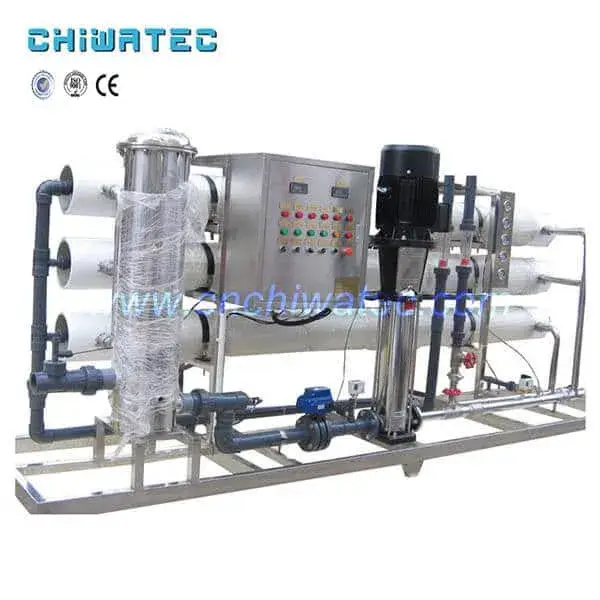
Double-Pass RO Process with Positively Charged Membranes
An alternative advanced configuration uses double-pass reverse osmosis with positively charged RO membranes for the second stage. This configuration provides excellent water quality without the need for ion exchange or EDI in many applications:
Raw water → Raw water booster pump → Multi-media filter → Activated carbon filter → Water softener → Precision filter → Primary RO → pH adjustment → Intermediate water tank → Secondary RO (positively charged membrane) → Purified water tank → Pure water pump → UV sterilizer → Microporous filter → Water point
Advantages of double-pass RO:
- No chemical regeneration required
- Positively charged second-pass membranes improve rejection of ionized silica, boron, and TOC
- Suitable for feed water with moderate TDS levels
- Lower capital cost compared to RO + EDI systems
- pH adjustment between first and second pass optimizes rejection efficiency
Comprehensive RO + EDI + Distillation Process for High-Purity Applications
For the most demanding biomedical applications requiring ultrapure water with extremely low endotoxin and TOC levels, a comprehensive system combining multiple technologies is used:
Raw water → Multi-media filter → Activated carbon filter → Softening filter → Softening water tank → Security filter → Primary RO → Secondary RO → RO pure water tank → EDI ultrapure water device → Ultrapure water tank → Distillation device → Water point
This configuration achieves the highest water purity levels (resistivity > 18.2 MΩ·cm, TOC < 5 ppb, endotoxin < 0.001 EU/mL) required for critical biomedical applications such as injectable formulation, cell culture media preparation, and analytical instrumentation.
Technology Comparison: Which Process Is Right for Your Application?
| Parameter | RO + Ion Exchange | RO + EDI | Double-Pass RO |
|---|---|---|---|
| Product resistivity | 18.2 MΩ·cm | 16-18.2 MΩ·cm | 1-10 MΩ·cm |
| Chemical regeneration | Required (acid/caustic) | Not required | Not required |
| Operating cost | Moderate (chemicals) | Low | Low |
| Capital cost | Low | Moderate | Moderate |
| Continuous operation | Batch (regeneration downtime) | Continuous | Continuous |
| Best application | Small to medium pharma, existing infrastructure | New pharma, biotech, USP Purified Water | Medium purity, electronics, laboratory |
Frequently Asked Questions (FAQ)
What water quality standards apply to biomedical pure water systems?
Biomedical pure water must comply with pharmacopoeia standards including USP (United States Pharmacopeia), EP (European Pharmacopoeia), and CP (Chinese Pharmacopoeia). Key parameters include: conductivity below 1.3 µS/cm at 25°C (USP Purified Water), TOC below 500 ppb, bacterial count below 100 CFU/mL, and endotoxin below 0.25 EU/mL for Water for Injection (WFI) applications.
What is the difference between EDI and mixed-bed ion exchange?
EDI (Electrodeionization) uses an electric field to continuously regenerate ion exchange resins, eliminating the need for chemical regeneration. Mixed-bed ion exchange requires periodic chemical regeneration with acid and caustic. EDI offers continuous operation, lower operating costs, and no chemical handling, while mixed-bed achieves slightly higher resistivity (18.2 vs 16-18.2 MΩ·cm) at lower capital cost.
Can the traditional RO + ion exchange system be upgraded to RO + EDI?
Yes, upgrading from RO + ion exchange to RO + EDI is feasible in most cases. The primary RO system and pretreatment can typically be retained. The mixed-bed ion exchanger is replaced with an EDI module. The RO permeate quality must meet EDI feed requirements (conductivity below 30-40 µS/cm, hardness and silica levels within limits). A system audit by a water treatment professional is recommended before upgrading.
How often does a biomedical pure water system need sanitization?
Pharmaceutical water systems require periodic sanitization to prevent biofilm formation. UV sterilizers and hot water sanitization loops are common. Most systems are sanitized weekly or monthly depending on the specific pharmacopoeia requirements and system design. The purified water storage and distribution loop should be designed for continuous recirculation with turbulent flow to minimize stagnation and microbial growth.
What pretreatment is essential before RO in pharmaceutical water systems?
Essential pretreatment includes: multimedia filtration to remove suspended solids, activated carbon filtration to remove chlorine and organic compounds, water softening to prevent membrane scaling, antiscalant dosing for silica and calcium control, and 5-micron cartridge filtration. For high-TDS feed water, a primary RO or nanofiltration stage may be added before the main RO system to reduce the load on the downstream polishing stages.
Conclusion & Call to Action
The biomedicine pure water equipment process has evolved significantly from traditional RO + ion exchange to advanced RO + EDI and double-pass RO configurations. Each technology approach offers distinct advantages for different pharmaceutical water quality requirements, application types, and operational preferences. Modern biomedical pure water systems deliver consistent, high-purity water that meets the most stringent pharmacopoeia standards while reducing chemical usage and operating costs.
CHIWATEC provides complete biomedical pure water treatment solutions, from system design and equipment supply to installation and commissioning. For expert guidance on selecting the right pharmaceutical water system for your facility, contact us at [email protected] or [email protected] for a customized water treatment solution.
Related Resources and Further Reading
Do you have a water treatment project we can help with
* Designing,machining,installing,commissioning, customize and one-stop service






 English
  Spanish
  Portuguese




