

Application and Improvement of Reverse Osmosis Desalination Technology
This article provides a comprehensive overview of the operational principles and engineering improvements of reverse osmosis desalination technology, focusing on the optimization of pretreatment processes, ultrafiltration performance, RO system configuration, flux balancing, pH adjustment, membrane selection, and mixed-bed operation efficiency. It highlights practical transformation measures that significantly improve desalination rate, membrane service life, and system reliability.
1. Overview of Reverse Osmosis Desalination Technology
Reverse osmosis (RO) desalination is a physical membrane separation process driven by pressure without phase change. Compared with traditional water treatment technologies, RO systems offer the following advantages:
- Simple process flow and easy operation
- Low operating cost with no acid or alkali consumption in normal operation
- Minimal environmental impact
- Stable product water quality, especially beneficial for downstream mixed-bed ion exchange systems
- High desalination rate and strong ability to remove dissolved salts and microorganisms
These features make RO desalination a leading technology for seawater, brackish water, industrial water, and high-purity water production.
2. Improvement of Sand Filter for Enhanced Iron Removal
2.1 Background
During flood seasons in the Yangtze River basin, the raw water often contains elevated iron concentrations—up to 0.60 ppm.
However, RO membrane manufacturers typically require <0.10 ppm iron to avoid membrane blockage.
2.2 Solution: High-Quality Natural Manganese Sand
To meet these requirements, the sand filter was upgraded by adding:
- 400 mm layer of natural manganese sand
- Particle size 0.5–0.6 mm
2.3 Reaction Mechanism
In natural water:
- Iron exists as Fe²⁺ and Fe³⁺
- Fe²⁺ is easily oxidized to Fe³⁺
- Fe³⁺ hydrolyzes to form Fe(OH)₃, which clogs RO membranes
Manganese sand (MnO₂) catalyzes Fe²⁺ oxidation:
4MnO2 + 3O2 → 2Mn2O7
Mn2O7 + 6Fe2+ + 3H2O → 2MnO2 + 6Fe3+ + OH−
Fe³⁺ then precipitates as Fe(OH)₃ and is removed by filtration.
2.4 Results
After upgrading the filter bed:
- Iron concentration at the outlet: <0.04 ppm
- Meets RO feedwater requirements
- Greatly reduces membrane fouling risk
3. Improvement of Ultrafiltration (UF) Operating Mode
UF pretreatment is critical for preventing:
- Suspended solids fouling
- Microorganism accumulation
- Colloid blockage
- Scaling of insoluble salts
3.1 System Upgrades
- Retained original two low-pressure circulation pumps
- Connected raw water pipe network directly to pump suction port
- Increased inlet flow and crossflow velocity
- Improved shear force on membrane surface
3.2 Benefits
- Reduced concentration polarization
- Decreased membrane fouling
- Increased UF permeate flux
- Lower frequency of chemical cleaning
- Added automatic rapid surface flushing for UF modules
4. Improvement of RO Desalination System
4.1 Balanced Water Flux Distribution (Backpressure Adjustment Method)
In typical RO systems:
- Front-end membrane elements experience high flux and high recovery
- Tail-end elements experience low flux and poor salt rejection
- This imbalance promotes concentration polarization and fouling
Upgraded System Design
- Original 5 × 3 layout replaced with two sets of 3 × 1 parallel trains
- Installed pressure gauge between stage outputs
- Added adjustable valve for flux balancing
Results
- Freshwater production distributed optimally at 75% (first stage) and 25% (second stage)
- Desalination rate improved to 98.6%
- Significant improvement in product water quality
4.2 pH Adjustment to Enhance CO₂ Removal
CO₂ permeates RO membranes easily. At pH 8.2–8.3:
- HCO₃⁻ becomes the dominant form
- CO₂ conversion increases
- Effective CO₂ removal through RO improves
Upgrade Measures
- Added NaOH dosing before security filter
- Adjusted pH to 8.2–8.3
- Eliminated RO product water tank to prevent CO₂ re-dissolution
- Installed double-alkali respirator on desalinated water tank
Results
- Higher RO desalination efficiency
- Increased mixed-bed ion exchange capacity
- Reduced gas contamination
4.3 Pure Water Rinse During RO Shutdown
Implementing pure-water rinsing during shutdown allows:
- Reverse osmosis through osmotic flow
- Removal of contaminants adsorbed on membrane surfaces
- Reduction of concentration polarization
- Decrease in fouling rate
This significantly prolongs membrane life.
4.4 Selection of Anti-Fouling RO Membrane
The system uses DOW FILMTEC BW30-365FR, featuring:
- Optimized feed channel turbulence
- Wider feedwater channels
- Smoother membrane surface (40% improvement)
- Strong anti-fouling performance
Results Recorded After Upgrade
- Low clogging rate and reduced energy consumption
- Chemical cleaning frequency cut drastically (no cleaning for 11 months vs. 50 days previously)
- Stable desalination rate of 98%
5. Mixed-Bed Constant Flow Operation to Increase Fixed Yield
Variable downstream demand previously caused unstable mixed-bed flow, resulting in:
- Poor ion exchange
- Low fixed yield (3600–4000 tons)
System Improvement
- Installed return line and automatic recirculation valve
- Stabilized flow at 30–40 m³/h
Results
- Mixed-bed fixed yield increased to 7000–8000 tons
- Significantly improved effluent quality
Conclusion
Through comprehensive technical upgrades—including improved iron removal, enhanced UF pretreatment, balanced RO flux, optimized pH adjustment, advanced membrane selection, and stabilized mixed-bed flow—the overall Reverse Osmosis Desalination Technology system achieved:
- Higher desalination rate (98–98.6%)
- Remarkably reduced membrane fouling
- Extended membrane lifespan
- Improved product water quality
- Increased mixed-bed output
- Lower maintenance and operating cost
These improvements serve as valuable reference points for industrial RO desalination system design and optimization.
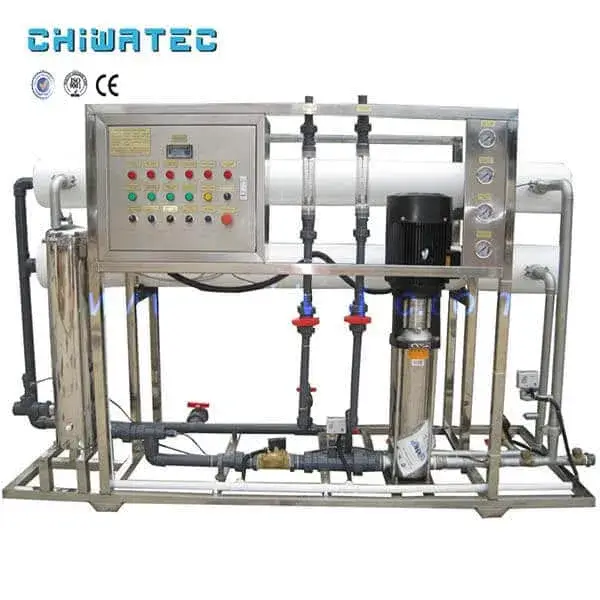
For advanced RO and pretreatment systems, explore CHIWATEC’s full product range:
👉 CHIWATEC Water Treatment Equipment & Solutions
FAQ
1. What causes fouling in RO desalination systems?
Common causes include iron, suspended solids, microorganisms, colloids, organic matter, and scaling from dissolved salts.
2. Why is UF pretreatment important for RO?
UF significantly reduces turbidity, SDI, and microbial load, preventing RO membrane fouling and improving system stability.
3. How does adjusting pH help with CO₂ removal?
Higher pH converts CO₂ into bicarbonate, which is more easily rejected by RO membranes.
4. What are the advantages of anti-fouling RO membranes?
They provide higher permeability, better surface smoothness, reduced clogging, and longer operating cycles between cleanings.
5. Why is balanced flux distribution important in multi-stage RO systems?
It prevents concentration polarization, improves salt rejection, and extends membrane life.
Xi’an CHIWATEC Water Treatment Technology is a high-tech enterprise specialized in various water processing devices. Aside from these individual products, which cover a number of types and series, we can also help with related comprehensive engineering projects. Thanks to our hard work and dedication upon our founding, we are now one of the fastest-developing water treatment equipment manufacturers in Western China.
Further reading:
- Fundamentals of Reverse Osmosis Technology
- Chiwatec RO Reverse Osmosis Equipment: Introduction to Reverse Osmosis Technology
- What is the importance of reverse osmosis technology
- Introduction of reverse osmosis water treatment system-reverse osmosis equipment, reverse osmosis technology, reverse osmosis pure water system
- What are the importance of reverse osmosis technology
FOLLOW US
Do you have a water treatment project we can help with
* Designing,machining,installing,commissioning, customize and one-stop service






 English
  Spanish
  Portuguese




