

RO System Technical Specifications: Reverse Osmosis Water Treatment System Design and Parameters 2026
Designing an efficient water treatment system requires a clear understanding of reverse osmosis system technical specifications — from production capacity and desalination rate to pretreatment configuration and control instrumentation. This guide presents a detailed 15m³/h reverse osmosis system technical specifications case study, covering equipment parameters, system design, and operational features for industrial water treatment applications. CHIWATEC specializes in custom RO system design and manufacturing for commercial and industrial clients worldwide.
Reverse Osmosis System Technical Specifications — Key Parameters Overview
The core reverse osmosis system technical specifications define the system’s production capacity, water quality, and operational efficiency. Below are the primary technical indicators for a standard 15m³/h industrial RO system:
| Parameter | Specification |
|---|---|
| Product Water Flow Rate | 15 m³/h |
| System Desalination Rate | ≥97% |
| Water Recovery Rate | 75% |
| Operating Power | 20 kW |
| Feed Water Requirement | 20 m³/h (including RO concentrate) |
| Membrane Type | Composite polyamide RO membrane elements |
| Control System | PLC automatic control with interlocking |
These reverse osmosis system technical specifications form the foundation for system sizing, equipment selection, and pretreatment design discussed in the following sections.
RO System Design: Pretreatment System Configuration
Pretreatment is critical to meeting reverse osmosis system technical specifications for membrane protection and long-term performance. For a 15m³/h RO system, the pretreatment system is designed to deliver 20 m³/h of treated feed water (accounting for the 75% recovery rate):
- Raw water pump: Boosts incoming water pressure to feed the pretreatment system
- Fine sand filter: Uses 0.3–0.5 mm fine-grained quartz sand media to remove suspended solids,泥沙, and rust particles
- Spun yarn cartridge filter: F2000mm filter housing, 30 m³/h filtration capacity, removes fine particulates down to 5–10 µm
- Scale inhibitor dosing: PTP-0100 high-efficiency antiscalant prevents Ca, Mg carbonate and sulfate scaling on membrane surfaces
Proper pretreatment ensures the feed water meets the SDI <5 requirement specified in the reverse osmosis system technical specifications.
Reverse Osmosis Desalination System Equipment
The RO desalination system is the core of any RO plant. The reverse osmosis system technical specifications for the desalination stage include:
| Component | Specification / Description |
|---|---|
| High-Pressure Feed Pump | Stainless steel multistage centrifugal pump, 10–15 bar operating pressure |
| Electric Slow-Opening Valve | Prevents water hammer during system start-up and shutdown |
| RO Membrane Elements | Composite polyamide TFC membranes, 15 m³/h total output |
| Membrane Pressure Vessels | FRP or stainless steel housing, arranged in series/parallel configuration |
| Concentrate Control Valve | Regulates recovery rate to maintain 75% target |
| Instrumentation Panel | Centralized flow meters, pressure gauges, conductivity meters (American SIGNET brand) |
The skid-mounted design integrates all components on a single frame for easy transport, installation, and maintenance.
Automatic Flushing and Control System for RO Systems
Modern reverse osmosis system technical specifications include automatic flushing to protect membranes from scaling during shutdown. When the system stops, the PLC opens the electric flushing drain valve, allowing low-pressure water to sweep across the membrane surface:
- Flushing action: Removes concentrated brine from the membrane surface
- Prevents scaling: Eliminates conditions for CaCO₃, CaSO₄, and silica precipitation
- Automatic sequence: Initiated by PLC upon system shutdown signal
- Duration: Typically 30–60 seconds or until flush water conductivity stabilizes
This automatic flushing feature is a standard requirement in reverse osmosis system technical specifications for industrial RO installations.
Instrumentation and Monitoring in Reverse Osmosis Systems
Comprehensive instrumentation is essential for tracking reverse osmosis system technical specifications during operation. The system is equipped with:
- Flow meters: Measure feed water, product water, and concentrate flow rates (SIGNET brand)
- Pressure gauges: Monitor feed pressure, interstage pressure, and concentrate pressure
- Conductivity meters: Real-time TDS monitoring of feed and product water
- pH sensor: Feed water pH monitoring for optimal membrane performance
- Temperature sensor: Feed water temperature compensation for accurate flow normalization
All instruments are centrally mounted on the system’s operation panel for convenient monitoring and maintenance. PLC-based control handles start-up, operation, monitoring, shutdown, and flushing operations through interlocked automatic sequences.
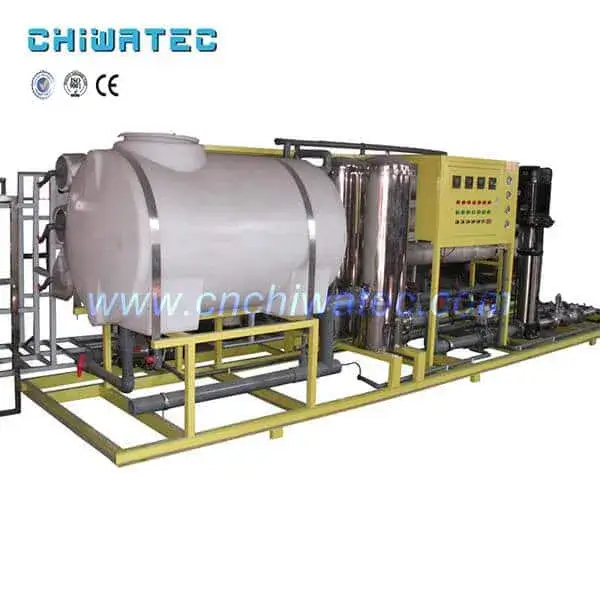
RO System Installation: Skid-Mounted Design Benefits
The reverse osmosis system technical specifications include physical design features that simplify deployment. All components are assembled on a single sliding skid frame:
- Compact footprint: Minimizes floor space requirements in industrial facilities
- Factory pre-assembled: Reduces on-site installation time and labor costs
- Pre-piped and pre-wired: All interconnections completed before shipping
- Easy transport: Standard container or flatbed truck compatible
- Quick commissioning: Connect feed, product, and drain lines to begin operation
Skid-mounted configuration is the preferred delivery method for industrial reverse osmosis system technical specifications requiring rapid deployment.
Comparing RO System Technical Specifications for Different Applications
Reverse osmosis system technical specifications vary significantly by application. Below is a comparison of typical parameters across common industrial RO applications:
| Application | Capacity (m³/h) | Desalination Rate | Recovery Rate | Pressure (bar) |
|---|---|---|---|---|
| Boiler Feed Water | 5–50 | 97–99% | 70–80% | 10–15 |
| Pharmaceutical / WFI | 1–20 | 99%+ | 65–75% | 12–17 |
| Food & Beverage | 5–30 | 95–98% | 70–80% | 10–15 |
| Electronics Rinsing | 10–100 | 99%+ | 70–85% | 10–15 |
| Seawater Desalination | 1–1000+ | 99–99.8% | 40–50% | 55–70 |
Understanding how reverse osmosis system technical specifications scale across applications helps in selecting the right system for your specific water quality needs and budget.
Frequently Asked Questions
Q1: What are the standard reverse osmosis system technical specifications for a 15m³/h RO system?
Standard reverse osmosis system technical specifications for a 15m³/h system include: 20 kW operating power, ≥97% desalination rate, 75% water recovery, PLC automatic control, and a skid-mounted design with centralized instrumentation.
Q2: How much feed water is needed for a RO system with 75% recovery?
At 75% recovery, a 15m³/h RO system requires approximately 20 m³/h of feed water. The remaining 5 m³/h becomes concentrate (brine) that must be properly discharged or treated. This feed-to-product ratio is a key reverse osmosis system technical specification.
Q3: What pretreatment is required to meet RO system technical specifications?
Typical pretreatment includes: raw water pump, fine sand filter (0.3–0.5 mm quartz sand), cartridge filter (5–10 µm), and antiscalant dosing. The goal is to achieve SDI <5 and free chlorine <0.1 ppm at the RO membrane inlet.
Q4: How are RO systems controlled automatically?
Industrial RO systems use PLC-based control with interlocking logic for start-up, operation, monitoring, shutdown, and automatic flushing. The system sensors (flow, pressure, conductivity) provide real-time feedback for maintaining reverse osmosis system technical specifications.
Q5: What is the lifespan of an industrial RO system?
With proper operation and maintenance, an industrial RO system designed to standard reverse osmosis system technical specifications has a 15–20 year equipment lifespan. RO membrane elements typically require replacement every 3–5 years depending on feed water quality and cleaning frequency.
Conclusion & Call to Action
Understanding reverse osmosis system technical specifications is essential for designing, procuring, and operating a reliable water treatment system. From key parameters like production rate and desalination percentage to pretreatment configuration and automatic control features, every specification directly impacts system performance and total cost of ownership. Whether you need a standard 15m³/h system or a custom design for a specialized application, CHIWATEC provides engineering support and turnkey solutions tailored to your requirements. Contact us at [email protected] or [email protected] for a free consultation and customized reverse osmosis system technical specifications proposal.
Do you have a water treatment project we can help with
* Designing,machining,installing,commissioning, customize and one-stop service






 English
  Spanish
  Portuguese




