Activated Carbon Filter vs Activated Sand Filter: Complete Comparison Guide 2026
Choosing between activated carbon and activated sand filters for your water treatment system? This comprehensive comparison guide covers the key differences between these two essential filtration technologies — from working principles and adsorption mechanisms to application suitability, operational costs, and maintenance requirements. Featuring detailed performance data and selection criteria for 2026.
*Last Updated: May 2026 | Industry-Verified Technical Data*
Why This Guide Matters
The global water filtration equipment market was valued at approximately USD 42.5 billion in 2024 and is projected to reach USD 71.3 billion by 2033, growing at a CAGR of 5.9%. Activated carbon filters and activated sand filters represent two of the most widely deployed pretreatment technologies, used in over 80% of municipal and industrial water treatment systems worldwide. CHIWATEC engineers both types of filtration systems and understands the critical importance of selecting the right technology for specific water quality challenges. This guide provides a detailed comparison to help water treatment professionals make informed decisions based on their specific application requirements.
Key Industry Trends (2026 Update)
- Dual-media filtration adoption — Combined activated carbon and sand filter systems now account for 35% of new pretreatment installations in 2025-2026, leveraging the complementary strengths of both media types for superior water quality.
- Automatic backwash optimization — Smart filtration systems with IoT-enabled backwash scheduling based on differential pressure monitoring have reduced backwash water consumption by 25-40% in activated sand filter installations.
- Activated carbon regeneration economics — On-site thermal regeneration of spent activated carbon has become economically viable for facilities processing over 500 m3/day, reducing media replacement costs by 60-70% compared to virgin carbon purchases.
- Stringent chlorine removal requirements — Updated RO membrane protection guidelines (2024-2025) emphasize residual chlorine reduction below 0.1 ppm, driving increased adoption of catalytic activated carbon grades with 3-5x higher chlorine removal kinetics than standard GAC.
1. What Is an Activated Carbon Filter and How Does It Work?
Construction and Media Characteristics
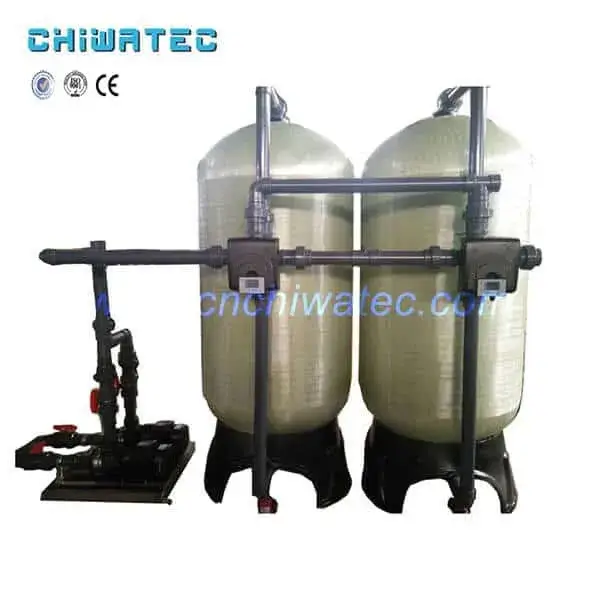
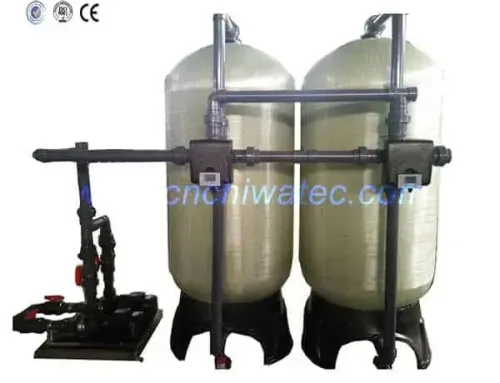
The activated carbon filter pressure vessel is a pressure vessel filled with a coarse quartz sand cushion layer and high-quality activated carbon media. The activated carbon particles that make up the carbon bed contain numerous micropores and an enormous specific surface area, typically 500-1500 m2 per gram, giving them strong physical adsorption capacity. Water passes through the carbon bed, where organic pollutants are effectively adsorbed onto the activated carbon surface through van der Waals forces and chemical bonding.
Primary Functions in Water Treatment
In the water pretreatment system, the activated carbon filter serves several critical functions. It absorbs residual chlorine that cannot be removed in previous stage filtration, preventing downstream reverse osmosis membranes from being oxidized and degraded (RO membranes are extremely sensitive to chlorine, with maximum exposure limits of 0.1 ppm for polyamide thin-film composite membranes). Simultaneously, it adsorbs small molecular organics, volatile organic compounds (VOCs), and disinfection by-products leaked from upstream processes. The activated carbon filter also provides significant removal of odors, colloids, pigments, heavy metal ions, and COD (chemical oxygen demand). A properly designed activated carbon filter can reduce the SDI (Silt Density Index) of RO influent to below 5 and TOC (Total Organic Carbon) to below 2.0 ppm.
Key Operating Parameters
The main factors affecting the adsorption effect and service life of the activated carbon filter include: the type and concentration of pollutants in the feed water, the empty bed contact time (EBCT, typically 5-15 minutes for water treatment applications), the temperature and pH of the water, and the type and grade of activated carbon selected. In practical selection, the filter type and activated carbon grade should be determined according to specific pollutant types, concentrations, and flow rates. Activated carbon filter for water treatment: complete guide provides detailed design parameters and selection criteria.
2. What Is an Activated Sand Filter and How Does It Work?
Continuous Filtration Principle
The activated sand filter is a continuous filtration equipment that integrates coagulation, clarification, and filtration based on countercurrent principles. Influent water enters the treatment system through a water distribution pipe at the bottom of the equipment, flows upward through the sand bed, and overflows from the top outlet after complete filtration. The sand bed traps suspended solids and particulate matter throughout its depth, providing depth filtration rather than just surface straining.
Self-Cleaning Mechanism
The impurities trapped in the sand bed during filtration are continuously transported by aerodynamic force to the sand washer located at the top of the filter tank. Here, contaminants are separated from the filter sand surface through mechanical friction and turbulent action. The impurities are discharged with the sand washing water, while the cleaned sand returns to the sand bed by its own weight. This continuous cleaning cycle allows the activated sand filter to operate 24 hours a day without the need to stop for conventional backwash cycles. The quartz sand filter material is the only moving part during operation, contributing to exceptionally low failure rates and maintenance costs.
3. What Are the Key Performance Advantages of Activated Sand Filters?
Operational Benefits
Activated sand filters offer several distinctive advantages: (1) 24-hour continuous operation — no need to stop for backwashing, making them ideal for critical water supply applications; (2) low operating costs — no high-lift, high-flow backwash pumps required, reducing energy consumption by 40-60% compared to conventional sand filters; (3) minimal maintenance — no rotating parts except the quartz sand media, resulting in low failure rates; (4) low head loss — total head loss of 0.5 meters or less, compared to 2-5 meters for conventional media filters.
Water Quality and Flexibility
Continuous sand filters accept loose influent water quality requirements, tolerating up to 150 mg/L suspended solids (SS) for long-term operation and up to 300 mg/L SS for short-term shock loads without compromising effluent quality. The effluent quality remains stable because the filter media is continuously cleaned, preventing the periodic water quality fluctuations common in conventional batch-backwash filters. Additionally, the continuous filter system eliminates the need for separate coagulation tanks, clarification tanks, backwash pumps, and electric/pneumatic valve systems, reducing one-time investment by 30-50% and saving approximately 70-80% of the land area compared to traditional three-stage treatment processes. Practical application of activated carbon in water treatment provides real-world performance data for combined filtration systems.
4. How Does Filtration Mechanism Differ Between Activated Carbon and Sand Filters?
Activated Carbon: Adsorption-Driven Filtration
Activated carbon filters rely primarily on adsorption — the adhesion of molecules to the surface of the carbon media. The extensive micropore structure of activated carbon creates a large surface area (500-1500 m2/g) that attracts and retains organic molecules, chlorine, and other dissolved contaminants. In addition to physical adsorption, the oxygen-containing functional groups on the non-crystalline portion of the activated carbon surface enable chemisorption of specific pollutants, including some heavy metals and polar organic compounds.
Activated Sand: Mechanical Straining and Coagulation
Activated sand filters operate primarily through depth filtration — mechanical straining and physical entrapment of suspended particles within the sand bed. The sand media also provides surface area for coagulation reactions when coagulants are dosed upstream. Unlike carbon filtration, sand filtration does not remove dissolved contaminants, chlorine, or organic molecules. Understanding these fundamental mechanism differences is essential for proper filter selection: carbon filters target dissolved contaminants, while sand filters target suspended solids. What is the difference between activated carbon fiber and activated carbon provides additional perspective on how different carbon-based media compare.
5. What Is the Typical Configuration for Activated Carbon Filters?
Pre-Filtration Requirements
For optimal activated carbon filter performance, dust removal filters should be installed both upstream and downstream of the carbon bed. The upstream filter prevents dust and particulate matter from clogging the activated carbon media, preserving its adsorption capacity for target contaminants. The downstream filter blocks carbon fines (dust generated by the activated carbon itself through attrition and handling) from entering downstream equipment. Both filters should have efficiency ratings of F7 or higher according to EN 779 standards, corresponding to minimum efficiency reporting values (MERV) of 13-14.
Carbon Bed Design Considerations
Activated carbon filters should be designed with proper bed depth (typically 1.2-2.4 meters), adequate empty bed contact time (5-15 minutes for water treatment), and appropriate media size (8×30 or 12×40 mesh for typical water treatment applications). The support bed beneath the carbon layer consists of graded quartz sand or gravel ranging from 2-3 mm at the top to 15-25 mm at the bottom, providing uniform flow distribution and preventing carbon media loss during backwash. Classifications of activated carbon filter in water purifier filter elements explains how different carbon media grades affect filtration performance.
6. What Maintenance Requirements Apply to Each Filter Type?
Activated Carbon Filter Maintenance
Activated carbon filter maintenance involves periodic backwashing (typically every 24-72 hours depending on suspended solids loading), carbon media replacement (every 12-24 months depending on organic loading and chlorine exposure), and regular inspection of underdrain systems. The backwash flow rate should be sufficient to expand the carbon bed by 20-30% (typically 8-15 gpm/ft2), effectively removing trapped particles and carbon fines while preventing media loss.
Activated Sand Filter Maintenance
Continuous activated sand filters require significantly less routine maintenance due to their self-cleaning design. The primary maintenance tasks are: periodic inspection of the air lift system that transports sand to the top washer, verification of sand washer operation, and annual sand media replenishment (typically replacing 5-10% of the bed volume lost through normal attrition during the cleaning cycle). The sand media itself has an indefinite lifespan, unlike activated carbon which requires periodic replacement. Standard analysis for buying activated carbon provides quality parameters for carbon procurement and replacement scheduling.
7. Which Applications Are Best Suited for Each Filter Type?
Activated Carbon Filter Applications
Activated carbon filters are the preferred choice for: (1) RO membrane pretreatment — chlorine removal and organic fouling reduction to protect polyamide membranes, (2) drinking water treatment — removal of taste, odor, color, and disinfection by-products, (3) industrial process water — TOC reduction and removal of organic contaminants that could affect downstream processes, (4) pharmaceutical water systems — ensuring feed water quality for USP purified water and WFI systems, and (5) food and beverage production — decolorization and dechlorination for product quality assurance.
Activated Sand Filter Applications
Continuous activated sand filters excel in: (1) municipal wastewater tertiary treatment — polishing secondary effluent to meet discharge standards, (2) industrial process water — removal of high suspended solids loads upstream of finer filtration, (3) cooling tower sidestream filtration — continuous solids removal without system shutdown, (4) groundwater iron and manganese removal — when combined with oxidation pretreatment, and (5) RO pretreatment for high-SS source waters — reducing SDI to acceptable levels for membrane systems. How activated carbon reduces turbidity and color of water provides additional context on organic removal performance in specific applications.
8. How Do Operating Costs Compare Between the Two Technologies?
Cost Comparison Table
Cost Factor — Activated Carbon Filter — Continuous Sand Filter
Media replacement cost — USD 1,500-4,000 per m3 (every 1-2 years) — USD 100-300 per m3 (replenishment only)
Energy consumption — 0.05-0.15 kWh/m3 (backwash pumps) — 0.03-0.08 kWh/m3 (air lift system)
Backwash water loss — 3-8% of throughput — 1-3% of throughput (continuous cleaning)
Chemical consumption — None for normal operation — Coagulant optional
Labor requirement — 2-4 hours per week — 1-2 hours per week
Annual maintenance cost (per 100 m3/h) — USD 8,000-15,000 — USD 3,000-6,000
Total Cost of Ownership Considerations
While activated sand filters offer lower ongoing operating costs, the activated carbon filter provides unique adsorption capabilities that sand filters simply cannot match. For applications requiring organic contaminant removal, chlorine dechlorination, or taste and odor control, the added cost of activated carbon media replacement is justified by the specific treatment function. For applications primarily concerned with suspended solids removal, continuous sand filters offer superior economics.
9. Can Activated Carbon and Sand Filters Be Used Together?
Optimal Treatment Train Configuration
In many water treatment applications, activated carbon and sand filters are not competing technologies but complementary partners in an optimized treatment train. A typical sequence places the sand filter upstream of the activated carbon filter: raw water first passes through the sand filter for suspended solids removal (reducing the particle loading on the carbon bed), then flows to the activated carbon filter for organic contaminant and chlorine removal. This configuration maximizes the service life of the activated carbon media by preventing premature fouling from particulate matter.
Combined Filter Advantages
Installing both filter types in series provides: longer carbon media life (2-3x longer before replacement due to reduced solids loading), more consistent effluent quality across varying raw water conditions, and enhanced protection for downstream reverse osmosis membranes (both particulate and organic/chlorine protection). For applications where space or budget constraints prevent separate vessels, dual-media filters with a sand layer overlaying a carbon layer offer a compact alternative, though with less operator flexibility for independent media management. CHIWATEC provides complete multi-stage filtration system designs incorporating both technologies for optimized water treatment performance.
10. How to Choose Between Activated Carbon and Sand Filters for Your Application?
Decision Framework
Use the following decision criteria: (1) Target contaminant — dissolved organics, chlorine, taste/odor → carbon filter; suspended solids, turbidity → sand filter; (2) Effluent quality requirement — TOC below 2 ppm AND SDI below 5 → carbon filter; SDI below 5 alone → sand filter; (3) Flow rate — above 500 m3/day → consider continuous sand filter for lower operating costs; below 100 m3/day → conventional carbon filter more economical; (4) Operating philosophy — continuous 24/7 operation with minimal attention → continuous sand filter; periodic batch operation with conventional backwash → carbon filter; (5) Downstream process — preceding RO membranes → carbon filter required for chlorine removal; preceding UF membranes → sand filter sufficient for particulate protection.
Selection Summary Matrix
Application Scenario — Recommended Filter — Key Reason
RO pretreatment with chlorine present — Activated carbon — Chlorine removal essential
Municipal wastewater polishing — Continuous sand — High SS tolerance, continuous operation
Drinking water taste/odor control — Activated carbon — Organic removal capability
Industrial cooling tower filtration — Continuous sand — Low head loss, continuous operation
Pharmaceutical water pretreatment — Activated carbon — TOC reduction required
Groundwater iron removal — Continuous sand — Continuous oxidation/filtration
Combined organics + SS removal — Both in series — Complementary protection
Compact single-vessel solution — Dual-media (sand/carbon) — Space optimization
Conclusion
Activated carbon filters and activated sand filters serve fundamentally different but complementary roles in water treatment. Activated carbon filters excel at removing dissolved organic contaminants, chlorine, and improving taste and odor through adsorption, making them essential for RO membrane pretreatment and drinking water polishing. Continuous activated sand filters offer superior suspended solids removal with lower operating costs and continuous self-cleaning operation, making them ideal for high-SS applications and continuous-process industries. The optimal choice depends on specific water quality challenges, effluent requirements, and operational priorities — and in many cases, the best solution incorporates both technologies in a well-designed treatment train. Contact CHIWATEC today to discuss your filtration requirements. Our engineering team specializes in designing optimized multi-stage filtration systems for municipal and industrial applications. Reach us at [email protected] or [email protected], or via WhatsApp at 008618292684865.
Frequently Asked Questions
Q1: What is the main difference between activated carbon and sand filters?
The main difference is their filtration mechanism. Activated carbon filters remove dissolved contaminants (chlorine, organics, VOCs) through adsorption onto porous carbon media, while sand filters remove suspended solids and turbidity through physical straining and depth filtration within the sand bed. Carbon filters target chemical contaminants; sand filters target physical contaminants.
Q2: Can a sand filter replace an activated carbon filter?
No. A sand filter cannot replace an activated carbon filter for dissolved contaminant removal. Sand filters do not remove chlorine, organic compounds, taste, or odor — these require the adsorption capability of activated carbon. Conversely, an activated carbon filter is less effective than a sand filter for high suspended solids removal.
Q3: How often should activated carbon media be replaced?
Activated carbon media typically requires replacement every 12-24 months depending on feed water quality, organic loading rate, and chlorine exposure. Indicators that replacement is needed include: chlorine breakthrough detected in effluent, TOC removal efficiency dropping below 50%, or increased pressure drop across the bed beyond design limits.
Q4: What is the advantage of continuous sand filters over conventional sand filters?
Continuous sand filters operate without interruption — they clean themselves while filtering, eliminating backwash downtime and the need for duplicate vessels. This results in 24/7 operation, lower head loss (below 0.5 m), reduced energy consumption (no backwash pumps), and stable effluent quality without the quality fluctuations typical of batch-backwash filters.
Q5: What is the recommended sequence when using both filters together?
The recommended configuration is sand filter first, followed by activated carbon filter. The sand filter removes suspended solids and reduces the particle load on the carbon filter, extending carbon media life by 2-3 times. This sequence also protects the carbon bed from premature fouling by particulate matter that would otherwise occupy adsorption sites.
Related Resources and Further Reading
- What is the difference between activated carbon fiber and activated carbon?
- Activated carbon filter: complete guide to use, working principles, and maintenance
- Practical application of activated carbon in water treatment
- Activated carbon filter for water treatment: complete guide
- Activated carbon for water filters — CHIWATEC media products
Do you have a water treatment project we can help with
* Designing,machining,installing,commissioning, customize and one-stop service
 English
  Spanish
  Portuguese