

2026 Complete Guide to Natural Mineral Water Filter Media: Technical Characteristics, Applications, and Benefits
Looking for a long-lasting, cost-effective water filtration media that outperforms conventional options? Natural mineral water filter media — derived from modified zeolite and other aluminosilicate minerals — has been used in water treatment for over 60 years, with modern activated grades offering fluoride removal efficiency exceeding 95% and filter media service life surpassing 30 years. Here is the direct answer: natural mineral water filter media is a zeolite-based filtration material processed through modification and activation treatment to create a unique pore structure with specific surface area of 500-1,000 m²/g, enabling superior ion exchange, adsorption selectivity, and catalytic properties for removing fluoride, heavy metals, turbidity, and organic contaminants from drinking water and industrial process water. CHIWATEC supplies high-grade natural mineral filter media for municipal water plants, residential water purifiers, and industrial wastewater treatment applications worldwide.
What Is Natural Mineral Water Filter Media?
Natural mineral water filter media is a modified aluminosilicate material derived from natural zeolite minerals — primarily clinoptilolite, mordenite, and chabazite. These minerals possess a unique crystalline structure composed of silicon-oxygen (SiO₄) and aluminum-oxygen (AlO₄) tetrahedra arranged in a three-dimensional honeycomb framework with cavities and channels that account for more than 50% of the total crystal volume.
The key differentiator of natural mineral water filter media from conventional filtration materials lies in its modification and activation treatment. Through controlled thermal, chemical, or acid activation processes, the pore structure is optimized and the specific surface area is increased to 500-1,000 m²/g — comparable to premium activated carbon. This treatment also creates active aluminum sites within the zeolite framework that serve as excellent carriers for fluoride and heavy metal adsorption. The characteristics of activated carbon provide an instructive comparison, as both materials rely on high surface area and porous structure for adsorption, though natural mineral media offers superior selectivity for ionic contaminants.
Key Technical Characteristics of Natural Mineral Water Filter Media
The unique properties of natural mineral water filter media derive from its modified crystalline structure and surface chemistry:
- Superior fluoride removal efficiency: The modified zeolite structure contains activated aluminum sites that selectively bind fluoride ions (F–) through ligand exchange. Effluent fluoride levels consistently meet WHO and national drinking water standards (below 1.5 mg/L), with reduction rates of 85-98% from initial fluoride concentrations of 3-10 mg/L.
- Extremely low operating cost: At USD 0.03-0.05 per cubic meter (0.2-0.3 yuan/ton), the operating cost is 60-80% lower than activated carbon filtration and 80-90% lower than ion exchange or RO-based defluoridation, making it the most economical choice for fluoride-affected communities.
- Exceptional service life exceeding 30 years: Unlike activated carbon that requires replacement every 1-3 years, natural mineral filter media does not degrade, harden, or lose structural integrity over decades of continuous use. The media can be periodically backwashed to remove trapped solids and restore flow capacity.
- Simple operation with minimal maintenance: No chemical dosing pumps, regeneration cycles, or complex control systems are required. Standard operation involves only periodic backwashing (5-15 minutes daily at 8-15 L/s/m²) to remove accumulated suspended solids.
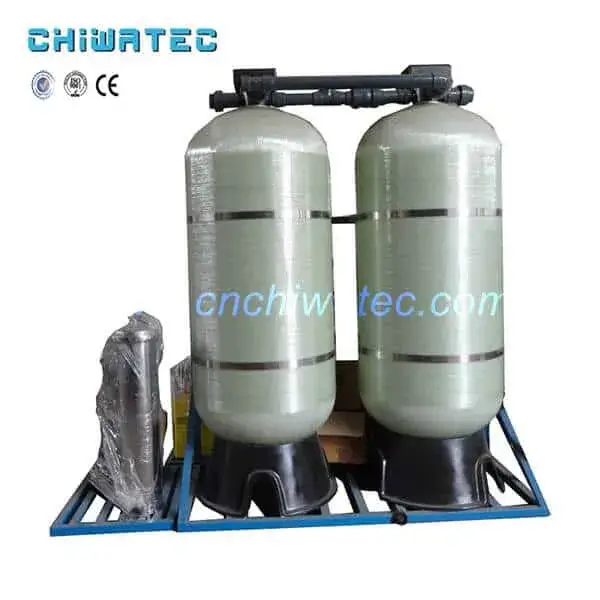
- Scalable treatment capacity: Systems can be designed for flow rates from 0.5 m³/h (household point-of-entry) to 5,000 m³/h (municipal water treatment plants) using standard pressure or gravity filter vessel configurations.
- Multi-contaminant removal: In addition to fluoride, the media effectively removes arsenic (80-95%), iron (90-99%), manganese (85-95%), aluminum (90-98%), turbidity (85-95% reduction), and various organic substances that exceed drinking water standards.
The definition and physical properties of activated carbon provide a useful reference point for understanding how natural mineral media compares to the most widely used adsorption material.
Fluoride Removal Mechanism and Performance
Fluoride removal is the primary application of natural mineral water filter media, and understanding the mechanism is essential for proper system design:
- Adsorption mechanism: Fluoride ions (F–) form strong coordination bonds with activated aluminum (Al3+) sites on the modified zeolite surface. The reaction follows the Langmuir isotherm model with a maximum adsorption capacity of 2-5 mg F–/g of media at pH 5.5-7.0.
- pH dependency: Optimal fluoride removal occurs at pH 5.5-7.0, where the aluminum sites are positively charged and electrostatically attract fluoride anions. Below pH 4.5, aluminum may leach from the structure; above pH 8.0, hydroxide ions compete with fluoride for binding sites.
- Competing ions: Bicarbonate (HCO₃–), silica (SiO₃2-), and phosphate (PO₄3-) ions can reduce fluoride removal efficiency by 10-30%. Pre-treatment with weak acid cation exchange or pH adjustment can mitigate these effects in challenging water matrices.
- Field performance: Treatment plants in fluoride-affected regions of China, India, and East Africa consistently achieve effluent fluoride below 1.0 mg/L from feed concentrations of 3-8 mg/L, with contact times of 10-20 minutes and linear flow velocities of 5-15 m/h.
Application Range of Natural Mineral Water Purification Filter Media
The versatility of natural mineral water filter media makes it suitable for diverse applications across municipal, residential, and industrial sectors:
- Municipal water treatment plants: Installed in rapid gravity filters or pressure vessels, the media serves as the primary filtration and defluoridation stage. Typical design: 1,000-5,000 mm bed depth, 5-10 m/h filtration rate, and 24-48 hour service cycle between backwashes. The standard analysis for buying activated carbon provides comparable media specification criteria for municipal buyers.
- Household water purifiers: Small-form-factor cartridges (10-20 cm bed depth, 2-5 L/min flow rate) for under-sink and countertop systems, particularly in fluoride-affected rural areas where reverse osmosis is cost-prohibitive. Operating cost as low as USD 0.02-0.05 per household per day.
- Community water stations: Self-contained filtration units serving 50-500 households in rural towns, villages, and peri-urban communities. Treatment cost of USD 0.03-0.08 per cubic meter makes community-scale defluoridation economically viable.
- Industrial process water: Used in the pharmaceutical, beverage, food processing, and brewing industries for water quality improvement where ionic and organic contaminants must be controlled without adding chemicals or generating wastewater.
- Power plant and boiler feed water: Integrated as a pre-treatment stage for water softening before ion exchange or RO. Effective removal of hardness-forming ions, iron, and manganese reduces downstream membrane fouling by 40-60%.
- RO and EDI pretreatment: Natural mineral media serves as an efficient pre-filter for reverse osmosis, electrodialysis, and electrodeionization systems, removing fouling precursors and extending membrane life by 12-24 months.
- Swimming pool and recreational water: Used in recirculation filtration for swimming pools, baths, hotels, and resorts. The media effectively removes chloramines, organic contaminants, and turbidity at filter rates of 10-20 m/h.
- Wastewater treatment: Applied in polishing stages for domestic sewage and industrial wastewater, removing residual fluoride, heavy metals, and color bodies to meet discharge standards.
Natural Mineral Media vs. Activated Carbon: A Technical Comparison
While both natural mineral water filter media and activated carbon are filtration materials, they serve complementary rather than competing roles:
| Parameter | Natural Mineral Media | Activated Carbon |
|---|---|---|
| Primary mechanism | Ion exchange + adsorption | Physical adsorption |
| Surface area | 500-1,000 m²/g | 800-1,200 m²/g |
| Target contaminants | Fluoride, arsenic, heavy metals | Chlorine, VOCs, organics, odor |
| Service life | 30+ years | 1-3 years |
| Operating cost | USD 0.03-0.05/m³ | USD 0.08-0.15/m³ |
| Regeneration | Not required | Thermal/chemical regeneration |
| pH sensitivity | Optimal 5.5-7.0 | Broad (3-11) |
The practical application of activated carbon in water treatment provides additional operational context for comparing these two media types across various treatment scenarios.
Frequently Asked Questions
Q1: How does natural mineral water filter media remove fluoride from water?
Fluoride removal occurs through ligand exchange between fluoride ions (F–) and hydroxyl groups (OH–) on activated aluminum sites within the modified zeolite crystal structure. The adsorption capacity is 2-5 mg F–/g media, with optimal performance at pH 5.5-7.0 and contact time of 10-20 minutes. Unlike ion exchange resins, the media does not require chemical regeneration — it is a single-pass adsorption process that gradually saturates over 2-5 years of operation.
Q2: Is natural mineral water filter media better than activated carbon?
The materials serve different purposes. Natural mineral media is superior for ionic contaminant removal (fluoride, arsenic, heavy metals) and offers a 10-30 times longer service life at 50-70% lower operating cost. Activated carbon is better for organic contaminant removal (chlorine, VOCs, pesticides, taste and odor compounds). In many treatment systems, both media are used in series — for example, activated carbon upstream removes chlorine and organics, while natural mineral media downstream polishes ionic contaminants.
Q3: Can natural mineral filter media be cleaned or regenerated?
Physical cleaning via backwashing (8-15 L/s/m² for 5-15 minutes) removes accumulated suspended solids and restores hydraulic capacity. However, chemical regeneration of exhausted fluoride adsorption sites is not economically practical for natural mineral media. Instead, the media acts as a single-use adsorption medium with an exceptionally long service life of 30+ years — the fluoride capacity gradually saturates over decades of operation, at which point the media is replaced.
Q4: What is the typical installation cost for a natural mineral filter system?
Installation costs vary by scale: household systems (under-sink cartridge) cost USD 50-200, community water stations (1-10 m³/h) cost USD 2,000-20,000, and municipal treatment plants (100-5,000 m³/h) cost USD 50,000-500,000. The media itself costs USD 300-800 per cubic meter, significantly less than activated carbon at USD 800-2,500 per cubic meter, contributing to the lower capital cost of mineral media systems.
Q5: What water quality parameters affect natural mineral media performance?
The primary performance-affecting parameters are: pH (optimum 5.5-7.0, efficiency drops 30-50% outside this range), competing anions (bicarbonate, silica, phosphate reduce fluoride capacity by 10-30%), turbidity (above 10 NTU requires pre-filtration to prevent media fouling), iron and manganese (above 0.5 mg/L can precipitate and coat media surfaces), and temperature (adsorption kinetics improve by 2-5% per 5°C increase up to 35°C).
Conclusion & CTA
Natural mineral water filter media offers a uniquely cost-effective, long-lasting solution for fluoride removal and multi-contaminant polishing across a wide range of applications — from household under-sink filters to municipal water treatment plants. With a service life exceeding 30 years, operating costs of just USD 0.03-0.05 per cubic meter, and excellent removal of fluoride (85-98%), arsenic (80-95%), and heavy metals, it represents the most economical choice for communities and industries facing ionic contamination challenges.
Contact CHIWATEC today at [email protected] or [email protected] (WhatsApp available) for technical consultation on selecting and specifying natural mineral filter media for your water treatment application.
Related Resources and Further Reading
- Standard Analysis for Buying Activated Carbon — Media specification criteria for procurement professionals
- Characteristics of Activated Carbon — Comparative understanding of filtration media properties
- Practical Application of Activated Carbon in Water Treatment — Operational best practices for adsorption media
- Activated Carbon Quality Specifications — Quality standards for filtration media procurement
- Mechanical Filtration Equipment — CHIWATEC filter vessels and media systems for water treatment
Do you have a water treatment project we can help with
* Designing,machining,installing,commissioning, customize and one-stop service






 English
  Spanish
  Portuguese




