

Activated Carbon Definition and Physical Properties: Complete Guide 2026
Activated carbon is a highly porous carbonaceous material with an extraordinarily large surface area (500–1,700 m²/g), making it one of the most effective adsorbents for water treatment, air purification, and industrial separation processes. Understanding the activated carbon definition and properties — its physical structure, pore distribution, adsorption mechanisms, and manufacturing methods — is essential for engineers and operators designing filtration systems for municipal water, wastewater, and industrial gas treatment applications.
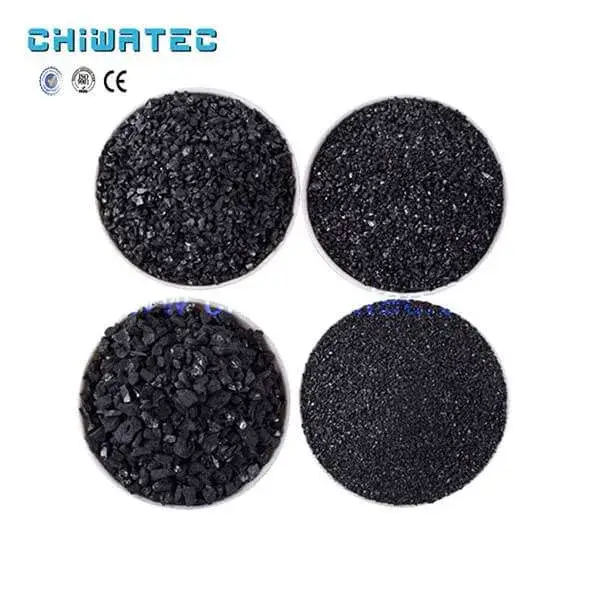
Activated Carbon Definition and Properties: Basic Composition and Structure
Activated carbon is a black, amorphous carbon material available in powder, granular, and pelletized forms. Its main component is elemental carbon, with small amounts of oxygen, hydrogen, sulfur, nitrogen, and chlorine. The carbon atoms are arranged in a microcrystalline structure similar to graphite, but the crystal grains are small and the hexagonal carbon layers are stacked irregularly — creating a highly disordered structure with extensive internal porosity.
| Property | Typical Value |
| Specific surface area (BET) | 500–1,700 m²/g |
| Pore volume | 0.5–1.5 cm³/g |
| Bulk density | 0.3–0.6 g/cm³ |
| Iodine number | 600–1,200 mg/g |
| Methylene blue adsorption | 100–300 mg/g |
| Ash content | 2–15% |
| Moisture content (as packed) | <5% |
Pore Structure and Classification
The unique adsorption power of activated carbon arises from its complex pore structure. According to IUPAC classification, pores are categorized by diameter:
- Micropores (< 2 nm, radius < 20 Å) — Account for 90–95% of the total surface area. These pores are responsible for the majority of adsorption of small-molecule contaminants (chlorine, VOC, taste/odor compounds). Micropore volume: 0.2–0.6 cm³/g
- Mesopores (transition pores) (2–50 nm, radius 20–1000 Å) — Serve as transport channels for molecules to reach micropores and adsorb larger molecules (color bodies, humic acids). Mesopore volume: 0.05–0.3 cm³/g
- Macropores (> 50 nm, radius 1000–100,000 Å) — Primarily function as entry ports for the adsorbate to reach the interior pore network. Macroporous structure contributes minimal surface area but is critical for adsorption kinetics
Every gram of activated carbon contains an internal surface area equivalent to 1,000 m² — roughly the area of a football field compressed into a single gram of material.
Adsorption Mechanism and Selectivity
Activated carbon adsorbs contaminants through two primary mechanisms: physical adsorption (van der Waals forces) and chemical adsorption (surface functional group reactions). Key characteristics of activated carbon adsorption include:
- Non-polar preference — Non-polar substances are more readily adsorbed than polar substances. This makes activated carbon exceptionally effective for removing organic compounds, chlorine, and volatile organic compounds (VOCs) from water
- Boiling point correlation — Within the same chemical series, higher-boiling-point compounds adsorb more strongly
- Pressure and temperature effects — Higher pressure increases adsorption capacity; higher temperature promotes desorption. This principle is exploited in thermal regeneration processes where spent carbon is heated to 800–900°C to release adsorbed contaminants and restore adsorption capacity
- Concentration dependence — Higher influent concentration increases the mass transfer driving force, resulting in greater adsorption per unit mass of carbon (Freundlich and Langmuir isotherm models)
Activated Carbon Production Methods
Activated carbon is manufactured from carbonaceous raw materials — wood, coconut shells, nut shells, coal, peat, or petroleum coke — through two main processes:
Steam and Gas Activation (Physical Activation)
The raw material is first carbonized (pyrolyzed) at 400–600°C in an oxygen-free atmosphere, then activated at 850–950°C using steam (H₂O) or carbon dioxide (CO₂). The activating gas reacts with the carbon skeleton, creating micropores by selectively gasifying carbon atoms. Steam activation produces a wider pore size distribution suitable for liquid-phase applications, while CO₂ activation creates finer micropores preferred for gas-phase adsorption.
Chemical Activation
The raw material is impregnated with a chemical activator (phosphoric acid H₃PO₄, zinc chloride ZnCl₂, or potassium hydroxide KOH) and heated to 450–900°C in an inert atmosphere. The activator promotes dehydration and cross-linking reactions that create porosity. Chemical activation typically produces higher yields (30–50% vs 20–30% for physical activation) and is preferred for producing activated carbon with very high surface areas (>2,000 m²/g) for supercapacitor and specialty applications.
Activated Carbon Definition and Properties: Physical Characteristics
For industrial applications, activated carbon must meet specific physical quality criteria beyond adsorption capacity:
- Mechanical strength — Hardness (ball-pan abrasion resistance) of 90–99% is required to withstand backwashing, pneumatic conveying, and handling without generating excessive fines
- Abrasion number — Measures resistance to attrition during service. Minimum 85% for granular activated carbon (GAC) used in fixed-bed filters
- Particle size distribution — Critical for pressure drop and mass transfer kinetics. Typical GAC sizes: 8×20 mesh, 12×40 mesh, 20×50 mesh (US sieve series)
- Structural stability — The microcrystalline carbon structure must remain stable through repeated adsorption-desorption cycles. Low structural stability leads to pore collapse and irreversible capacity loss
Additionally, adsorption energy should be minimized to facilitate easy regeneration — thermal regeneration at 800–950°C or chemical regeneration with acid/base solutions can restore 90–95% of the original adsorption capacity.
Frequently Asked Questions
What is activated carbon?
Activated carbon is a highly porous carbonaceous material with a surface area of 500–1,700 m²/g, produced by heating carbon-rich raw materials (coal, coconut shells, wood) under controlled conditions to create an extensive internal pore network. It is used for adsorption of contaminants from water, air, and industrial process streams.
What are the physical properties of activated carbon?
Key physical properties include: specific surface area (500–1,700 m²/g), pore volume (0.5–1.5 cm³/g), bulk density (0.3–0.6 g/cm³), particle size distribution, mechanical hardness (90–99%), ash content (2–15%), and moisture content (<5%). The pore structure is classified into micropores, mesopores, and macropores.
How does activated carbon adsorb contaminants?
Activated carbon adsorbs contaminants through physical adsorption (van der Waals forces attracting molecules to the carbon surface) and chemical adsorption (chemical bonding with surface functional groups). Non-polar and higher-boiling-point compounds are preferentially adsorbed. The adsorption follows Langmuir or Freundlich isotherm models depending on the contaminant and carbon type.
What is the difference between physical and chemical activation?
Physical activation uses steam or CO₂ at 850–950°C to gasify carbon atoms and create pores. Chemical activation impregnates raw material with H₃PO₄, ZnCl₂, or KOH and heats to 450–900°C — producing higher yields and finer micropores. Physical activation is more common for water treatment carbons; chemical activation is used for specialty high-surface-area carbons.
What are the common applications of activated carbon in water treatment?
Activated carbon is used for: chlorine and chloramine removal (dechlorination), taste and odor control (geosmin, MIB), organic contaminant removal (pesticides, herbicides, pharmaceuticals, VOCs), color removal (humic acids, industrial dyes), and as a pretreatment step to protect downstream RO membranes and ion exchange resins from organic fouling.
Conclusion and Call to Action
The activated carbon definition and properties — its microporous structure, enormous surface area, non-polar adsorption preference, and production versatility — make it an indispensable material for water treatment, air purification, and industrial separation processes throughout the world. Selecting the correct activated carbon type (GAC, PAC, or extruded pellet) with the right pore size distribution, hardness, and activation method is critical for achieving optimal treatment performance and cost efficiency. CHIWATEC supplies high-quality activated carbon products — coconut shell, coal-based, and wood-based — along with custom-designed activated carbon filter systems for municipal and industrial water treatment applications. Contact our team for technical recommendations: [email protected] or [email protected].
Related Resources and Further Reading
Do you have a water treatment project we can help with
* Designing,machining,installing,commissioning, customize and one-stop service






 English
  Spanish
  Portuguese




