Activated Carbon Physicochemical Properties: Chemistry, Catalysis, and Mechanical Characteristics 2026
Activated carbon’s effectiveness as an adsorbent depends on three interconnected property groups: its surface chemistry, catalytic behavior, and mechanical strength. Understanding these activated carbon physicochemical properties allows engineers to select the right carbon grade for specific water treatment, air purification, and industrial catalysis applications. CHIWATEC supplies activated carbon products with certified chemical composition, ash content, and mechanical specifications for municipal and industrial use.
Activated Carbon Physicochemical Properties: Surface Chemistry and Functional Groups
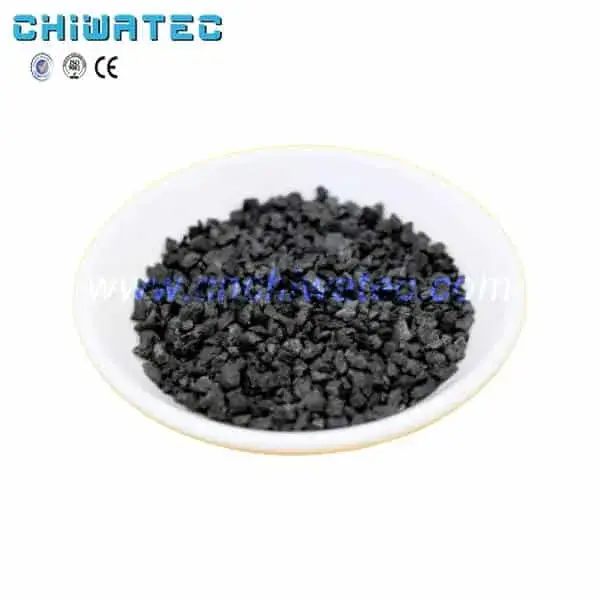
The adsorption capacity of activated carbon is governed not only by its physical pore structure but also by its chemical composition. In addition to carbon (85–95% by weight), activated carbon contains chemically bonded oxygen, hydrogen, nitrogen, and sulfur that form surface functional groups. The principal activated carbon physicochemical properties related to surface chemistry include:
- Oxygen-containing groups: Carbonyl (C=O), carboxyl (–COOH), phenolic hydroxyl (–OH), lactone, quinone, and ether groups. These determine surface polarity, acidity, and ion-exchange capacity.
- pH of point of zero charge (pHPZC): Typically pH 6–9 for commercial activated carbons. Below pHPZC the surface is positively charged (attracts anions); above it the surface is negatively charged (attracts cations).
- Ash content: 2–15% by weight, consisting of alkali and alkaline earth metal carbonates, phosphates, and silicates inherited from the raw material. Ash can be reduced by acid washing to <1% for high-purity applications.
- Boehm titration: Quantifies acidic (carboxyl, lactone, phenol) and basic (pyrone, chromene) surface groups, providing a chemical fingerprint for predicting adsorption behavior.
The combination of these surface functional groups means that activated carbon adsorption involves both physical forces (van der Waals) and chemical bonding (electrostatic attraction, hydrogen bonding, complexation). This dual mechanism gives activated carbon its broad-spectrum removal capability.
Catalytic Properties of Activated Carbon
Activated carbon exhibits intrinsic catalytic activity in many oxidation, reduction, and decomposition reactions due to the presence of specific oxygen-containing surface complexes. In adsorption processes, the carbon surface catalyzes reactions that transform adsorbed contaminants into less harmful or more easily removable forms:
- SO₂ oxidation: Activated carbon adsorbs sulfur dioxide and catalytically oxidizes it to sulfur trioxide in the presence of oxygen and moisture
- Chlorine and phosgene formation: The carbon surface catalyzes the reaction between chlorine and carbon monoxide to form phosgene
- Ozone decomposition: Catalytic decomposition of residual ozone in water treatment systems
- Reductive dechlorination: Catalytic removal of chlorine from chlorinated organic compounds
Beyond its own catalytic activity, activated carbon serves as an outstanding catalyst support material. The developed pore structure, large internal surface area (800–1,200 m²/g), and excellent thermal, acid, and alkali resistance make it ideal for supporting precious metal catalysts. Palladium-impregnated activated carbon, for example, catalyzes olefin oxidation reactions at high speed and selectivity without requiring copper salt co-catalysts. In industrial organic chemistry, activated carbon is the carrier of choice for platinum and palladium catalysts in hydrogenation, dehydrocyclization, and isomerization reactions.
Mechanical Properties of Activated Carbon
The mechanical integrity of activated carbon directly affects filter bed performance, pressure drop, and replacement frequency. Key mechanical activated carbon physicochemical properties include:
| Property | Description | Typical Range |
|---|---|---|
| Particle size distribution | Measured by standard sieve analysis; determines bed permeability and contact efficiency | 8×30 mesh to 4×10 mesh (water treatment grades) |
| Bulk density | Weight per unit volume including pore volume and inter-particle voids | 400–550 kg/m³ (granular), 300–450 kg/m³ (powdered) |
| Hardness / abrasion number | Resistance to attrition during backwashing and hydraulic transport | 90–99% (ASTM D3802) |
| Ball-pan hardness | Measures resistance to physical breakdown under mechanical agitation | 85–98% |
Activated carbon with higher mechanical strength causes less fines generation during operation, reducing pressure drop buildup and extending service life. For high-flow applications or frequent backwashing cycles, select carbon grades with abrasion numbers above 95%.
Frequently Asked Questions (FAQ)
What is the difference between physical and chemical adsorption in activated carbon?
Physical adsorption involves van der Waals forces between the carbon surface and the adsorbate molecule — it is reversible and temperature-dependent. Chemical adsorption (chemisorption) involves electron transfer or chemical bond formation between surface functional groups and the adsorbate, making it stronger and often irreversible. Most activated carbon applications utilize both mechanisms simultaneously.
How does ash content affect activated carbon performance?
High ash content (8–15%) reduces the effective carbon content per unit weight, lowering adsorption capacity for organic compounds. Ash also leaches metal ions (calcium, magnesium, iron) into treated water, which can be problematic in high-purity applications. Acid-washed activated carbon with <3% ash is recommended for drinking water and pharmaceutical processing.
Can activated carbon be used as a catalyst carrier?
Yes. Activated carbon’s high surface area, thermal stability (up to 500°C in inert atmosphere), and resistance to acidic and alkaline conditions make it an excellent catalyst support. Precious metals such as platinum, palladium, and ruthenium are commonly impregnated onto activated carbon for hydrogenation and oxidation reactions in the chemical and pharmaceutical industries.
What is the typical particle size for activated carbon in water treatment?
Granular activated carbon (GAC) with 8×30 mesh (0.6–2.36 mm) is the most common size for fixed-bed water treatment filters. Powdered activated carbon (PAC) with <0.15 mm particle size is used in slurry applications such as taste and odor control. Larger particles (4×10 mesh) are used in high-flow applications where lower pressure drop is required.
How do oxygen functional groups affect adsorption?
Oxygen-containing groups (carboxyl, phenol, lactone) increase the hydrophilicity of the carbon surface, enhancing adsorption of polar compounds and metal ions while reducing adsorption of non-polar organics. Controlled oxidation or reduction treatments can tailor the surface chemistry for specific target contaminants.
Conclusion & Call to Action
Activated carbon’s performance as an adsorbent, catalyst, and catalyst support is defined by its three core property sets: surface chemistry (functional groups, ash content, pHPZC), catalytic activity (intrinsic and supported catalysis), and mechanical strength (particle size, density, hardness). Selecting the right carbon grade requires matching these activated carbon physicochemical properties to the target application’s chemical environment, flow conditions, and purity requirements. For certified activated carbon products with full chemical and mechanical specifications, contact the CHIWATEC team at [email protected] or [email protected].
Related Resources and Further Reading
- Activated Carbon Quality Specifications
- Activated Carbon Water Treatment: Key Factors Affecting Adsorption Efficiency
- Activated Carbon Filter vs Activated Sand Filter: Complete Comparison Guide
- Practical Application of Activated Carbon in Water Treatment
- Activated Carbon Filter Products — CHIWATEC Product Line
Do you have a water treatment project we can help with
* Designing,machining,installing,commissioning, customize and one-stop service
 English
  Spanish
  Portuguese