

Boiler Water Softening Equipment Process: Complete Guide to 5-Step Flow and Regeneration 2026
The boiler water softening equipment process consists of five essential steps — water production (service), backwashing, salt absorption (regeneration), slow flushing (replacement), and fast flushing — that work together to remove hardness-causing calcium and magnesium ions from boiler feed water. Understanding this workflow is critical for maintaining efficient boiler operation, preventing scale formation, and extending equipment life. CHIWATEC provides professional water softening equipment and sodium ion exchange systems for boiler feed water treatment worldwide.
Overview of the Boiler Water Softening Equipment Process
The boiler water softening equipment process is based on sodium ion exchange — a chemical process where hard water passes through a bed of ion exchange resin beads. The resin beads are pre-saturated with sodium ions (Na+). As hard water flows through the resin bed, calcium (Ca2+) and magnesium (Mg2+) ions in the water are exchanged for sodium ions, effectively removing the hardness. Over time, the resin becomes saturated with calcium and magnesium ions and must be regenerated to restore its softening capacity. This regeneration cycle follows a standardized five-step process that all sodium ion exchange water softeners use, though fully automatic systems may add a brine refill step.
Step 1: Water Production (Service Cycle)
During the water production (service) cycle, raw water enters the resin tank and flows downward through the ion exchange resin bed. The resin beads, loaded with sodium ions, capture calcium and magnesium ions from the water while releasing sodium ions into the effluent. The softened water produced has negligible hardness, making it suitable for boiler feed water without risking scale formation on heat exchange surfaces.
The service cycle continues until the resin reaches its hardness breakthrough point, at which stage the effluent hardness begins to increase. The duration of the service cycle depends on resin volume, raw water hardness, and flow rate.
Step 2: Backwashing
After the service cycle, the resin bed contains trapped dirt, suspended solids, and compacted resin fines accumulated from the raw water. These contaminants are concentrated at the top of the resin bed and must be removed to restore the resin surface area and ensure effective regeneration.
Backwash process: Water flows upward from the bottom of the resin tank and exits from the top, fluidizing the resin bed and carrying away accumulated dirt and debris. The upward flow expands the bed volume by 30-50%, allowing the trapped particles to be released and washed out to drain.
Typical duration: 5-15 minutes, depending on water temperature, flow rate, and the degree of fouling. Backwashing should continue until the effluent runs clear.
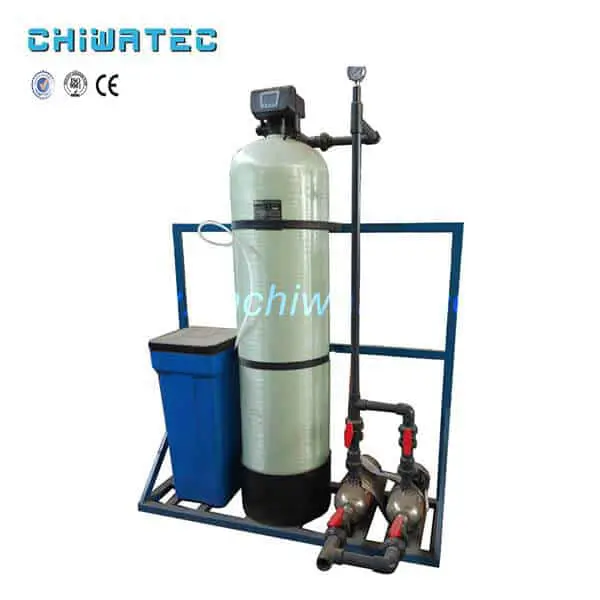
Step 3: Salt Absorption (Regeneration)
Regeneration is the core step of the boiler water softening equipment process. During this step, a concentrated brine (salt) solution is passed through the resin bed to displace the accumulated calcium and magnesium ions and restore the resin to its sodium form.
Regeneration mechanism: The high concentration of sodium ions in the brine solution forces the ion exchange equilibrium in the reverse direction — calcium and magnesium ions are released from the resin functional groups, while sodium ions are re-adsorbed onto the resin. The displaced hardness ions are flushed out to drain.
Brine delivery methods:
- Traditional equipment: Uses a dedicated salt pump to inject brine into the resin tank
- Fully automatic equipment: Uses a built-in ejector (venturi) to draw brine from the salt tank using inlet water pressure — no pump required
Important: The regeneration effect is significantly better when brine flows slowly through the resin bed, allowing sufficient contact time, rather than simply soaking the resin in brine. The brine should flow at a slow, controlled rate for optimal ion displacement.
Typical duration: Approximately 30 minutes, though actual time varies based on salt dosage and resin volume.
Step 4: Slow Flushing (Replacement)
After the brine has passed through the resin bed, a slow rinse step is performed to complete the regeneration process. During slow flushing, raw water is passed through the resin at the same slow flow rate used during brine injection. This serves two important functions:
- Rinse residual brine: Removes remaining salt solution from the resin tank
- Complete ion exchange: The remaining calcium and magnesium ions on the resin functional groups continue to be displaced by sodium ions during this slow wash
According to practical experience, this slow flushing step actually contributes significantly to the overall regeneration effect. Many water treatment specialists refer to this step as “replacement” because the sodium-calcium/magnesium exchange continues actively throughout the process.
Typical duration: Approximately 30 minutes — generally the same duration as the salt absorption step.
Step 5: Fast Rinsing
The final step of the boiler water softening equipment process is fast rinsing, which serves to thoroughly remove any remaining brine and displaced hardness ions from the resin bed. Raw water is passed through the resin at a flow rate close to the actual service flow rate, ensuring that the resin bed is fully rinsed and ready for the next service cycle.
- Effluent quality check: The water exiting during the final minutes of fast rinsing should meet the required softened water quality standard
- Brine refill (for automatic systems): Fully automatic water softeners include a brine tank refill step after fast rinsing, replenishing the salt supply for the next regeneration cycle
Typical duration: 5-15 minutes. The fast rinse continues until the effluent hardness is confirmed to be at the acceptable level for boiler feed water.
Summary of the 5-Step Softening Cycle
| Step | Process | Flow Direction | Duration |
|---|---|---|---|
| 1 | Water production (service) | Top to bottom | Variable (hours to days) |
| 2 | Backwashing | Bottom to top | 5-15 minutes |
| 3 | Salt absorption (regeneration) | Top to bottom (slow) | ~30 minutes |
| 4 | Slow flushing (replacement) | Top to bottom (slow) | ~30 minutes |
| 5 | Fast rinsing | Top to bottom (fast) | 5-15 minutes |
Frequently Asked Questions (FAQ)
How often does a boiler water softener need to regenerate?
Regeneration frequency depends on raw water hardness, daily water consumption, and resin volume. For most industrial boiler applications, regeneration occurs every 1-3 days. The frequency can be calculated based on the resin’s total exchange capacity and the cumulative hardness load treated between regenerations. Most automatic systems trigger regeneration based on water meter readings or elapsed time.
What happens if the boiler water softener does not backwash properly?
Inadequate backwashing allows dirt and compacted resin fines to accumulate at the top of the resin bed. This reduces the effective resin surface area available for ion exchange, leading to premature hardness breakthrough. Over time, channeling can develop in the resin bed, where water flows through preferential paths without contacting the resin effectively, significantly reducing softening performance.
Can I use table salt for water softener regeneration?
Standard table salt is not recommended for water softener regeneration. Use specially formulated water softener salt pellets, solar salt, or evaporated salt. These products have controlled impurity levels and dissolve evenly to create the proper brine concentration. Table salt may contain anti-caking agents and iodine that can foul the resin bed and reduce softening efficiency over time.
What is the ideal brine concentration for resin regeneration?
The ideal brine concentration for cation exchange resin regeneration is 8-12% (by weight). At this concentration, the sodium ions effectively displace calcium and magnesium from the resin functional groups. Concentrations below 8% result in poor regeneration efficiency, while concentrations above 12% provide diminishing returns and waste salt. Automatic softeners typically draw brine from a saturated salt solution (approximately 26% at room temperature) and dilute it to the effective concentration during the brine injector metering process.
Why is slow flushing important in the water softening process?
Slow flushing is critical because the ion exchange reaction between sodium ions in the brine and the calcium/magnesium ions on the resin requires adequate contact time to reach equilibrium. If the water flows too quickly during the rinse, the regeneration reaction may not complete, leaving residual hardness on the resin. This reduces the effective softening capacity for the next service cycle and can cause hardness leakage into the softened water.
Conclusion & Call to Action
Mastering the boiler water softening equipment process is essential for maintaining efficient boiler operation and preventing scale-related failures. The five-step cycle — water production, backwashing, regeneration, slow flushing, and fast rinsing — works in sequence to ensure consistent soft water quality and reliable system performance.
CHIWATEC offers a complete range of professional water softening equipment, including automatic and manual systems for boiler feed water treatment. For expert guidance on selecting and operating the right softening system for your boiler application, contact us at [email protected] or [email protected] for a customized water treatment solution.
Related Resources and Further Reading
Do you have a water treatment project we can help with
* Designing,machining,installing,commissioning, customize and one-stop service






 English
  Spanish
  Portuguese




