Ultrapure Water Process Flow for Electronics Industry: Complete Guide to Preparation Methods and Applications 2026
What is the best ultrapure water process flow for your electronics manufacturing application? This comprehensive guide compares three distinct preparation methods — traditional ion exchange, reverse osmosis combined with ion exchange, and the latest RO-EDI technology — and explores their application fields across semiconductor, PCB, optoelectronic, and other high-tech manufacturing sectors. Understanding the ultrapure water process flow for electronics is essential for selecting the most cost-effective, environmentally sustainable, and quality-compliant water treatment approach.
*Last Updated: May 2026 | Verified Technical Data
Why This Guide Matters
The electronics industry’s demand for ultrapure water continues to escalate, with global consumption projected to exceed 1.2 billion cubic meters annually by 2030. The choice of ultrapure water process flow for electronics directly impacts manufacturing yield, water quality consistency, operating costs, and environmental compliance. Three primary process flows compete in the market — all-ion exchange, RO-ion exchange hybrid, and RO-EDI hybrid — each with distinct advantages, limitations, and total cost of ownership profiles. This guide provides the complete comparative analysis needed to make an informed decision for any electronics manufacturing application.
Key Industry Trends (2026 Update)
- RO-EDI becoming the default standard — Over 80% of new electronics ultrapure water systems installed in 2025-2026 use RO-EDI hybrid technology, displacing traditional mixed-bed ion exchange for all but the smallest and lowest-purity applications.
- Zero liquid discharge pressure mounting — Environmental regulations in key semiconductor manufacturing regions (Taiwan, South Korea, US, EU) increasingly require ZLD or near-ZLD wastewater management, driving adoption of brine concentrators and crystallizers downstream of RO-EDI systems.
- Real-time digital water quality traceability — Advanced fabs now require blockchain-based water quality traceability systems that record every batch of ultrapure water’s quality parameters, source, and distribution path for compliance and yield analysis.
- Decentralized point-of-use polishing expanding — Rather than producing one water grade centrally, advanced fabs increasingly deploy distributed polishing stations delivering different water grades (18.2, 15, 10, 2 Mohm-cm) to different process areas from a common RO-EDI backbone.
1. What Are the Three Primary Ultrapure Water Process Flows?
Overview of Available Technologies
The preparation of ultrapure water for electronics industry applications can be accomplished through three distinct process flows, each representing a different generation of water treatment technology. Method 1 uses ion exchange resin alone (ion exchange beds and mixed beds). Method 2 combines reverse osmosis with ion exchange. Method 3 combines reverse osmosis with electrodeionization (EDI). Each subsequent method represents an advancement in water quality, operating efficiency, and environmental sustainability. The basic progression of technology has moved from purely chemical-based deionization (ion exchange) toward membrane-based processes (RO) combined with electrically-regenerated deionization (EDI). For a detailed comparison of these approaches, see our article on top 10 benefits of EDI electric desalination systems.
2. How Does the Traditional Ion Exchange Process Flow Work?
Process Description: Ion Exchange Resin Only
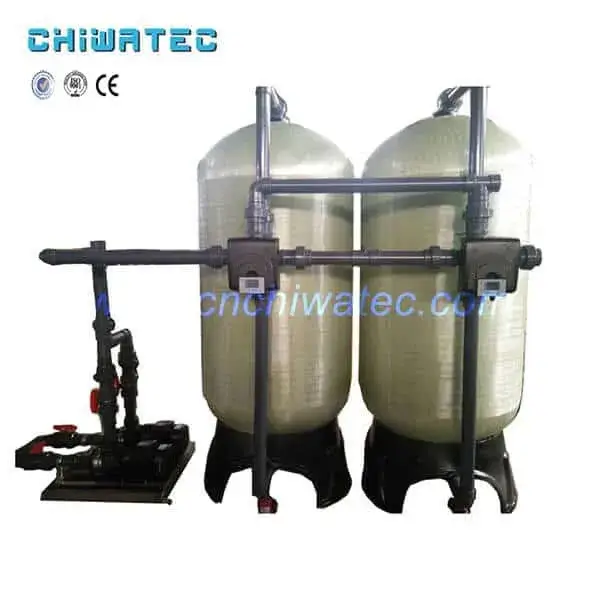
The traditional ultrapure water process flow for electronics using only ion exchange resin follows this sequence: raw water to multi-media filter, to activated carbon filter, to precision filter, to intermediate water tank, to cation exchange bed (anode bed), to anion exchange bed (cathode bed), to mixed bed (multi-bed), to ultrapure water storage tank, to ultrapure water pump, to post-security filter, and finally to water points. This method relies entirely on synthetic ion exchange resin beads — cation resin exchanges hydrogen ions (H+) for cations, anion resin exchanges hydroxide ions (OH-) for anions, and the combined H+ and OH- form water molecules. While proven over decades of service, this method has significant drawbacks: periodic chemical regeneration with acid and caustic, handling and storage of hazardous regeneration chemicals, generation of acidic and alkaline waste streams requiring neutralization before discharge, and declining effluent quality between regeneration cycles as the resin approaches exhaustion. For a foundational understanding, see our article on EDI working principle and technical understanding.
Historical Significance and Current Status
The all-ion-exchange method was the dominant ultrapure water production technology from the 1960s through the 1990s and remains in service at many older electronics manufacturing facilities. While still capable of achieving 18.2 Mohm-cm resistivity, the method’s reliance on chemical regeneration and its batch-mode operation (requiring offline regeneration cycles) make it increasingly unsuitable for modern continuous-process manufacturing environments. Many facilities are retrofitting their systems with RO-EDI technology to reduce chemical handling, improve water quality consistency, and enable continuous 24/7 operation.
3. How Does the RO + Ion Exchange Hybrid Process Flow Work?
Process Description: Reverse Osmosis Plus Ion Exchange
The RO + ion exchange hybrid process flow adds reverse osmosis before the ion exchange polishing stage: raw water to multi-media filter, to activated carbon filter, to precision filter, to intermediate water tank, to reverse osmosis equipment, to mixed bed (multi-bed), to ultrapure water tank, to ultrapure water pump, to post-security filter, to water points. In this configuration, the RO system removes 95-99% of dissolved solids from the feed water before it reaches the ion exchange mixed beds, dramatically reducing the ionic load on the resin beds. This extends the time between regenerations by 5-10 times compared to all-ion-exchange systems — from days to weeks or months between regenerations — significantly reducing chemical consumption and waste generation. For guidance on system operation, refer to our operating instructions for EDI equipment.
Advantages Over All-Ion-Exchange
The RO + ion exchange hybrid offers several important advantages: significantly reduced chemical consumption (80-90% less acid and caustic compared to all-ion-exchange), extended mixed-bed service life between regenerations, improved and more consistent effluent water quality (the RO provides consistent feed water quality to the mixed bed regardless of raw water TDS fluctuations), and reduced operating labor and maintenance requirements. However, this method still requires chemical regeneration of the mixed beds, with associated chemical handling, storage, safety, and waste disposal requirements — albeit at much lower frequency than the all-ion-exchange method.
4. How Does the RO + EDI Process Flow Work — and Why Is It the Gold Standard?
Process Description: Reverse Osmosis Plus Electrodeionization
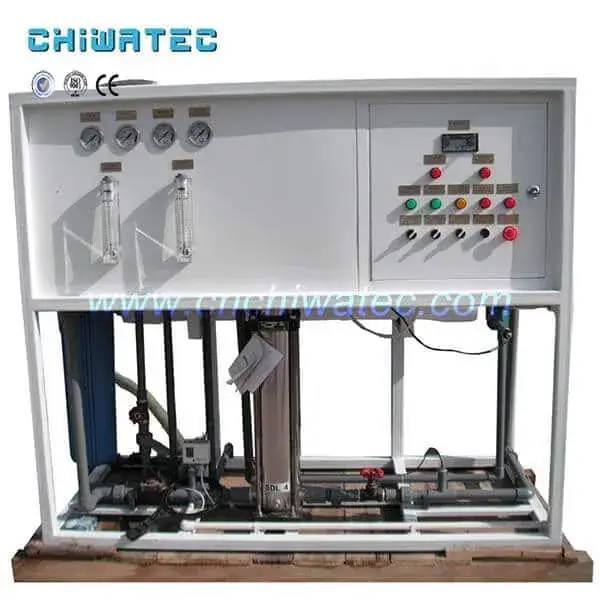
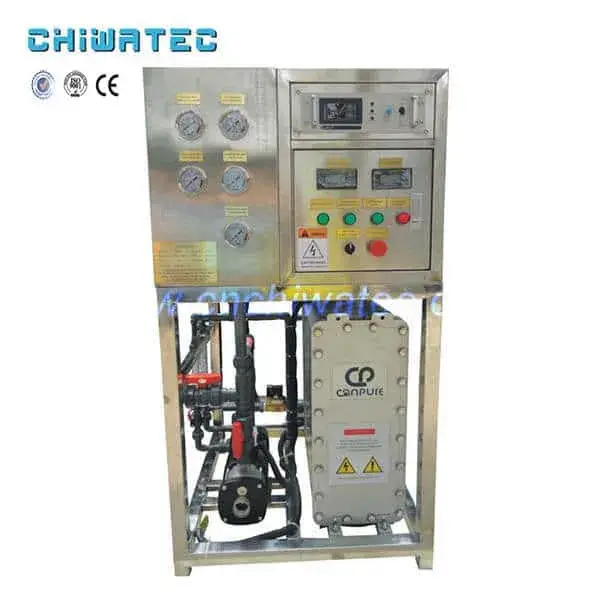
The RO + EDI hybrid process flow represents the latest and most advanced ultrapure water process flow for electronics: raw water to multi-media filter, to activated carbon filter, to precision filter, to intermediate water tank, to reverse osmosis equipment, to electrodeionization (EDI), to ultrapure water tank, to ultrapure water pump, to post-security filter, to water points. In this configuration, the RO system removes 95-99% of dissolved solids, and the EDI module uses electrical current to continuously deionize the RO permeate without chemical regeneration. The EDI module contains ion exchange resin, ion exchange membranes, and electrodes arranged in alternating dilute and concentrate compartments — the electrical field drives ionic contaminants through the membranes into the concentrate stream while continuously regenerating the resin through water dissociation at the resin-membrane interfaces. Xi’an CHIWATEC specializes in designing and commissioning RO-EDI ultrapure water systems for electronics manufacturing.
Why RO-EDI Is the Greenest, Most Economical Choice
The RO-EDI process flow is widely recognized as the most environmentally friendly, economical, and forward-looking method for preparing ultrapure water. Key advantages over the alternatives include: zero chemical consumption — EDI uses only electrical energy for regeneration, eliminating acid and caustic handling, storage, and waste disposal; continuous operation — EDI produces consistent 16-18.2 Mohm-cm water 24/7 without the batch regeneration cycles required by mixed beds; lower operating costs — total operating costs are typically 20-30% lower than RO + mixed bed over a 10-year lifecycle when chemical, waste disposal, and labor costs are included; and smaller footprint — EDI stacks are compact compared to the regeneration chemical storage tanks, neutralization equipment, and resin inventory required for mixed bed systems. For a comprehensive introduction, see our EDI ultrapure water system working principle and technology guide.
5. What Are the Detailed Steps in Each Process Flow?
Common Pretreatment Stages
All three process flows share the same pretreatment steps. The multi-media filter removes suspended solids above 20-50 microns using graded quartz sand and anthracite media. The activated carbon filter removes free chlorine, chloramines, organic compounds, taste, and odor — critical for protecting downstream RO membranes from oxidation damage. The precision filter (5-micron cartridge filter) provides the final particulate barrier. These pretreatment stages are sized and configured based on the specific raw water quality and the target ultrapure water production rate, with redundant components recommended for critical electronics manufacturing applications. For in-depth discussion of water treatment fundamentals, see our introduction to electrodeionized water purification technology.
RO Stage in Hybrid Systems
In the RO + mixed bed and RO + EDI process flows, the RO system is the key intermediate stage that removes the bulk of dissolved solids. A two-pass RO configuration is typically specified for electronics applications, achieving product water conductivity below 2-5 microsiemens/cm from typical municipal feed water of 200-500 microsiemens/cm. This represents a 99-99.5% reduction in ionic load before the final polishing stage, dramatically extending the service life of downstream mixed bed resin or reducing the size and power consumption of EDI stacks. The RO system also removes 99% plus of bacteria, viruses, and organic compounds, providing critical protection for the final polishing stage.
Final Polishing Stage Comparison
The final polishing stage differs fundamentally among the three methods. Mixed beds (ion exchange) use cation and anion resin mixed in a single vessel, requiring periodic chemical regeneration with 4-8% HCl and 4-8% NaOH solutions, generating 2-5 bed volumes of acidic and alkaline waste per regeneration cycle. EDI modules use electrical current (typically 1-4 amps and 50-600 volts DC per module) to continuously regenerate the resin, with only a continuous concentrate bleed stream (typically 5-10% of feed flow) as waste. The choice between mixed bed and EDI for the polishing stage has the most significant impact on operating costs, environmental footprint, and water quality consistency.
6. What Are the Key Application Fields for Ultrapure Water in Electronics?
Semiconductor and Integrated Circuit Manufacturing
Semiconductor materials, devices, printed circuit boards (PCBs), and integrated circuit (IC) products and semi-finished products represent the largest and most demanding application field for ultrapure water in the electronics industry. At every stage of semiconductor fabrication — wafer cleaning, photolithography, etching, chemical mechanical planarization (CMP), and final cleaning — ultrapure water is the universal medium for removing chemical residues, particles, and metallic contaminants without introducing any new contamination. The water quality requirements for advanced node fabrication (7 nm and below) are the most stringent of any industry: resistivity above 18.15 Mohm-cm, TOC below 1 ppb, dissolved oxygen below 1 ppb, and particles above 0.05 micron below 100 counts per liter. For a detailed process flow discussion, see our EDI high-purity water equipment installation guide.
Ultra-Pure Materials and Chemical Reagent Preparation
The blending and preparation of ultra-pure materials and ultra-pure chemical reagents require ultrapure water as the base solvent or diluent. Electronic-grade chemicals such as hydrogen peroxide, ammonium hydroxide, hydrochloric acid, hydrofluoric acid, and isopropyl alcohol are manufactured or diluted using ultrapure water with 18.2 Mohm-cm resistivity. Any impurities in the dilution water would be concentrated in the final chemical product, potentially causing contamination during wafer processing. This application field also includes the production of high-purity cleaning solutions and photoresist developers used in photolithography.
Laboratory and Pilot Plant Applications
Electronics industry research laboratories, quality control laboratories, and pilot plants require ultrapure water for analytical instrumentation (HPLC, ICP-MS, GC-MS), sample preparation, and process development. These applications typically require 18.2 Mohm-cm water from point-of-use polishing systems connected to the central ultrapure water distribution network. Laboratory-grade ultrapure water must meet ASTM Type I standards with TOC below 5 ppb and bacteria below 1 CFU/mL.
Surface Finishing and Advanced Manufacturing
Ultrapure water is used in the surface polishing of automobiles and home appliances, optical and optoelectronic products, and other high-technology micro-products. In these applications, ultrapure water ensures that surface preparation and cleaning steps leave no residual ionic or particulate contamination that would affect subsequent coating, plating, or bonding processes. This application field also includes cleaning of precision optical components, fiber optic connectors, and MEMS (micro-electromechanical systems) devices where sub-micron cleanliness is essential. CHIWATEC provides comprehensive ultrapure water system solutions for all electronics industry applications.
7. How to Choose the Right Process Flow for Your Application?
Water Quality Requirements vs. Process Flow Selection
The choice of ultrapure water process flow for electronics depends primarily on the target water quality. For applications requiring 18.2 Mohm-cm with TOC below 1-5 ppb — such as advanced semiconductor fabrication and ultra-pure chemical preparation — the RO + EDI process flow is strongly recommended for its consistent quality output and zero-chemical operation. For applications requiring 15-18 Mohm-cm with moderate TOC specifications — such as general semiconductor processing, LCD manufacturing, and PCB production — either RO + EDI or RO + mixed bed may be suitable, with EDI preferred for new installations. For applications requiring 0.5-10 Mohm-cm — such as less critical rinsing, equipment cooling, and general washing — the all-ion-exchange or RO + mixed bed approach may be adequate, although even these applications increasingly specify EDI for environmental and operational benefits.
Total Cost of Ownership Comparison
When comparing the three process flows, total cost of ownership over a 10-year period reveals clear differences. All-ion-exchange systems have the lowest initial capital cost (approximately USD 200,000-500,000 for a 50 m3/h system) but the highest operating costs due to chemical consumption, waste disposal, and labor for regeneration operations. RO + mixed bed systems have moderate capital costs (USD 400,000-800,000) with moderate operating costs. RO + EDI systems have the highest initial capital cost (USD 600,000-1,200,000) but the lowest operating costs, achieving payback within 3-5 years compared to RO + mixed bed due to chemical and waste savings. For high-utilization facilities operating 24/7, the RO + EDI process flow achieves the lowest 10-year total cost of ownership. For a comparison of EDI versus mixed-bed economics, see our advantages of EDI and applications of pure water devices.
8. How to Design and Commission an RO-EDI Process Flow System?
System Design Parameters
Designing an effective RO-EDI system for electronics industry ultrapure water requires careful consideration of: feed water quality (TDS, hardness, alkalinity, silica, TOC, bacterial counts), target water quality (resistivity, TOC, DO, silica, particles, bacteria), system capacity (m3/h or GPM) with 10-20% safety margin and future expansion allowance, RO system configuration (single-pass or two-pass, array ratio, membrane element selection), EDI module selection (number of stacks, stack type, voltage and current requirements), and post-treatment requirements (UV oxidation, membrane degasification, mixed-bed polishing for 18.2 Mohm-cm). Each design parameter must be optimized for the specific application requirements and site conditions.
Commissioning and Validation Protocol
Commissioning an electronics-grade RO-EDI system follows a structured protocol: (1) flush and test all pretreatment components, (2) load RO membrane elements and verify performance (flux, rejection, pressure drop), (3) install EDI modules and program the DC power supply parameters, (4) start the system in recirculation mode until target resistivity is achieved, (5) verify all online instruments against laboratory grab sample results, (6) perform a 72-hour continuous operation test with full data logging, and (7) certify the system’s ability to consistently produce water meeting the specified quality parameters. Xi’an CHIWATEC provides complete design, fabrication, installation, and commissioning services for RO-EDI ultrapure water systems.
9. What Are the Environmental and Sustainability Benefits of Each Process Flow?
Chemical Usage and Waste Generation Comparison
The three process flows have dramatically different environmental footprints. An all-ion-exchange system producing 50 m3/h of ultrapure water consumes approximately 10-20 tons of 30% HCl and 15-25 tons of 50% NaOH per month for mixed-bed regeneration, generating 100-300 m3 of acidic and alkaline wastewater requiring neutralization before discharge. An RO + mixed bed system reduces chemical consumption by 80-90% to approximately 1-3 tons per month. An RO + EDI system eliminates chemical regeneration entirely, consuming only electrical energy at approximately 0.5-1.5 kWh/m3 — making it the clear environmental choice and the only option compatible with zero-liquid-discharge (ZLD) facility objectives. For additional discussion of EDI system installation and operation, see our EDI principle and influencing factors guide.
Energy Consumption and Carbon Footprint
Total energy consumption for the three process flows varies: all-ion-exchange systems consume 1-2 kWh/m3 for pumps plus the embedded energy in chemical manufacturing and transport (approximately 10-20 kWh equivalent per kg of acid and caustic). RO + mixed bed systems consume 3-5 kWh/m3 for the RO high-pressure pump plus reduced chemical energy. RO + EDI systems consume 3-6 kWh/m3 (RO at 2-4 kWh/m3 plus EDI at 0.5-1.5 kWh/m3) with zero chemical energy. When the full lifecycle carbon footprint is considered — including chemical manufacturing, transportation, and waste treatment — RO + EDI has the lowest carbon footprint of the three methods.
10. What Is the Future Outlook for Ultrapure Water Process Flows?
Emerging Technologies on the Horizon
Several next-generation technologies are being developed for ultrapure water production. Capacitive deionization (CDI) uses electrically charged electrodes to remove ions without membranes or resin — while current systems are limited to lower purity levels, research continues for higher-performance applications. Forward osmosis (FO) uses osmotic pressure differential rather than hydraulic pressure, with the potential for lower energy consumption and fouling propensity than RO. Advanced oxidation processes (AOPs) using UV + ozone or UV + hydrogen peroxide are being refined for TOC reduction below 0.1 ppb. These emerging technologies may eventually complement or partially replace RO-EDI for specific applications.
Integration with Smart Manufacturing (Industry 4.0)
The ultrapure water process flow of the future will be fully integrated with smart manufacturing systems. AI-powered predictive maintenance will optimize RO membrane cleaning and EDI stack replacement timing. Real-time water quality data will be fed directly into the manufacturing execution system (MES) for yield correlation analysis. Digital twins of the water treatment system will enable virtual commissioning and operator training. Blockchain-based water quality traceability will provide immutable records for compliance and quality assurance. These innovations will further enhance the already impressive performance of RO-EDI ultrapure water systems in electronics manufacturing. For a comprehensive overview of EDI system technology, see our EDI system water treatment equipment guide.
Conclusion
The ultrapure water process flow for electronics has evolved through three distinct generations — all-ion-exchange, RO + ion exchange, and RO + electrodeionization (EDI). Each generation represents significant improvements in water quality consistency, operating efficiency, and environmental sustainability. The RO + EDI process flow has emerged as the gold standard for new electronics manufacturing facilities, offering zero-chemical operation, continuous 18.2 Mohm-cm water production, lower lifecycle costs, and the smallest environmental footprint. As emerging technologies and smart manufacturing integration continue to advance, the ultrapure water systems of the future will deliver even higher water quality, greater reliability, and deeper integration with the manufacturing processes they support. For expert guidance on selecting and implementing the optimal ultrapure water process flow for your electronics manufacturing application, contact Xi’an CHIWATEC today at [email protected] or [email protected], or reach us via WhatsApp.
Frequently Asked Questions
Q1: What is the difference between RO-EDI and RO-mixed bed for ultrapure water?
The fundamental difference is the regeneration method. RO-mixed bed systems use chemical regeneration with acid and caustic solutions, requiring batch regeneration cycles that interrupt continuous operation and generate chemical waste. RO-EDI systems use electrical current for continuous regeneration, eliminating chemicals and enabling uninterrupted 24/7 operation. RO-EDI also provides more consistent effluent quality because deionization is continuous rather than declining between regeneration cycles. The initial capital cost of RO-EDI is higher, but total lifecycle costs are typically 20-30% lower.
Q2: Can existing all-ion-exchange systems be retrofitted to RO-EDI?
Yes, most existing all-ion-exchange systems can be retrofitted with RO and EDI technology. The typical retrofit involves: installing an RO system between the existing precision filter and the ion exchange beds, replacing the mixed bed vessels with EDI module racks, and upgrading the control system. The pretreatment, storage, and distribution infrastructure can usually be retained. The retrofit capital cost is typically 50-70% of a completely new system, with payback periods of 2-4 years from chemical and waste disposal savings.
Q3: What water quality can RO-EDI systems achieve?
A properly designed and operated RO-EDI system consistently achieves: resistivity of 16-18.2 Mohm-cm (with the higher value requiring a final polishing mixed bed or optimized EDI operating parameters), TOC below 5-10 ppb (below 1 ppb with UV oxidation), silica below 0.5-1 ppb, sodium below 0.1-0.5 ppb, chloride below 0.1-0.5 ppb, bacteria below 0.1 CFU/100 mL (with UV sterilization), and particles above 0.05 micron below 100-500 counts per liter (with 0.04-micron ultrafiltration).
Q4: How much does an RO-EDI system cost compared to alternatives?
For a 50 m3/h system producing 18.2 Mohm-cm water: all-ion-exchange costs approximately USD 200,000-500,000 capital with operating costs of USD 0.50-1.00/m3; RO + mixed bed costs approximately USD 400,000-800,000 capital with operating costs of USD 0.30-0.60/m3; RO + EDI costs approximately USD 600,000-1,200,000 capital with operating costs of USD 0.15-0.30/m3. The payback period for RO + EDI versus RO + mixed bed is typically 3-5 years.
Q5: What is the typical lifetime of an RO-EDI system?
The mechanical components of an RO-EDI system — piping, valves, instrument panels, and control system — have a service life of 15-20 years. RO membrane elements require replacement every 3-5 years. EDI module stacks have a service life of 5-10 years, with the ion exchange resin and ion exchange membranes gradually degrading due to continuous electrical and chemical stress. With proper maintenance and timely component replacement, a well-designed RO-EDI system can deliver consistent ultrapure water quality for 20 years or more.
Related Resources and Further Reading
Do you have a water treatment project we can help with
* Designing,machining,installing,commissioning, customize and one-stop service
 English
  Spanish
  Portuguese