

RO Pure Water Equipment Pretreatment and Main Unit: System Components and Working Principles 2026
Reverse osmosis pure water equipment adopts advanced, energy-saving membrane separation technology. Under applied pressure higher than the solution osmotic pressure, water molecules pass through the semi-permeable membrane while dissolved salts, colloids, microorganisms, and organic matter are rejected. This RO pure water equipment pretreatment guide focuses on the two essential parts of every RO system: the pretreatment stage and the main unit. Understanding RO pure water equipment pretreatment and main unit components is fundamental for system selection, operation, and maintenance.
RO Pure Water Equipment Pretreatment: First-Stage Filtration
The pretreatment section of a reverse osmosis pure water system consists of three main components: multi-media filter, activated carbon filter, and automatic water softener. Each plays a specific role in protecting the downstream RO membranes.
| Component | Construction | Function |
| Multi-media filter | Automatic control valve, FRP tank, graded quartz sand media | Removes suspended solids and colloidal substances; reduces raw water turbidity; automatic backwash capability |
| Activated carbon filter | Automatic control valve, high-quality FRP tank, GAC media | Removes residual chlorine, organic matter, odor, and color; protects TFC polyamide RO membranes from oxidative damage |
| Automatic water softener | Automatic control valve, FRP tank, strong acid cation exchange resin | Removes calcium and magnesium hardness ions to prevent membrane scaling; regenerates automatically with brine solution |
Effective pretreatment is the single most important factor in RO system reliability. Inadequate pretreatment accounts for over 70% of premature RO membrane failures in industrial installations.
Main Unit of Reverse Osmosis Pure Water Equipment
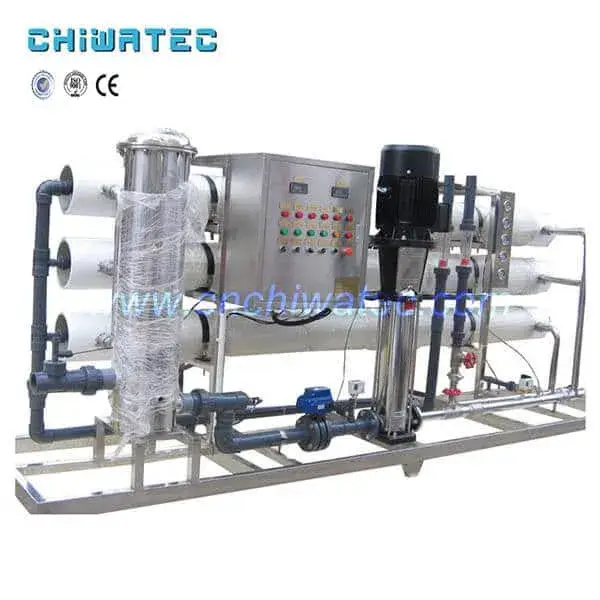
The host of the reverse osmosis water purification equipment mainly consists of: security filter, high-pressure pump, reverse osmosis membrane elements, and various control and display instruments.
Security Filter (Precision Filter)
The security filter is the last protection before raw water enters the RO membrane. It effectively removes particles larger than 5 microns that may have leaked from the pretreatment stages. The primary purpose is to prevent suspended particles from entering the reverse osmosis membrane elements and depositing on the membrane surface, which would cause fouling and performance degradation. The filter uses PP melt-blown or pleated cartridge elements, typically replaced when the pressure differential reaches 1.0-1.5 bar.
High-Pressure Pump
The high-pressure pump provides the driving pressure required for reverse osmosis separation. It must deliver consistent pressure above the feed water osmotic pressure — typically 8-15 bar for brackish water RO systems. The pump material must be compatible with feed water chemistry; 316 stainless steel is standard for industrial applications. Pump performance directly determines the system’s water production rate and energy consumption.
Reverse Osmosis Membrane Elements
The RO membrane is the core component where actual desalination occurs. Modern spiral-wound thin-film composite (TFC) polyamide membranes achieve 98-99.5% salt rejection. The membrane elements are housed in fiberglass-reinforced plastic (FRP) pressure vessels, arranged in a staged array configuration (typically 2:1 or 3:2) to optimize cross-flow velocity and minimize concentration polarization.
Control and Monitoring Instruments
The main unit includes pressure gauges (feed, permeate, concentrate), flow meters (permeate and concentrate), conductivity meters, and pH monitoring. These instruments provide real-time data for system operation and troubleshooting. Automatic controls manage startup, shutdown, flushing cycles, and alarm conditions.
Complete System Process Flow
The full RO pure water treatment process combines pretreatment and main unit in sequence:
Raw water → Multi-media filter → Activated carbon filter → Water softener → Security filter (5 micron) → High-pressure pump → RO membrane elements → Pure water tank
Key performance indicators for the complete system:
- Salt rejection: 98-99.5% for standard TFC membranes
- Recovery rate: 50-75% for brackish water, depending on feed water scaling potential
- Permeate conductivity: 5-40 uS/cm from typical 200-800 uS/cm feed water
- Operating pressure: 8-15 bar for single-pass brackish water RO
- Temperature range: 5-45C (standard TFC membranes)
For higher purity requirements, a second RO pass or EDI polishing stage can be added downstream.
Frequently Asked Questions
Q1: What is the difference between pretreatment and main unit in RO systems?
Pretreatment prepares the feed water by removing suspended solids, chlorine, and hardness to protect the RO membranes. The main unit performs the actual desalination through the RO membrane elements. Both are essential — without proper pretreatment, the RO membranes would foul rapidly and fail within weeks.
Q2: How often should pretreatment filters be backwashed?
Multi-media filters typically backwash every 8-24 hours based on pressure differential or timer. Activated carbon filters backwash every 24-72 hours. Water softeners regenerate based on water meter or timer, typically every 1-7 days depending on feed water hardness.
Q3: What happens if the security filter is not replaced on time?
A clogged security filter causes pressure drop, reducing flow to the high-pressure pump and causing cavitation damage. If the element ruptures, particles can bypass directly to the RO membrane elements, causing irreversible fouling and requiring premature membrane replacement.
Q4: Can an RO system operate without a water softener?
For feed water with hardness above 50 mg/L as CaCO3, operating without a softener will cause calcium carbonate scaling on the membrane surface within weeks. An alternative is antiscalant chemical dosing, which inhibits crystal formation without removing hardness. The choice depends on feed water chemistry and operating conditions.
Q5: What is the recommended pressure for RO operation?
For brackish water RO systems, the recommended operating pressure is 8-15 bar at the membrane inlet. Operating below this range reduces water production; operating above increases energy consumption without proportional water quality improvement and may cause membrane compaction over time.
Conclusion and Call to Action
This RO pure water equipment pretreatment guide has covered the two essential parts of every reverse osmosis pure water system: the pretreatment stage (multi-media filter, activated carbon filter, water softener) and the main unit (security filter, high-pressure pump, RO membrane elements, and monitoring instruments). Proper selection and maintenance of both stages are essential for reliable system performance and long membrane life.
CHIWATEC Water Treatment Technology is a high-tech enterprise specialized in water processing devices. We design and manufacture complete RO pure water systems including pretreatment and main unit components. For project inquiries, email [email protected] or [email protected] with your capacity requirements.
Related Resources and Further Reading
- RO Pure Water Equipment Complete Guide — Comprehensive RO system overview
- RO Pure Water Equipment System Guide — Complete system configuration details
- Pollution Control for RO Systems — Membrane fouling prevention strategies
- RO Pure Water Equipment Process Flow — Complete process description
- Chiwatec RO Water Treatment Systems — Browse commercial and industrial RO equipment
Do you have a water treatment project we can help with
* Designing,machining,installing,commissioning, customize and one-stop service






 English
  Spanish
  Portuguese




