

Pure Water Preparation Methods: Distillation, Ion Exchange, Electrodialysis, and RO Compared 2026
Pure water is essential for analytical laboratories, pharmaceutical manufacturing, electronics production, and industrial processes. There are four primary pure water preparation methods — distillation, ion exchange, electrodialysis, and reverse osmosis — each with distinct characteristics, advantages, and limitations. This guide provides a comprehensive comparison of these technologies, helping engineers and laboratory managers select the optimal method for their specific water quality requirements and budget constraints.
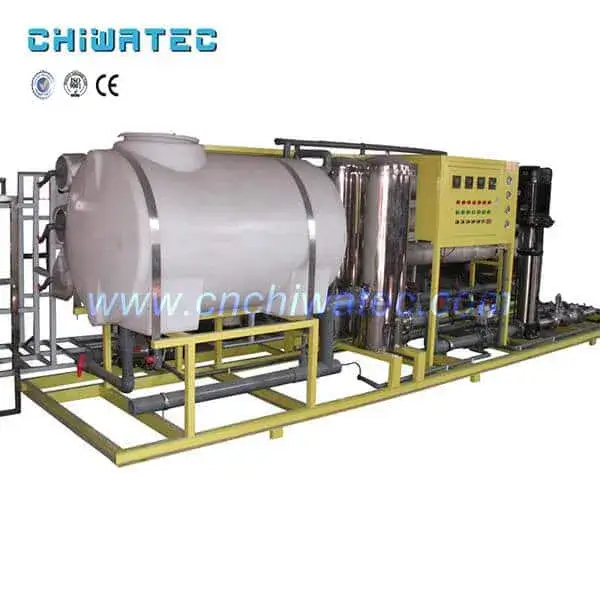
Comparison of Pure Water Preparation Methods
The table below summarizes the key characteristics of each pure water preparation method:
| Method | Effluent Resistivity | Key Contaminants Removed | Energy Consumption | Best Application |
| Distillation | <1 MΩ·cm | Most ions, bacteria, pyrogens | High (boiling energy) | General lab use, small volumes |
| Ion exchange | 10–18 MΩ·cm | Dissolved ions only | Low (regeneration) | High-purity DI water, labs |
| Electrodialysis | ~1 MΩ·cm | Dissolved ions (partial) | Low (DC current) | Pretreatment for IX, brackish water |
| Reverse osmosis | 0.1–1 MΩ·cm | Ions (>99%), organics, bacteria, viruses, pyrogens, particles | Moderate (100–200 psi pump) | Industrial pure water, pretreatment for UPW |
Modern pure water systems often combine multiple methods — for example, RO followed by ion exchange or electrodeionization (EDI) — to achieve the 18.2 MΩ·cm resistivity required for ultrapure water.
Distillation Method for Pure Water Preparation
Distillation is the oldest pure water preparation method, relying on the phase change of water from liquid to vapor and back to liquid. As water evaporates (at 100°C at sea level), non-volatile dissolved solids, salts, and most organic compounds remain in the boiling chamber. The steam is then condensed on a cooled surface and collected as purified distillate.
Types of Distillation Equipment
Distillation vessels are classified by material — glass, quartz, copper, stainless steel, or platinum — depending on the required purity level and budget. By distillation count, systems range from single-effect (one evaporation cycle) to multiple-effect (2–3 stages) for higher purity. Multi-effect distillation reuses the latent heat of condensation from each stage, reducing energy consumption by 40–60% compared to single-effect.
Limitations
- Low resistivity — Distilled water typically has resistivity below 1 MΩ·cm due to dissolved CO₂ (forming carbonic acid, H₂CO₃). Carbon dioxide is volatile and re-dissolves in the condensate, lowering pH and resistivity
- High energy cost — The latent heat of vaporization of water is 2,260 kJ/kg, making distillation the most energy-intensive method. Producing 1 liter of distilled water consumes approximately 0.5–1.0 kWh
- Slow production rate — Typical laboratory distillers produce 2–10 L/h, unsuitable for large-volume applications
Ion Exchange Method for Deionized Water
Ion exchange (IX) removes dissolved ionic contaminants by passing water through beds of synthetic resin beads — cation exchange resins (R-SO₃H) remove positively charged ions (Na⁺, Ca²⁺, Mg²⁺, Fe³⁺) while anion exchange resins (R-NR₃OH) remove negatively charged ions (Cl⁻, SO₄²⁻, HCO₃⁻, SiO₃²⁻). The overall reaction exchanges H⁺ and OH⁻ ions for the dissolved salts, producing H₂O.
System Configurations
- Multiple-bed systems — Cation → Anion → Cation → Anion → Mixed bed (series configuration). This was the early standard as it facilitated individual resin regeneration. However, it requires more vessels and piping
- Mixed-bed systems — Cation and anion resins are intimately mixed in a single vessel (2–5 stages in series). Mixed-bed deionization produces the highest quality water, reaching 10–18 MΩ·cm resistivity. Regeneration is more complex — the resins must be separated by backwashing (cation resin is denser and settles below), regenerated separately, and remixed
Important Limitation: TOC/COD Issues
Ion exchange effectively removes dissolved ions but can increase Total Organic Carbon (TOC) and Chemical Oxygen Demand (COD) levels. This occurs because:
- Resin leaching — New or poorly prepared resins release oligomers, monomers, and additives (residual solvents, cross-linking agents) into the water
- Resin degradation — Over time, the resin matrix degrades and releases decomposition products (sulfonated polystyrene fragments)
For example, tap water with a COD of 2 mg/L may produce deionized water with a COD of 5–10 mg/L. High-quality virgin resins with thorough pretreatment minimize this effect.
Electrodialysis: Selective Ion Removal
Electrodialysis (ED) was commercialized in the 1950s and is often used as a pretreatment step before ion exchange due to its low energy consumption. Under an external DC electric field, anion exchange membranes (AEM) and cation exchange membranes (CEM) are arranged alternately. When saline water flows through the channels, cations migrate toward the cathode (passing through CEMs) and anions migrate toward the anode (passing through AEMs), resulting in alternating dilute and concentrated streams.
Performance Characteristics
- Desalination efficiency — ED can reduce total hardness from 77 mg/L to ~10 mg/L. Effluent resistivity can reach approximately 1.03 MΩ·cm from a raw water resistivity of 1.6 kΩ·cm
- Energy consumption — ED operates at 0.5–2.0 kWh/m³ for brackish water desalination, significantly lower than distillation (10–50 kWh/m³) but higher than RO for comparable TDS reduction
- Application niche — ED is most economical for feed water with TDS of 500–5,000 mg/L where moderate desalination (50–70% salt removal) is acceptable. It does not remove non-ionized contaminants such as organics, bacteria, or silica
Reverse Osmosis: The Most Widely Used Pure Water Preparation Method
Reverse osmosis (RO) is currently the most widely used desalination and pure water preparation method globally. Although RO membranes were first developed in the 1960s, their large-scale production and widespread industrial use accelerated significantly from the 1980s onward with the advent of thin-film composite (TFC) polyamide membranes.
What RO Removes
A properly operated RO system removes:
- Inorganic salts — >99% rejection of dissolved ions (Na⁺, Cl⁻, Ca²⁺, Mg²⁺, SO₄²⁻, etc.)
- Organic compounds — >95% rejection of organics with molecular weight >200 Da, >99% for MW >500 Da
- Microorganisms — Bacteria (>99.9%), viruses, and pyrogens (endotoxins) are physically excluded by the membrane pore structure (0.5–10 nm)
- Colloids and particles — Suspended solids down to 0.1 µm are completely removed
Water Quality Improvement
The resistivity of RO permeate is typically 0.1–1.0 MΩ·cm, representing an approximately 10× improvement over the raw water resistivity. For example, tap water at 10–50 kΩ·cm produces RO permeate at 100–500 kΩ·cm. When RO is used as pretreatment for ion exchange or EDI, the combined system easily achieves 18.2 MΩ·cm ultrapure water — the current industry standard for critical laboratory and semiconductor applications.
How to Choose the Right Pure Water Preparation Method
Selecting the optimal method depends on five key factors:
- Required water quality — For resistivity <1 MΩ·cm (general lab use): distillation or basic RO. For 1–10 MΩ·cm: RO + mixed-bed IX. For 18.2 MΩ·cm (ultrapure): RO + EDI or RO + mixed-bed IX + UV + UF
- Volume requirements — Small volumes (<10 L/day): distillation. Medium (10–1,000 L/day): RO or IX. Large (>1,000 L/day): RO + EDI systems
- Feed water quality — High TDS (>1,000 mg/L): RO. Low TDS (<200 mg/L): IX or ED. High organic content: RO (IX alone increases COD)
- Operating cost — Lowest OPEX: RO (¥0.3–1.0 per 100 L). Moderate: IX (resin replacement + chemicals). Highest: distillation (electricity for heating)
- Maintenance complexity — Distillation: periodic scale removal. RO: membrane cleaning + filter replacement. IX: resin regeneration (chemical handling). ED: membrane stack maintenance
Frequently Asked Questions
What are the four main pure water preparation methods?
The four main pure water preparation methods are: distillation (phase-change separation), ion exchange (resin-based ion removal), electrodialysis (electric-field-driven membrane separation), and reverse osmosis (pressure-driven membrane filtration). Each method produces water of different quality with different operating costs and application niches.
Which pure water preparation method produces the highest quality water?
Ion exchange (mixed-bed) can achieve 10–18 MΩ·cm resistivity, the highest among all single methods. However, for ultrapure water (18.2 MΩ·cm) with low TOC (<5 ppb), a combination of RO + EDI + UV oxidation + UF is required — no single method achieves all purity parameters.
Why does ion exchange sometimes increase TOC?
Ion exchange resins can leach organic compounds — oligomers, monomers, and additives — especially when the resin is new, improperly pretreated, or degrading. Tap water with COD of 2 mg/L can produce deionized water with COD of 5–10 mg/L. This is why semiconductor and pharmaceutical applications use RO before IX to reduce organic load.
Is reverse osmosis better than distillation?
For most industrial applications, yes. RO operates at ambient temperature (no phase change), consumes 80–90% less energy than distillation, produces water at higher flow rates, and removes a broader spectrum of contaminants including organics, bacteria, and viruses. Distillation remains useful for small-scale laboratory applications where equipment simplicity is valued.
Can electrodialysis replace reverse osmosis?
No. ED and RO serve different niches. ED is most economical for moderate desalination (50–70% salt removal) of brackish water (500–5,000 mg/L TDS), while RO achieves >99% salt rejection across a wider TDS range. ED does not remove non-ionized contaminants (organics, bacteria, silica), making it unsuitable as a standalone pure water method for most high-purity applications.
Conclusion and Call to Action
Understanding the four pure water preparation methods — distillation, ion exchange, electrodialysis, and reverse osmosis — enables informed decision-making for laboratory, industrial, and pharmaceutical water systems. Each method has distinct strengths: distillation for small-scale simplicity, IX for maximum resistivity, ED for low-energy partial desalination, and RO for broad-spectrum, energy-efficient contaminant removal. In practice, hybrid systems combining RO with IX or EDI deliver the highest-quality water at the lowest total cost of ownership. CHIWATEC designs and manufactures complete pure water systems — from single-technology units to multi-stage ultrapure water plants — for laboratories, hospitals, pharmaceutical facilities, and industrial manufacturers. Contact our engineering team: [email protected] or [email protected].
Related Resources and Further Reading
Do you have a water treatment project we can help with
* Designing,machining,installing,commissioning, customize and one-stop service






 English
  Spanish
  Portuguese




