

Hospital Pure Water System Design: Complete Guide to Centralized RO Water Purification for Medical Facilities 2026
Hospitals require reliable, high-purity water for critical applications including hemodialysis, laboratory testing, surgical instrument sterilization, and pharmaceutical preparation. Proper hospital pure water system design is essential for meeting regulatory standards (AAMI, ISO 13959, USP) while controlling operational costs. This guide covers centralized vs decentralized approaches, RO system design parameters, water quality requirements by department, and equipment selection for medical-grade pure water systems. CHIWATEC provides custom-engineered hospital pure water systems designed to meet specific facility requirements.
Why Hospitals Require Dedicated Pure Water Systems
Modern hospitals consume 1,500-5,000 liters of purified water daily, used across multiple departments with varying quality requirements. Key applications include:
- Hemodialysis — Requires AAMI-compliant water with bacteria <100 CFU/mL, endotoxin <0.25 EU/mL, and specific chemical contaminant limits
- Laboratory and pathology — Clinical analyzers need Type I (≥10 MΩ·cm) or Type II (≥1 MΩ·cm) water for accurate test results
- Surgical instrument sterilization — Autoclaves and washer-disinfectors require purified water to prevent mineral scaling on instruments
- Pharmaceutical compounding — USP Purified Water (PW) standards apply for non-sterile compounding and irrigation solutions
- General clinical use — Patient drinking water, hand hygiene stations, and cleaning procedures benefit from consistent purified water quality
A well-designed hospital pure water system ensures each department receives water meeting its specific quality specification without cross-contamination risk.
Key Design Parameters for Hospital Pure Water Systems
| Design Parameter | Consideration | Typical Value |
|---|---|---|
| Peak flow rate | Based on number of beds, dialysis stations, and lab demand | 2-10 m³/h for 200-1000 bed hospitals |
| Water quality targets | Different departments need different purity levels | 10 MΩ·cm (lab) to 2 μS/cm (general) |
| Storage capacity | Sufficient for peak demand + emergency backup | 3-6 hours of peak consumption |
| Distribution loop | Closed-loop circulation prevents stagnation | Velocity >0.9 m/s to prevent biofilm |
| Redundancy | N+1 configuration for critical medical services | Dual RO units, dual EDI/mixed bed |
| Monitoring | Continuous TOC, resistivity, and bacteria monitoring | In-line sensors at each point of use |
These parameters form the foundation of effective hospital pure water system design, ensuring capacity, quality, and reliability.
Centralized vs Decentralized: Choosing the Hospital Pure Water System Design
A critical decision in hospital pure water system design is whether to use a centralized plant with distribution loops or decentralized point-of-use units. Each approach has distinct advantages:
| Factor | Centralized System | Decentralized Units |
|---|---|---|
| Capital cost | Higher initial investment | Lower initial cost |
| Operating cost | 30-50% lower long-term | Higher per-liter cost |
| Water quality | Consistent, centrally monitored | Varies by unit and maintenance |
| Space requirement | Single equipment room | Multiple locations across hospital |
| Maintenance | Single point, professional staff | Multiple units, less training |
| Reliability | N+1 redundant configuration | Single point of failure per unit |
| Contamination risk | Closed-loop circulation prevents stagnation | Higher risk from unused outlets |
| Best for | 200+ bed hospitals, new construction | Small clinics, retrofit projects |
Most large hospitals (200+ beds) benefit from centralized hospital pure water system design with quality-specific distribution loops serving different departments.
RO-Based Pure Water System Design for Hospitals
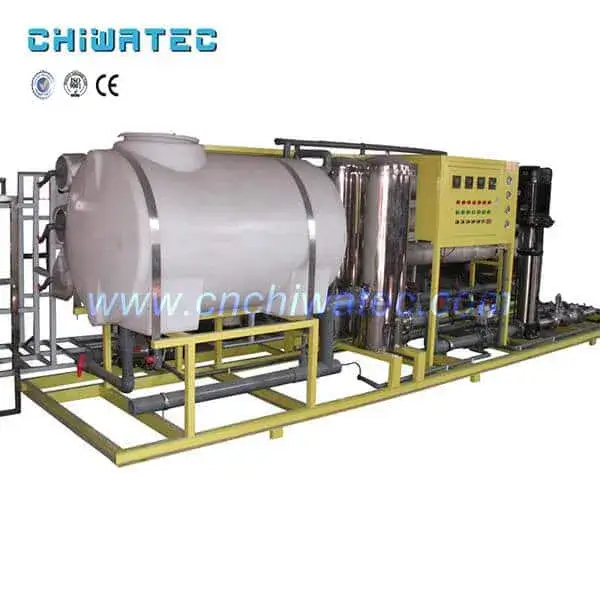
Reverse osmosis is the core technology for most hospital pure water systems, providing 95-99% contaminant rejection. A typical RO-based hospital pure water system design includes:
- Storage and distribution — Polyethylene or stainless steel storage tank (304L or 316L) with atmospheric vent filtration. Distribution loop constructed from PVDF, polypropylene, or stainless steel with continuous recirculation at >0.9 m/s velocity
- Final polishing — Mixed bed ion exchange or EDI for applications requiring ≥10 MΩ·cm resistivity. UV sterilizer (254 nm) and ultrafilter (0.01 μm) for bacteria and endotoxin removal at dialysis and lab points of use
- Point-of-use treatment — Additional polishing depending on departmental requirements. Dialysis units need endotoxin filters; labs may need TOC reduction UV
Water Quality Standards for Hospital Pure Water Applications
Hospital pure water system design must account for varying water quality standards across different medical applications:
- Hemodialysis (AAMI/ISO 13959): Bacteria <100 CFU/mL, endotoxin <0.25 EU/mL, specific limits on aluminum (<0.01 ppm), copper (<0.1 ppm), zinc (<0.1 ppm), and other contaminants
- Clinical laboratory (CLSI/ISO 3696): Type I water: resistivity ≥10 MΩ·cm, TOC <50 ppb, bacteria <10 CFU/mL. Type II: resistivity ≥1 MΩ·cm, TOC <50 ppb. Type III: resistivity ≥0.2 MΩ·cm
- USP Purified Water: Conductivity ≤1.3 μS/cm at 25°C, TOC ≤500 ppb. Used for non-sterile compounding and irrigation
- USP Water for Injection (WFI): Same conductivity/TOC limits as PW plus bacteria ≤10 CFU/100 mL and endotoxin <0.25 EU/mL. Typically produced by distillation or RO + EDI with UF
- Sterilization (autoclaves/washers): Conductivity ≤15 μS/cm, hardness <1 ppm, pH 5-7.5 to prevent instrument spotting and scaling
Frequently Asked Questions
What are the main components of a hospital pure water system?
A complete hospital pure water system includes feed water pretreatment (multimedia filter, carbon filter, softener), reverse osmosis unit, storage tank with distribution pump, closed-loop distribution piping (PVDF or stainless steel), UV sterilizer, point-of-use polishing (mixed bed, EDI, or ultrafilter), and continuous monitoring sensors for resistivity, flow, and TOC.
How much pure water does a typical hospital need per day?
A 300-bed general hospital typically consumes 3,000-5,000 liters of purified water daily. Dialysis units require 500-1,000 L/day per 10 stations. Clinical labs need 200-500 L/day. Autoclaves and washer-disinfectors consume 1,000-2,000 L/day. Total peak demand can reach 5-15 L/min during morning procedures.
What is the difference between USP Purified Water and WFI?
USP Purified Water (PW) has conductivity ≤1.3 μS/cm and TOC ≤500 ppb. It is used for non-sterile compounding and general laboratory work. USP Water for Injection (WFI) meets the same chemical standards but additionally must have bacteria ≤10 CFU/100 mL and endotoxin <0.25 EU/mL. WFI is used for preparing parenteral medications and requires more stringent validation.
Can a single centralized system serve all hospital departments?
Yes. A well-designed centralized hospital pure water system can supply multiple quality grades through dedicated distribution loops. RO permeate (5-15 μS/cm) serves autoclaves and general rinsing. RO + mixed bed or EDI (≥1 MΩ·cm) serves clinical labs. RO + EDI + UF (≥10 MΩ·cm, endotoxin-free) serves dialysis. A single central plant with appropriately designed polishing at each point of use is the most cost-effective approach.
How often should a hospital pure water system be maintained?
Daily: check resistivity, flow rates, and UV intensity. Weekly: sanitize distribution loop if required. Monthly: replace pre-filters, test bacteria levels. Every 3-6 months: clean RO membranes. Annually: replace UV lamps, service pumps and valves, replace RO membranes (3-5 years). EDI modules: 5-8 years. Continuous monitoring with alarm thresholds ensures immediate detection of quality deviations.
Conclusion & Call to Action
Hospital pure water system design is a specialized discipline requiring careful consideration of water quality standards, departmental requirements, flow capacity, redundancy, and long-term operating costs. Centralized RO-based systems with quality-specific distribution loops offer the best balance of water quality, reliability, and cost efficiency for 200+ bed facilities. CHIWATEC provides custom-designed hospital pure water systems with full validation support, from pretreatment through point-of-use polishing.
Email: [email protected] or [email protected]
Related Resources and Further Reading
- Application of Hospital Pure Water Central Processing System
- Pharmaceutical Pure Water System Engineering Case
- Laboratory Water Purifier: Complete Guide to Lab Water Purification
- Reverse Osmosis Pure Water System Applications: Industrial and Commercial
- RO Water Treatment System for Hospital and Medical Applications
Do you have a water treatment project we can help with
* Designing,machining,installing,commissioning, customize and one-stop service






 English
  Spanish
  Portuguese




