

Reverse Osmosis Pure Water Host Operation: Step-by-Step Startup Guide for RO Pure Water Equipment 2026
Proper reverse osmosis pure water host operation is essential for achieving reliable system performance, protecting membrane elements, and maintaining consistent water quality. This guide provides a detailed step-by-step procedure for starting up and operating a double-pass RO pure water system — from valve checks and pretreatment flushing to first-level and second-level RO startup. CHIWATEC supplies industrial RO pure water systems with comprehensive operation manuals and technical support.
Reverse Osmosis Pure Water Host Operation Overview
The reverse osmosis pure water host operation procedure involves several sequential steps that must be performed correctly to ensure system safety and membrane protection. The main stages include: pre-startup valve configuration, pretreatment flushing, low-pressure membrane flushing, first-level RO startup and parameter adjustment, and second-level RO startup. Below is the complete operating sequence for a typical two-pass RO pure water system:
| Step | Operation | Duration |
|---|---|---|
| 1 | Check all valves for correct positioning | 5 min |
| 2 | Pretreatment backwash and rinse | 30 min |
| 3 | Low-pressure flushing of RO membranes (first startup) | Extended |
| 4 | First-level RO startup and parameter adjustment | 10 min |
| 5 | Second-level RO startup and parameter adjustment | 10 min |
| 6 | Normal operation monitoring | Continuous |
Following the correct reverse osmosis pure water host operation sequence minimizes membrane damage and ensures optimal water quality from the first production cycle.
Step 1: Pre-Startup Valve Check and Configuration
Before any reverse osmosis pure water host operation can begin, all valves must be verified to be in the correct position:
- Primary inlet regulating valve: Set at the appropriate opening for the first-level RO unit
- Primary concentrate regulating valve: Set at the appropriate opening to achieve target recovery rate
- Secondary inlet regulating valve: Fully open for initial startup
- Secondary concentrate regulating valve: Fully open for initial startup
- Secondary product water valve: Set to discharge or connect to the pure water tank as required
A systematic valve check at the start of every reverse osmosis pure water host operation prevents pressure surges and equipment damage during the startup sequence.
Step 2: Pretreatment System Flushing
Before the RO system can operate, the pretreatment system (activated carbon filter and resin softener) must be prepared:
- Turn on the emergency stop switch and set the system to automatic mode
- Verify pretreatment water quality meets RO feed water requirements (SDI <5, free chlorine <0.1 ppm)
- Rotate automatic control valves to the operating position for each pretreatment vessel
- Manually backwash and rinse the activated carbon filter and resin softener for 30 minutes
- The inlet solenoid valve will open automatically when the system is ready
Proper pretreatment flushing removes any accumulated fines, channeling, or biological growth from the media beds before RO system startup.
Step 3: First-Level RO Low-Pressure Flushing
When starting the RO system for the first time or after extended shutdown, low-pressure flushing is critical:
- First-stage flushing solenoid valve opens automatically after the inlet solenoid valve activates
- Low-pressure flushing: RO membranes are flushed at low pressure (2–4 bar) for 2 minutes to remove air and preservative solution from the membrane elements
- Automatic transition: The flushing solenoid valve closes automatically after 2 minutes
- System startup: When inlet water pressure rises to the set point, the first-level RO high-pressure pump starts automatically
Low-pressure flushing is one of the most important steps in reverse osmosis pure water host operation — it prevents sudden pressure surges that can damage membrane elements and ensures even flow distribution across all vessels.
Step 4: First-Level RO Parameter Adjustment
After the first-level RO host starts, the operating parameters must be adjusted to their target values:
- Adjust the primary inlet regulating valve and concentrate regulating valve until parameters reach the set values
| Parameter | Target Value |
|---|---|
| Recovery Rate | 50–60% |
| Operating Pressure | 0.9–1.5 MPa (130–218 psi) |
| Primary Product Flow | 2.5 m3/h (example value) |
- First-time operation only: Extended low-pressure flushing should be performed before first full startup (see Step 3)
- Subsequent startups: Once the valves are fixed at the correct positions, repeat steps 1–4 each time (except the extended low-pressure flushing)
Note: The primary product water pressure must not exceed the set safety pressure. If pressure is too high, perform partial discharge or reduce primary operating pressure.
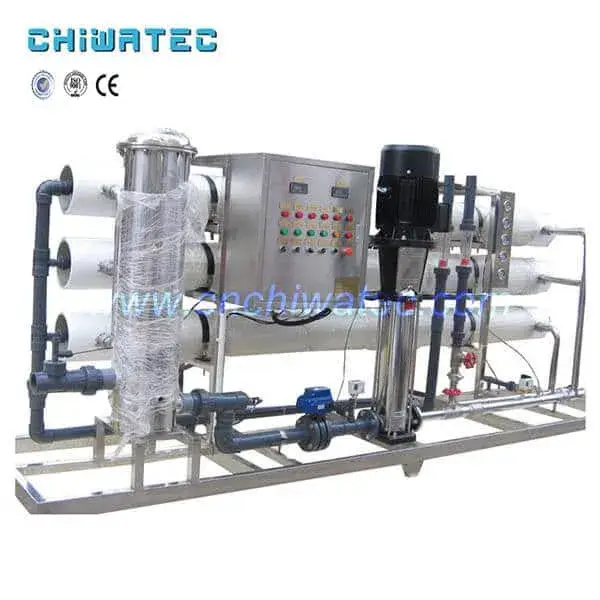
Step 5: Second-Level RO Startup Operation
After the first-level RO system is operating stably, the second-level RO can be started:
- Open the secondary inlet regulating valve and concentrate regulating valve to the appropriate opening
- First-level product water is boosted by the secondary high-pressure pump into the second-level RO membrane vessels
- Secondary product water is directed to discharge or the pure water tank
- Secondary flushing solenoid valve opens automatically, and the second-level RO membranes are flushed at low pressure for 2 minutes
- Automatic startup: The secondary flushing solenoid valve closes after 2 minutes, and when inlet pressure rises to the set point, the second-level RO host starts automatically
The second-level RO further polishes the first-level permeate, achieving higher water quality (conductivity <5 uS/cm) suitable for sensitive applications.
Normal Operation Monitoring and Maintenance
During continuous reverse osmosis pure water host operation, the following parameters should be monitored regularly:
| Parameter | Monitoring Frequency | Action if Out of Range |
|---|---|---|
| Feed pressure | Continuous | Check pretreatment and inlet valves |
| Interstage pressure | Daily | Check for membrane fouling or scaling |
| Concentrate pressure | Daily | Adjust concentrate valve |
| Product flow rate | Daily | Check for membrane fouling or temperature change |
| Product conductivity | Continuous | Check for seal leaks or membrane damage |
| Feed water temperature | Daily | Adjust pressure for temperature compensation |
Consistent monitoring during reverse osmosis pure water host operation allows early detection of performance changes and extends membrane life.
Common Startup Issues and Troubleshooting
Common problems encountered during reverse osmosis pure water host operation include:
- System does not start: Check emergency stop switch, inlet water pressure, and solenoid valve operation
- Low product flow: Verify feed water temperature (low temperature = low flow), check for clogged cartridge filters, or examine membrane fouling
- High product conductivity: Check for O-ring leaks in membrane vessels, damaged membrane elements, or brine seal displacement
- Excessive pressure drop: Indicates fouling or scaling — initiate membrane cleaning procedure
- Frequent system cycling: Check pressure switch settings and feed water supply stability
Identifying and resolving issues quickly minimizes downtime and maintains consistent water quality.
Frequently Asked Questions
Q1: What is reverse osmosis pure water host operation?
Reverse osmosis pure water host operation refers to the step-by-step startup, adjustment, and monitoring procedures for an RO pure water system, including valve checks, pretreatment flushing, low-pressure membrane flushing, first-level and second-level RO startup, and ongoing parameter monitoring.
Q2: Why is low-pressure flushing important in RO pure water host operation?
Low-pressure flushing removes air, preservative solution, and loose particles from the RO membrane elements before full-pressure operation. This prevents sudden hydraulic shock that can damage membrane elements and ensures even flow distribution across all pressure vessels.
Q3: How long should pretreatment flushing last before RO startup?
Pretreatment flushing (backwash and rinse of activated carbon and resin softener) should be performed for approximately 30 minutes before the first RO startup of the day. This removes accumulated fines and ensures pretreatment water quality meets RO feed requirements.
Q4: What are the normal operating parameters for a double-pass RO system?
Typical parameters: first-level recovery rate 50–60%, operating pressure 0.9–1.5 MPa, first-level product flow 2.5 m3/h (system-dependent). Second-level parameters depend on system design but generally operate at lower pressure since feed water is first-level permeate.
Q5: How often should RO pure water host operation procedures be performed?
The full startup procedure should be performed at the beginning of each production cycle. After initial valve positions are set and fixed, subsequent startups follow a simplified sequence (excluding extended low-pressure flushing, which is only needed for first startup or after extended shutdown).
Conclusion & Call to Action
Proper reverse osmosis pure water host operation is the foundation of reliable system performance, long membrane life, and consistent water quality. By following the correct startup sequence — valve checks, pretreatment flushing, low-pressure flushing, and staged RO startup — operators can maximize system uptime and minimize maintenance costs. For customized RO pure water systems with complete operation documentation and technical support, contact CHIWATEC today. Email us at [email protected] or [email protected] for a free consultation.
Do you have a water treatment project we can help with
* Designing,machining,installing,commissioning, customize and one-stop service






 English
  Spanish
  Portuguese




