RO Membrane Desalination Technology: Complete Guide to Seawater Desalination Equipment and Process 2026
RO membrane desalination technology is the mainstream solution for converting seawater and brackish water into fresh water in the 21st century. Using reverse osmosis membranes, high-pressure pumps, and energy recovery devices, modern desalination plants produce millions of cubic meters of fresh water daily with no phase change in the process — resulting in lower energy consumption and operating costs compared to thermal desalination methods. CHIWATEC provides integrated membrane desalination solutions for municipal water supply, industrial process water, and island/coastal fresh water production worldwide.
What Is RO Membrane Desalination Technology?
RO membrane desalination technology is a pressure-driven membrane separation process that removes dissolved salts and minerals from seawater or brackish water to produce fresh water. The technology uses semi-permeable reverse osmosis membranes with pore sizes of approximately 0.0001 microns — small enough to reject dissolved ions while allowing water molecules to pass through. By applying pressure greater than the osmotic pressure of the feed water (typically 55-85 bar for seawater), water is forced through the membrane against its natural osmotic flow direction.
The key characteristics that make RO the leading desalination technology include: no phase change during separation, relatively low investment costs, competitive desalinated water costs, short construction periods, and modular scalability. Modern RO seawater desalination plants can achieve over 99% salt rejection with energy consumption as low as 2.5-4.0 kWh/m3 of produced water.
Key Components of RO Desalination Systems
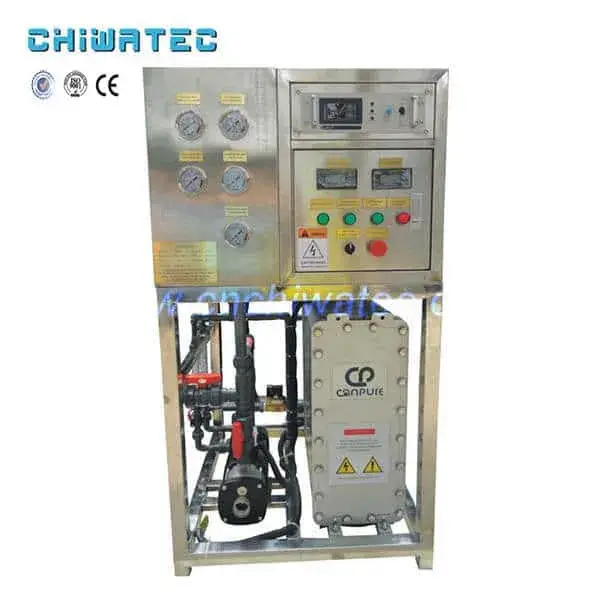
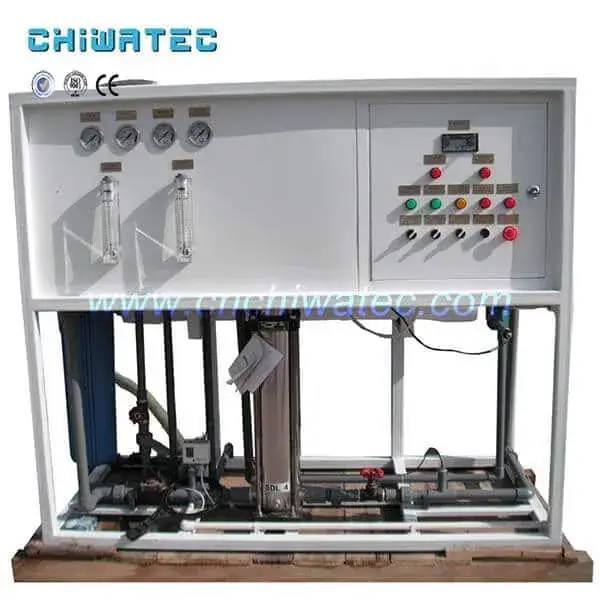
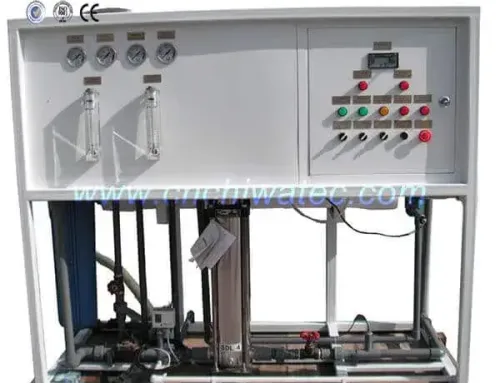
Seawater desalination equipment using RO membrane desalination technology consists of four main subsystems:
| Component | Function |
|---|---|
| RO membrane modules | Spiral-wound thin-film composite membranes arranged in pressure vessels — the core separation element |
| High-pressure pump | Provides the required feed pressure (55-85 bar) to overcome osmotic pressure and drive permeation |
| Energy recovery device | Captures pressure energy from the concentrate stream and transfers it to the feed stream, reducing overall energy consumption by up to 60% |
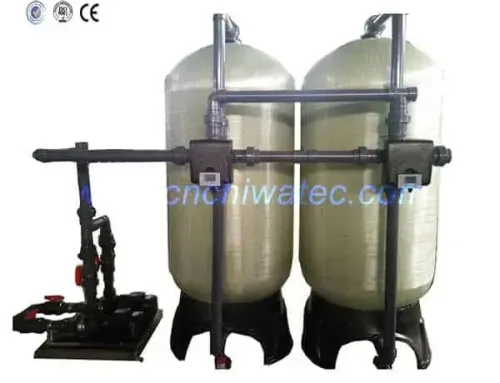
| Pre-treatment system | Cartridge filters, media filters, and antiscalant dosing to protect membranes from fouling and scaling |
| Post-treatment system | pH adjustment, remineralization, and disinfection to stabilize product water for distribution |
Seawater Desalination Process Flow Using RO Membranes
The complete seawater desalination process using RO membrane desalination technology follows these stages:
- Intake — Seawater is collected from open intake or beach wells, with preliminary screening to remove large debris and marine organisms
- Pre-treatment — Coagulation, media filtration (dual media or UF), and cartridge filtration (5 microns) to reduce SDI below 5 and remove suspended solids
- Antiscalant dosing — Scale inhibitor is injected to prevent calcium carbonate, calcium sulfate, and silica scaling on membrane surfaces
- High-pressure RO separation — Feed water at 55-85 bar passes through RO membrane arrays in stages, producing permeate (fresh water) and concentrate (brine)
- Energy recovery — The high-pressure brine stream passes through an energy recovery device (pressure exchanger or turbine) to recover pressure energy
- Post-treatment — Permeate is remineralized (calcium, magnesium, alkalinity added), pH adjusted, and disinfected before storage and distribution
Types of Reverse Osmosis Membranes Used in Desalination
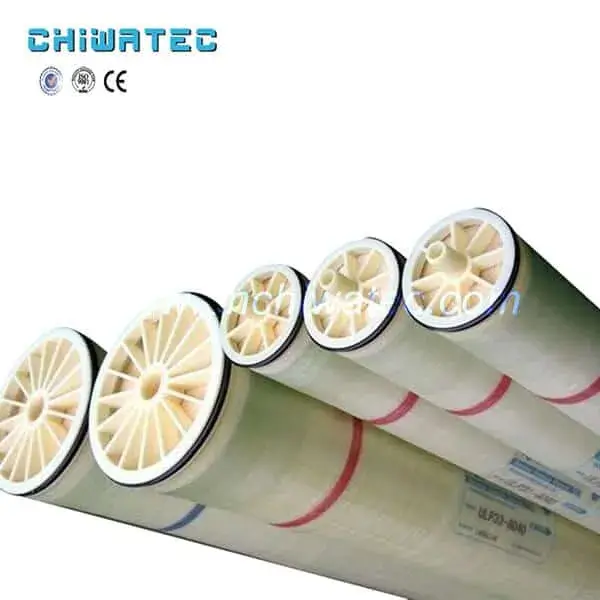
The most common membrane configuration for seawater desalination is the spiral-wound thin-film composite (TFC) membrane element. Key types include:
- Seawater RO (SWRO) membranes — High rejection (99.5-99.8%) membranes designed for seawater TDS of 32,000-45,000 mg/L at operating pressures of 55-85 bar
- Brackish water RO (BWRO) membranes — Lower pressure (10-25 bar) membranes for TDS up to 10,000 mg/L, offering higher flux and lower energy consumption
- Low-energy RO membranes — Modified SWRO or BWRO membranes that operate at lower pressures (15-30% reduction) with slightly lower rejection
- High-temperature RO membranes — Specialized membranes for feed water temperatures above 45°C, used in industrial applications
All modern RO desalination membranes use polyamide thin-film composite chemistry, providing excellent salt rejection, chemical stability, and resistance to biological degradation.
Energy Efficiency and Environmental Considerations
Modern RO membrane desalination technology has achieved remarkable energy efficiency improvements over the past two decades:
| Parameter | 2000 | Current (2024-2026) |
|---|---|---|
| Energy consumption (kWh/m3) | 5-8 | 2.5-4.0 |
| Membrane flux (L/m2·h) | 8-12 | 12-18 |
| Recovery rate (%) | 35-40 | 40-50 |
| Membrane lifespan (years) | 3-5 | 5-7 |
Key environmental innovations include energy recovery devices (pressure exchangers, Pelton turbines) that reduce system energy consumption by up to 60%, improved membrane anti-fouling properties that reduce chemical cleaning frequency, and advanced pre-treatment (UF membrane pre-filtration) that extends membrane life and reduces chemical usage.
Applications of Membrane Desalination Technology
RO membrane desalination technology is applied across diverse sectors:
- Municipal water supply — Coastal cities and islands where fresh water is scarce, such as the Middle East, Mediterranean, Singapore, and Australia
- Industrial process water — Power plants, chemical facilities, and refineries requiring high-purity feed water
- Tourism and hospitality — Resorts and hotels in coastal and island locations with limited fresh water sources
- Agriculture — Irrigation water for coastal agricultural zones facing fresh water shortages
- Emergency and disaster relief — Mobile desalination units for temporary fresh water supply during droughts or natural disasters
- Industrial wastewater reuse — Membrane technology used to treat and recycle industrial wastewater, recovering heavy metals and chemical products for sustainable production
Frequently Asked Questions (FAQ)
What is the difference between RO membrane desalination and thermal desalination?
RO membrane desalination uses pressure-driven membrane separation at ambient temperature, while thermal desalination (MSF, MED) uses heat to evaporate and condense water. RO has significantly lower energy consumption (2.5-4 vs 8-15 kWh/m3), lower capital costs, and a smaller footprint. Thermal desalination handles higher salinity feed water and produces higher purity distillate but at much higher energy and operating costs.
What is the typical salt rejection rate of RO membranes in seawater desalination?
Modern seawater RO membranes achieve 99.5-99.8% salt rejection, reducing seawater TDS from 35,000-45,000 mg/L to below 200-400 mg/L in a single pass. For ultra-pure applications, a second pass RO system can further reduce TDS to below 10 mg/L. The actual rejection depends on membrane type, operating pressure, temperature, and feed water composition.
How does an energy recovery device work in RO desalination?
An energy recovery device (ERD) captures the hydraulic pressure energy from the high-pressure concentrate (brine) stream and transfers it directly to the incoming feed water. Pressure exchangers (PX) use an isobaric chamber to transfer pressure with up to 97% efficiency, while Pelton turbines convert pressure to rotational energy to assist the main high-pressure pump motor. ERDs reduce overall system energy consumption by 40-60%.
What pre-treatment is required before RO membrane desalination?
Pre-treatment typically includes: screening to remove large debris, coagulation and flocculation, dual-media filtration or UF membrane filtration to reduce SDI below 5, cartridge filtration (5 microns) as a safety barrier, and antiscalant dosing to prevent membrane scaling. For seawater, chlorination/dechlorination may be needed to control biological fouling, and some plants incorporate dissolved air flotation (DAF) to remove algae and oil.
How is the brine (concentrate) from RO desalination disposed of?
Brine disposal methods include: discharge back to the sea through a multiport diffuser (most common), evaporation ponds, deep-well injection, or zero liquid discharge (ZLD) systems that crystallize the remaining salts. Modern desalination plants incorporate environmental impact assessments and brine dispersion modeling to minimize the impact on marine ecosystems around the outfall.
Conclusion & Call to Action
RO membrane desalination technology is a proven, efficient solution for addressing fresh water scarcity in coastal and island communities, industrial facilities, and agricultural operations worldwide. With continuous improvements in membrane materials, energy recovery, and system automation, RO desalination has become more affordable and accessible than ever before.
CHIWATEC offers comprehensive membrane desalination solutions, including RO membrane modules, high-pressure systems, energy recovery devices, and complete turnkey desalination plants. For expert guidance on implementing RO desalination for your water supply needs, contact us at [email protected] or [email protected] for a customized desalination solution.
Related Resources and Further Reading
Do you have a water treatment project we can help with
* Designing,machining,installing,commissioning, customize and one-stop service

 English
  Spanish
  Portuguese