

Difference Between RO Membrane and Ultrafiltration Membrane: Key Characteristics Compared 2026
When selecting a membrane-based water treatment system, understanding the difference between RO membrane and ultrafiltration membrane is essential for making the right choice. Reverse osmosis (RO) membranes and ultrafiltration (UF) membranes are both pressure-driven separation technologies, but they operate at fundamentally different scales of filtration. The difference between RO membrane and ultrafiltration membrane lies in pore size, operating pressure, rejection capability, and application suitability. CHIWATEC specializes in both RO and UF membrane systems, offering customized solutions for industrial and commercial water treatment projects worldwide.
What Is the Difference Between RO Membrane and Ultrafiltration Membrane — An Overview
The core difference between RO membrane and ultrafiltration membrane starts with pore size. RO membranes have pores of approximately 0.0001 microns (0.1 nm), making them capable of removing dissolved salts, heavy metals, and monovalent ions. UF membranes have larger pores, typically 0.01 to 0.1 microns, allowing dissolved salts to pass through while blocking suspended solids, bacteria, and viruses. This fundamental difference between RO membrane and ultrafiltration membrane determines their respective roles in water treatment — RO for desalination and high-purity water, UF for pretreatment and particle removal.
| Parameter | RO Membrane | UF Membrane |
|---|---|---|
| Pore Size | 0.0001 µm (0.1 nm) | 0.01–0.1 µm |
| Operating Pressure | 10–70 bar | 1–5 bar |
| Salt Rejection | >99% | None |
| Bacteria Removal | >99.9% | >99.9% |
| Viruses Removal | >99% | >99% |
| Flow Rate | Lower (restricted) | Higher (open pores) |
This comparison table highlights the primary difference between RO membrane and ultrafiltration membrane across key performance indicators. Each technology serves a distinct purpose in a complete water treatment train.
Pore Size Difference: How RO Membrane and Ultrafiltration Membrane Filter at Different Scales
The most fundamental difference between RO membrane and ultrafiltration membrane is the pore size. RO membranes use a dense non-porous active layer where water transport occurs via diffusion through the polymer matrix. UF membranes contain physical pores that act as a sieve, blocking particles larger than the pore diameter. An RO membrane rejects dissolved salts (Na+, Cl−, Ca2+, Mg2+) that are only 0.1–1 nm in size, while a UF membrane lets these ions pass freely. This pore size difference between RO membrane and ultrafiltration membrane means RO produces near-distilled water quality, while UF produces filtered water that retains mineral content.
- RO membrane: Non-porous active layer, diffusion-based transport, rejects 99%+ of dissolved salts
- UF membrane: Physical pores of 0.01–0.1 µm, sieve-based separation, passes all dissolved salts
- MWCO (Molecular Weight Cut-Off): RO = <100 Da, UF = 1,000–500,000 Da
Operating Pressure: RO Membrane vs Ultrafiltration Membrane Driving Forces
Another critical difference between RO membrane and ultrafiltration membrane is the pressure required. RO membranes need 10–70 bar (150–1,000 psi) to overcome osmotic pressure and force water through the dense membrane layer. UF membranes operate at just 1–5 bar (15–75 psi) because their porous structure offers minimal hydraulic resistance. This pressure difference between RO membrane and ultrafiltration membrane directly impacts energy consumption — RO systems require high-pressure pumps and consume 3–8 kWh/m³, while UF systems use standard low-pressure pumps at 0.2–0.5 kWh/m³. For applications where energy efficiency is a priority, UF offers a clear advantage over RO.
Rejection Rate Difference: What RO Membrane and UF Membrane Each Remove
The rejection capability difference between RO membrane and ultrafiltration membrane determines which contaminants each technology can address:
| Contaminant | RO Membrane | UF Membrane |
|---|---|---|
| Dissolved salts (TDS) | 95–99% rejection | 0% (passes through) |
| Hardness (Ca²⁺, Mg²⁺) | 94–98% rejection | 0% (passes through) |
| Heavy metals | 95–99% rejection | Partial (if particulate) |
| Suspended solids | 100% (with pretreatment) | >99% above pore size |
| Bacteria | >99.9% | >99.9% |
| Viruses | >99% | >99% |
| Colloidal silica | >99% | Partial |
| Dissolved organics | 90–98% | Varies by MWCO |
This table clearly shows the difference between RO membrane and ultrafiltration membrane in terms of contaminant removal. RO membranes provide comprehensive desalination, while UF membranes excel at particle, bacteria, and virus removal without altering the water’s chemical composition.
Membrane Material and Structure: Comparing RO Membrane and Ultrafiltration Membrane Construction
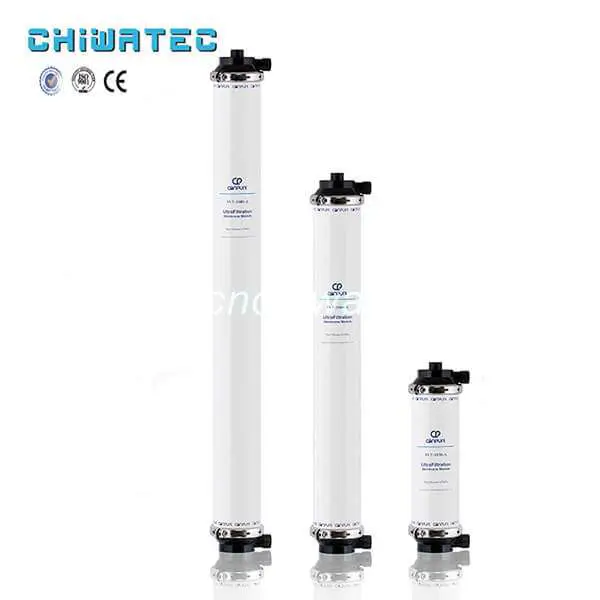
The construction difference between RO membrane and ultrafiltration membrane reflects their distinct filtration mechanisms. RO membranes are manufactured as thin-film composite (TFC) structures: a polyamide active layer (~0.2 µm) on a polysulfone support (~40 µm) on a polyester fabric backing (~120 µm). UF membranes are typically made as homogeneous porous structures from polyethersulfone (PES), polyvinylidene fluoride (PVDF), or polysulfone (PS), formed into hollow fiber or flat sheet configurations.
- RO membrane structure: TFC flat sheet → spiral wound element; sensitive to chlorine and oxidation
- UF membrane structure: Homogeneous porous hollow fiber or flat sheet; chlorine-resistant options available
- Material difference between RO membrane and ultrafiltration membrane: RO uses polyamide (sensitive), UF uses PES/PVDF (chemically robust)
Application Fields: Where RO Membrane and Ultrafiltration Membrane Excel
The application difference between RO membrane and ultrafiltration membrane follows their separation capabilities. RO membranes are used wherever high-purity water is required — seawater desalination, boiler feed water, pharmaceutical water, electronics rinsing, and beverage production. UF membranes serve as pretreatment for RO systems, as standalone filtration for drinking water, in wastewater reclamation, and in industrial process water where mineral content should be preserved.
- RO membrane applications: Desalination, ultrapure water, pharmaceutical water (WFI), dairy processing (concentration), seawater desalination
- UF membrane applications: RO pretreatment, drinking water filtration, MBR (membrane bioreactor), wastewater reclamation, juice clarification, protein concentration
Understanding this difference between RO membrane and ultrafiltration membrane in applications helps system designers build cost-effective multi-stage treatment trains.
Maintenance and Cleaning: RO Membrane vs Ultrafiltration Membrane
Maintenance requirements reveal another difference between RO membrane and ultrafiltration membrane. RO membranes are more sensitive to fouling and require careful pretreatment, antiscalant dosing, and periodic CIP (Clean-in-Place) with acidic and alkaline solutions. UF membranes can tolerate higher turbidity feeds and can be cleaned with backwashing, air scouring, and chemical cleaning using chlorine or caustic soda.
- RO membrane maintenance: CIP every 3–6 months, sensitive to chlorine (<0.1 ppm), requires SDI <5 feed water
- UF membrane maintenance: Backwash every 30–60 minutes, chlorine-tolerant, can handle SDI up to 20 feed water
- Lifespan difference between RO membrane and ultrafiltration membrane: RO = 3–5 years, UF = 5–10 years (with proper maintenance)
Cost Comparison: RO Membrane and Ultrafiltration Membrane Lifecycle Costs
The cost difference between RO membrane and ultrafiltration membrane involves capital expenditure (CAPEX) and operational expenditure (OPEX). RO membrane systems have higher CAPEX due to high-pressure pumps, piping, and corrosion-resistant materials. UF systems have lower CAPEX but may require more frequent cleaning and eventual replacement. On a lifecycle basis, RO systems cost $0.50–$2.00 per m³ of product water, while UF systems cost $0.10–$0.50 per m³. The energy consumption difference between RO membrane and ultrafiltration membrane — 3–8 kWh/m³ for RO vs 0.2–0.5 kWh/m³ for UF — is the largest OPEX differentiator.
How to Choose Between RO Membrane and Ultrafiltration Membrane
Selecting the right technology requires evaluating your specific water quality goals. The difference between RO membrane and ultrafiltration membrane guides the decision:
- Choose RO membrane when: You need desalination, TDS reduction >90%, or water quality below 50 µS/cm conductivity
- Choose UF membrane when: You need particle/bacteria removal but want to retain minerals, or as pretreatment for RO
- Choose both (RO + UF): When raw water has high turbidity or SDI, and final product water needs to be RO-quality. UF serves as ideal RO pretreatment, reducing RO membrane fouling by >50%.
For application-specific advice on the difference between RO membrane and ultrafiltration membrane for your project, contact CHIWATEC for engineering support and customized system design.
Frequently Asked Questions
Q1: What is the main difference between RO membrane and ultrafiltration membrane?
The main difference between RO membrane and ultrafiltration membrane is pore size. RO membranes have pores of ~0.0001 microns and remove dissolved salts via diffusion. UF membranes have pores of 0.01–0.1 microns and remove particles via sieving, allowing salts to pass through.
Q2: Can UF membrane replace RO membrane?
No. UF membrane cannot remove dissolved salts or TDS. If your application requires desalination or high-purity water, RO membrane is necessary. UF and RO are complementary technologies often used together in a treatment train.
Q3: Which has lower operating cost, RO membrane or UF membrane?
UF membrane has significantly lower operating cost because it operates at 1–5 bar (vs 10–70 bar for RO), consuming 0.2–0.5 kWh/m³ compared to RO’s 3–8 kWh/m³. However, UF does not provide desalination — the cost savings come with functional limitations.
Q4: How long do RO and UF membranes last?
RO membranes typically last 3–5 years, while UF membranes can last 5–10 years with proper maintenance. The difference between RO membrane and ultrafiltration membrane lifespan is due to RO’s higher operating pressure and greater susceptibility to fouling and oxidation.
Q5: Is UF membrane or RO membrane better for drinking water?
For drinking water, UF membrane is often sufficient as it removes bacteria, viruses, and particles while retaining beneficial minerals. RO membrane produces water low in TDS, which may require remineralization for drinking. The choice depends on raw water quality and desired final water composition.
Conclusion & Call to Action
Understanding the difference between RO membrane and ultrafiltration membrane is critical for designing effective and cost-efficient water treatment systems. RO membranes provide high-purity desalination for applications requiring near-zero TDS, while UF membranes offer economical particle and pathogen removal without altering water chemistry. By evaluating your feed water quality, target water standards, energy budget, and maintenance capabilities, you can select the right membrane technology — or combine both for optimal performance. For expert guidance on the difference between RO membrane and ultrafiltration membrane and customized system design, contact CHIWATEC today. Email us at [email protected] or [email protected] for a free consultation and project quotation.
Do you have a water treatment project we can help with
* Designing,machining,installing,commissioning, customize and one-stop service






 English
  Spanish
  Portuguese




