Ultrafiltration Membrane Industry Applications: Key Sectors and Selection Guide 2026
Ultrafiltration (UF) membranes serve diverse roles across multiple industrial sectors, but selecting the wrong membrane type for your application leads to fouling, low flux, and excessive operating costs. This guide covers the primary ultrafiltration membrane industry applications in pharmaceutical, food and beverage, water purification, and wastewater treatment sectors, along with guidance on choosing between external pressure and internal pressure hollow fiber modules. CHIWATEC supplies industrial-grade UF membrane modules with custom pore-size specifications for each application environment.
Ultrafiltration Membrane Industry Applications in Pharmaceutical and Biochemical Processing
The pharmaceutical industry relies on UF membranes for concentration and purification of biological products, fermentation broths, and Chinese herbal medicine extracts. UF membranes with molecular weight cutoffs (MWCO) of 10–100 kDa effectively separate active pharmaceutical ingredients (APIs) from cellular debris, proteins, and polysaccharides. Key ultrafiltration membrane industry applications in this sector include:
- Concentration and desalting of enzyme solutions and vaccines
- Clarification of antibiotic fermentation broth before downstream chromatography
- Refining of traditional Chinese medicine extracts by removing tannins and pigments
- Sterile filtration of injectable-grade water and buffer solutions
UF Membrane Applications in the Food and Beverage Industry
In food and beverage processing, UF membranes enable cold sterilization, concentration, and clarification without thermal damage to heat-sensitive products. Common applications include:
- Dairy processing: Concentration of milk proteins and whey protein recovery using 10–30 kDa UF membranes
- Beverage clarification: Removal of haze-forming colloids from wine, beer, and fruit juices while preserving flavor compounds
- Edible oil refining: Degumming and phospholipid removal by membrane filtration
- Low-alcohol wine production: Selective removal of alcohol through UF membrane permeation
UF membrane processing preserves the sensory qualities of food products and eliminates the need for diatomaceous earth filtration, reducing both operating costs and waste disposal requirements.
UF Membrane in Water Purification and RO Pretreatment
UF membranes serve as the primary barrier for particulate, colloidal, and microbial removal in drinking water systems and reverse osmosis (RO) pretreatment. With a pore size of approximately 0.01–0.1 µm, UF membranes achieve >99.99% removal of bacteria, viruses, and suspended solids, producing water with a silt density index (SDI) below 3 — the standard requirement for RO feed water. Applications include:
- Residential and community drinking water purification systems
- Sterile water supply for hospitals and laboratories
- RO pretreatment in seawater desalination and industrial demineralization plants
- Household water purifier filtration elements
UF Membrane in Wastewater Treatment and Reuse
Industrial and municipal wastewater treatment has become one of the fastest-growing ultrafiltration membrane industry applications. UF-based membrane bioreactors (MBRs) and continuous microfiltration (CMF) systems treat secondary effluent to reuse quality. Key applications include:
- Advanced sewage treatment and reclaimed water reuse
- Machining cutting fluid separation and oil-water separation in steel rolling coolant recovery
- Electrophoretic paint recovery in automotive coating processes
- Intermediate water treatment for building-scale greywater recycling
UF systems in wastewater applications typically use PVDF or PES hollow fiber membranes with backwash and chemical cleaning protocols to maintain stable flux over multi-year operating cycles.
External Pressure vs. Internal Pressure UF Membrane Selection
| Parameter | External Pressure UF | Internal Pressure UF |
|---|---|---|
| Feed flow direction | Outside-in (shell to lumen) | Inside-out (lumen to shell) |
| Typical pore size | 0.01–0.05 µm | 0.01–0.1 µm |
| Best suited for | High-solids feed (wastewater, surface water) | Low-turbidity feed (groundwater, treated effluent) |
| Fouling tendency | Lower (larger membrane area) | Higher (lumen may clog with particles) |
| Cleaning method | Backwash from lumen outward | Forward flush and chemical cleaning |
| Common applications | MBR, wastewater reuse, high-turbidity surface water | RO pretreatment, drinking water, low-turbidity feed |
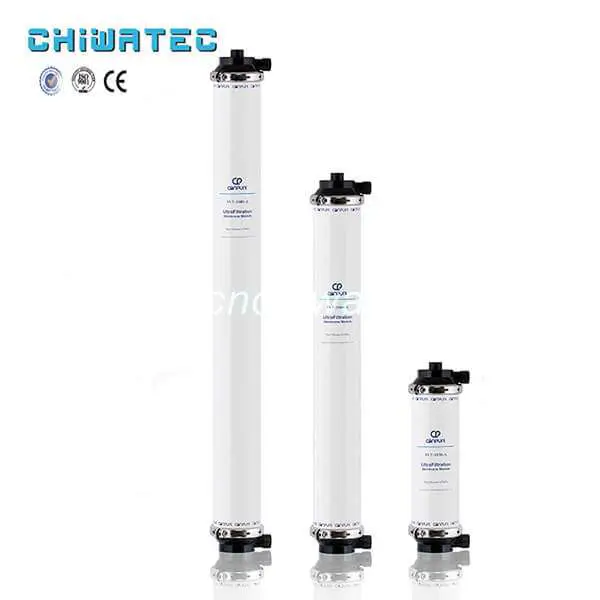
External pressure modules are preferred for feed water with higher suspended solids because the larger membrane area accommodates fouling without rapid pressure drop. Internal pressure modules are more efficient for clean feed sources and provide easier hydraulic control during operation.
Frequently Asked Questions (FAQ)
What is the difference between UF and MF membrane applications?
UF membranes (0.01–0.1 µm) remove viruses, proteins, and colloids, while microfiltration (MF) membranes (0.1–10 µm) remove only suspended solids and bacteria. UF is preferred for applications requiring viral clearance or RO pretreatment, whereas MF is sufficient for coarse particle removal.
Can UF membranes handle high-temperature feed streams?
Standard PES and PVDF UF membranes operate up to 40–50 °C. For hot process streams in food or pharmaceutical applications, ceramic UF membranes withstand temperatures up to 120 °C and are chemically compatible with aggressive cleaning agents.
How often should UF membranes be cleaned in wastewater applications?
In municipal wastewater MBR systems, automatic backwashing occurs every 30–60 minutes. Maintenance cleaning with chlorine or citric acid is typically performed weekly, and intensive chemical clean-in-place (CIP) is required every 3–6 months depending on feed water quality.
What MWCO is recommended for protein concentration?
For protein concentration, a 10–30 kDa UF membrane retains most proteins while allowing water and small solutes to pass. Use 5–10 kDa for smaller peptides and 50–100 kDa for large enzymes or polysaccharide separation.
What is the typical lifespan of a UF membrane module?
With proper pretreatment and cleaning protocols, polymeric UF membrane modules last 3–7 years. Factors affecting lifespan include feed water quality, chemical exposure, backwash frequency, and operating pressure. Ceramic UF membranes can last 10–15 years but have higher upfront costs.
Conclusion & Call to Action
Ultrafiltration membranes serve critical functions across pharmaceutical, food and beverage, water purification, and wastewater treatment industries. The choice between external pressure and internal pressure membrane modules depends on feed water quality, suspended solids loading, and cleaning requirements. For custom UF membrane solutions tailored to your specific ultrafiltration membrane industry applications, contact the CHIWATEC engineering team at [email protected] or [email protected].
Related Resources and Further Reading
Do you have a water treatment project we can help with
* Designing,machining,installing,commissioning, customize and one-stop service
 English
  Spanish
  Portuguese