EDI Ultrapure Water Equipment Maintenance: Complete Guide to EDI System Care and Troubleshooting 2026
Electrodeionization (EDI) ultrapure water equipment requires systematic maintenance to sustain 16-18.2 MΩ·cm output and maximize module lifespan (typically 5-8 years). Proper EDI ultrapure water equipment maintenance focuses on four critical areas: pretreatment system upkeep, reverse osmosis membrane care, EDI module stack monitoring, and final polishing component maintenance. This guide provides complete maintenance procedures, schedules, and troubleshooting for EDI systems used in industrial ultrapure water production. CHIWATEC offers comprehensive EDI system maintenance support and service contracts.
Why Regular EDI Ultrapure Water Equipment Maintenance Matters
EDI systems operate continuously, removing dissolved ions through ion exchange membranes and resin under a DC electrical field. Without proper maintenance, several issues degrade performance:
- Scaling — Calcium, magnesium, and silica deposits on EDI membrane surfaces increase voltage requirements and reduce ion removal efficiency
- Fouling — Organic compounds, colloids, and biological growth block ion exchange pathways in EDI stacks
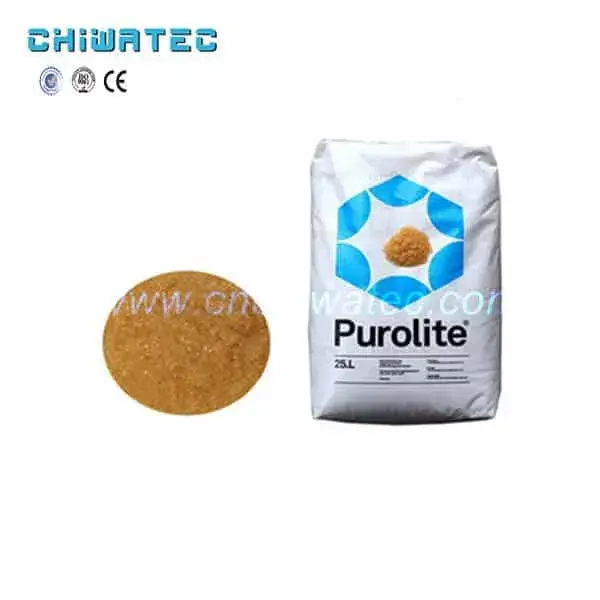
- Resin degradation — Continuous electrical cycling gradually breaks down ion exchange resin beads, reducing capacity over time
- Membrane damage — High pressure differentials or chemical attack can tear or delaminate EDI membranes
A well-maintained EDI ultrapure water equipment maintenance program prevents these issues, maintaining consistent water quality and extending equipment life to its full 5-8 year design lifespan.
Daily and Weekly EDI System Maintenance Checklist
| Frequency | Task | Target Value |
|---|---|---|
| Daily | Check EDI product water resistivity | ≥16 MΩ·cm |
| Daily | Monitor EDI module voltage and current | Within manufacturer spec (±10%) |
| Daily | Record feed water conductivity | <40 μS/cm |
| Weekly | Check pressure differential across EDI stack | <15 psi at rated flow |
| Weekly | Inspect pretreatment system backwash | Normal operation cycle |
| Weekly | Verify concentrate and electrode flow rates | Per design specification |
Pretreatment System Maintenance for EDI Ultrapure Water Equipment
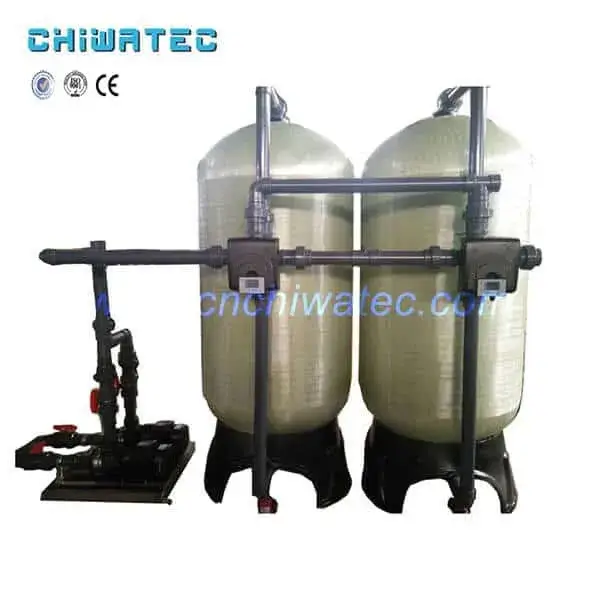
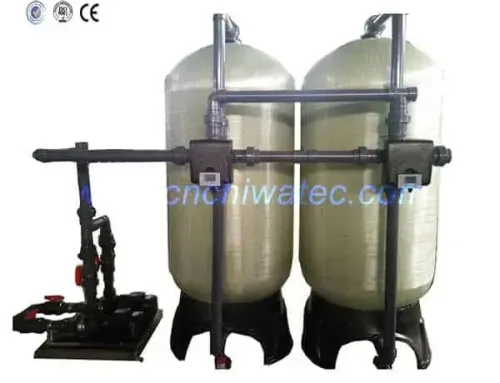
The pretreatment system — typically including multimedia sand filter, activated carbon filter, and water softener — protects downstream EDI components from fouling and scaling. Proper pretreatment maintenance is the foundation of reliable EDI ultrapure water equipment maintenance.
Sand filter maintenance:
- Backwash daily or when pressure differential reaches 8-10 psi
- Replace media every 3-5 years depending on water quality
- Inspect multi-port valve annually for leaks and proper sealing
Activated carbon filter maintenance:
- Backwash on the same schedule as sand filter
- Replace carbon every 12-18 months to prevent bacterial growth and chlorine breakthrough
- Test effluent for residual chlorine weekly — should read 0 ppm
Water softener maintenance:
- Regenerate when hardness reaches the setpoint (typically 1-5 ppm leakage)
- Check brine tank salt level weekly — maintain 50%+ salt saturation
- Clean brine tank annually to remove sediment and iron buildup
Reverse Osmosis Membrane Care in EDI Ultrapure Water Equipment
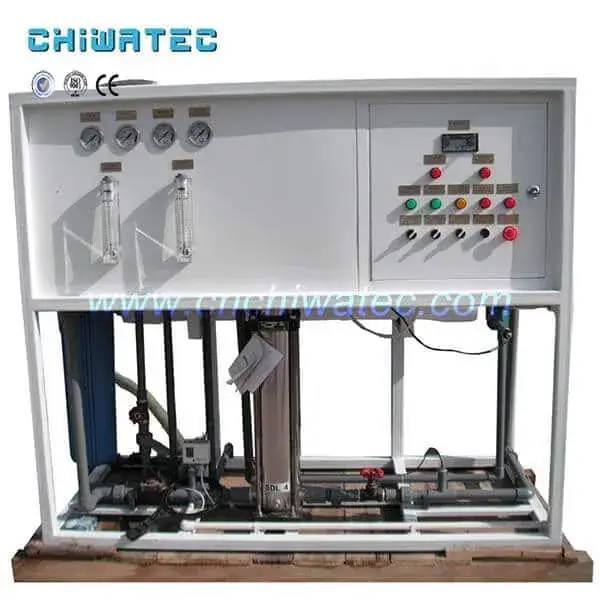
RO membranes are the primary desalination barrier, removing 95-99% of dissolved solids. RO maintenance directly impacts EDI module performance — poor RO operation forces the EDI stack to handle higher ionic load, reducing efficiency and lifespan.
Key maintenance procedures:
- Auto-flush: Most modern RO systems have automatic flushing at startup and shutdown. Flush pressure should not exceed 3 kg/cm² at high flow rate to remove deposits from membrane surfaces.
- Chemical cleaning: Clean RO membranes every 3-6 months — sooner if normalized permeate flow drops 15% or salt passage increases 10-15%. Use acidic cleaner for inorganic scaling (pH 2-3) and alkaline cleaner for organic fouling (pH 11-12).
- Membrane replacement: Replace RO membranes every 3-5 years depending on feed water quality and cleaning frequency.
- Pressure gauge monitoring: The pressure differential across RO membranes should remain stable. A rising differential indicates fouling; a falling differential indicates membrane damage.
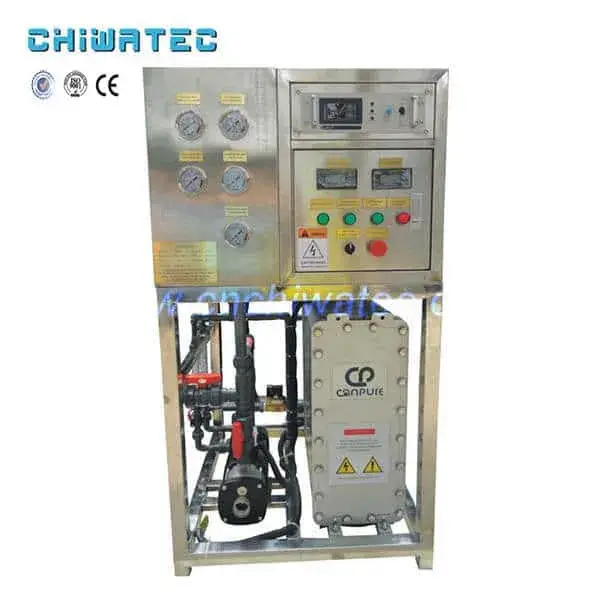
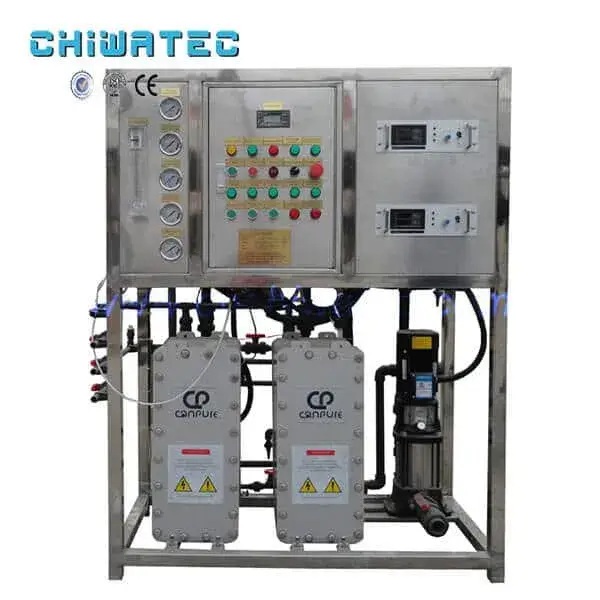
EDI Module Stack Maintenance and Monitoring
Common EDI Ultrapure Water Equipment Problems and Solutions
| Problem | Probable Cause | Solution |
|---|---|---|
| Product resistivity dropping | High feed conductivity, low voltage, scaling | Check RO performance; increase DC voltage gradually; clean RO membranes |
| High stack voltage | Membrane scaling or fouling | Reduce feed hardness; check softener performance; schedule RO cleaning |
| High pressure differential | Flow restriction or EDI stack blockage | Check concentrate flow control; inspect for debris; evaluate stack replacement |
| Decreasing product flow | RO membrane fouling, pump degradation | Clean RO membranes; check pump pressure and alignment |
| Chlorine in EDI feed | Carbon filter exhaustion | Replace activated carbon immediately; check EDI stack for membrane damage |
| Softener hardness leakage | Brine depletion, resin exhaustion | Refill brine tank; check regeneration cycle; replace resin if needed |
Frequently Asked Questions
How often should EDI modules be replaced?
EDI module stacks typically last 5-8 years with proper pretreatment and maintenance. Key end-of-life indicators include sustained voltage increase beyond manufacturer limits, inability to maintain product resistivity above 10 MΩ·cm with correct feed conditions, and physical damage to membrane sheets or spacer gaskets.
Can EDI stacks be chemically cleaned?
Some EDI manufacturers offer limited chemical cleaning protocols using mild acid (citric acid, pH 2-3) or dilute caustic (pH 10-11) for specific fouling conditions. However, EDI stacks cannot withstand the aggressive chemical cleaning cycles used for RO membranes. Prevention through proper pretreatment is always preferable to chemical cleaning.
What feed water quality does EDI require?
EDI modules require RO permeate with conductivity below 40 μS/cm (ideally below 20 μS/cm), hardness below 0.1 ppm as CaCO₃, free chlorine at 0 ppm, TOC below 0.5 ppm, silica below 1 ppm, and carbon dioxide below 10 ppm. Meeting these specifications requires properly maintained RO and pretreatment systems.
Why is my EDI product water resistivity fluctuating?
Resistivity fluctuation is often caused by feed water conductivity variation (check RO system), feed water temperature changes (conductivity is temperature-dependent), cyclic concentration polarization in the EDI stack, or intermittent concentrate flow restriction. Check all three flow streams (product, concentrate, electrode) daily.
What is the difference between EDI and mixed bed maintenance?
The key difference is chemical regeneration. Mixed bed systems require periodic regeneration with HCl and NaOH, including chemical handling, storage, and waste neutralization. EDI systems require no regeneration chemicals but need more careful monitoring of feed water quality and stack electrical parameters. EDI maintenance is less labor-intensive but more dependent on sensor reliability and upstream pretreatment.
Conclusion & Call to Action
Systematic EDI ultrapure water equipment maintenance is essential for maintaining 16-18.2 MΩ·cm water quality, maximizing stack lifespan, and minimizing unplanned downtime. Daily monitoring of resistivity, voltage, and flow — combined with weekly pretreatment checks and scheduled RO membrane cleaning — keeps your EDI system operating at peak efficiency. CHIWATEC provides complete maintenance support, spare parts, and service contracts for EDI ultrapure water systems.
Email: [email protected] or [email protected]
Related Resources and Further Reading
- EDI Ultrapure Water Equipment Problems and Solutions: Complete Troubleshooting Guide
- EDI Ultrapure Water Equipment: Features, Process Flow, and Applications
- EDI Technology Advantages Compared with Mixed Bed: Complete Guide
- EDI Ultrapure Water System: Working Principle, Technology, and Advantages
- Ultrapure Water Purification System with EDI Technology
Do you have a water treatment project we can help with
* Designing,machining,installing,commissioning, customize and one-stop service
 English
  Spanish
  Portuguese