

Ozone Generator Buyer’s Guide: Key Selection Criteria 2026
Choosing the wrong ozone generator wastes thousands of dollars on equipment that cannot deliver the required ozone concentration or output for your application. Whether you need air sterilization or water treatment, this ozone generator buyer’s guide covers the five critical criteria: model sizing, quality evaluation, application fit, cost-effectiveness, and common purchasing pitfalls. CHIWATEC offers high-performance ozone generators with air-source purification systems, dual-electrode cooling, and intelligent controls for stable long-term operation.
Ozone Generator Buyer’s Guide: Model Sizing and Output Selection
The first decision in any ozone generator buyer’s guide is determining the required ozone output (g/h). For air treatment, use 20–50 mg/m³ as the guideline — food and pharmaceutical industries should select the higher end. Calculate total ozone demand by multiplying the space volume (m³) by the required concentration. For water treatment, a high-concentration ozone generator (>12 mg/L) is mandatory because low-concentration ozone cannot effectively oxidize contaminants in water. Small-scale integrated models (5–200 g/h) suit most commercial applications, while industrial plants require medium-to-large modular units.
Quality Evaluation: Materials, Cooling, and Drive System
A high-quality ozone generator must use high-dielectric discharge materials, include a gas-source purification device, and employ dual-electrode cooling to maintain stable ozone output. High-frequency drive circuits increase ozone concentration while reducing power consumption. Intelligent control systems enable real-time adjustment of output parameters. Look for units that maintain consistent ozone concentration regardless of ambient temperature and humidity — low-configuration generators lose 30–50% of their output when temperature exceeds 35°C.
Air Treatment vs. Water Treatment: Application-Based Selection
Selecting an ozone generator without considering the application is the most common mistake. For air sterilization and deodorization, an economical open-type generator with air-source feed is sufficient. The cost is lower, and the simpler structure is adequate for most indoor environments. For water purification, wastewater treatment, or aquaculture, only high-concentration ozone generators with dedicated gas-source treatment devices should be used. Open-type ozone generators produce insufficient ozone concentration for water treatment — the dissolved ozone level will be too low to achieve meaningful disinfection or oxidation.
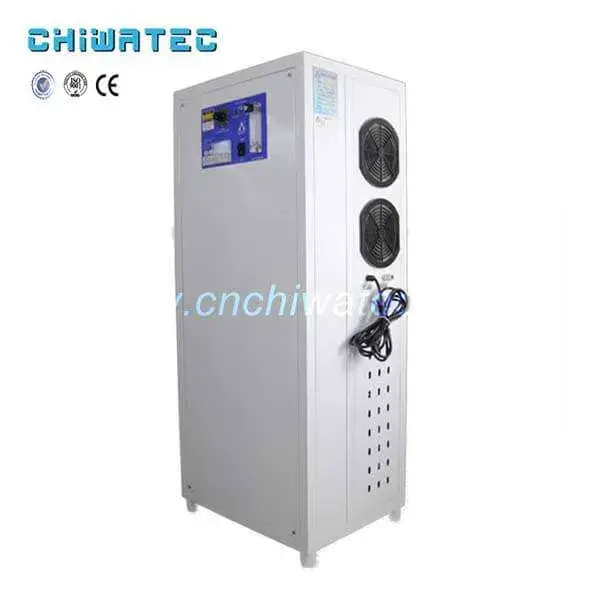
The 5G Ozone Generator Sterilizer shown below is an example of a high-performance unit suitable for both air and water applications:
Cost-Effectiveness: Total Cost of Ownership Evaluation
A low-cost ozone generator may seem attractive upfront, but the total cost of ownership tells a different story. Low-configuration generators are heavily affected by ambient conditions — rising temperature and humidity can cut ozone output by half, forcing you to run the unit longer to achieve the same treatment effect. This increases electricity and maintenance costs. High-quality ozone generators maintain stable performance across environmental variations, use less power per gram of ozone produced, and require fewer consumable replacements. When evaluating price, always factor in the gas source — an ozone generator sold without a gas source may appear cheaper but will require an additional investment equal to 30–50% of the purchase price.
Common Misunderstandings When Purchasing an Ozone Generator
- Gas source confusion: Some suppliers quote prices for ozone generators without specifying whether a gas-source system is included. An oxygen-fed generator produces twice the ozone output of an air-fed unit — make sure you are comparing like-for-like when reviewing specifications.
- Open-type generators cannot treat water: A common and costly error is purchasing an open (economical) ozone generator for water treatment. Open-type units cannot achieve the ozone concentration required for effective water disinfection.
- Rated output verification: Confirm whether the advertised output is measured with air feed or oxygen feed. Output ratings for oxygen-source operation are approximately double those for air-source operation, and the equipment cost differs proportionally.
Backup and Redundancy Considerations
For facilities where continuous ozone treatment is critical (e.g., food processing, pharmaceutical water systems, aquaculture hatcheries), a standby ozone generator is essential. Follow the “dual-use, one-standby” principle: one unit in active operation, one unit on standby for immediate swap during maintenance or repair. This prevents production downtime and ensures consistent treatment quality. When purchasing, consider whether the same model family supports both primary and backup roles for interchangeable parts and simplified training.
Frequently Asked Questions (FAQ)
What size ozone generator do I need for a 500 m³ warehouse?
For air sterilization in a 500 m³ warehouse at 30 mg/m³, you need 15 g/h of ozone output. Select a 20 g/h generator to allow a safety margin, using a high-concentration air-source unit with a purification system.
Can I use the same ozone generator for both air and water treatment?
Yes, if the generator is a high-concentration model (>12 mg/L ozone output). A single unit with adjustable output can serve both purposes, provided the gas-source and injection systems are correctly configured for each application.
How often should I replace the gas-source purification components?
Gas-source purification components (desiccant filters, particle filters) typically require replacement every 6–12 months depending on ambient humidity and dust levels. Replace sooner if ozone output drops below 80% of the rated value.
Does a higher-frequency drive really improve ozone concentration?
Yes. High-frequency (1–20 kHz) corona discharge produces a more uniform micro-discharge across the dielectric surface, increasing ozone concentration by 20–40% compared with 50/60 Hz line-frequency drives, while reducing electrode heating and energy consumption.
Why does my ozone generator lose output in summer?
High ambient temperature and humidity reduce ozone generation efficiency. Low-configuration generators without cooling systems can lose 30–50% of rated output above 35°C. A dual-electrode cooled generator with an air-source dryer maintains stable year-round output.
Conclusion & Call to Action
Selecting the right ozone generator requires careful evaluation of output capacity, build quality, cooling method, application fit, and total cost of ownership. Use this ozone generator buyer’s guide as your checklist — verify the gas source, confirm concentration ratings, and ensure your chosen unit can maintain stable output under real operating conditions. For expert advice and a full range of high-performance ozone generators, contact the CHIWATEC team today at [email protected] or [email protected].
Related Resources and Further Reading
Do you have a water treatment project we can help with
* Designing,machining,installing,commissioning, customize and one-stop service






 English
  Spanish
  Portuguese




