

Ozone for Aquaculture Water Treatment 2026: Application, Benefits, and Safety Guide
As the aquaculture industry shifts toward industrialized closed recirculating systems, maintaining water quality at high stocking densities has become a critical challenge. Ozone (O₃) technology has emerged as one of the most effective solutions for ozone for aquaculture water treatment, offering rapid disinfection, organic decomposition, and oxygenation — all without chemical residues. This article provides a comprehensive overview of ozone characteristics, its purification mechanisms, the scientific evidence supporting its use, key factors affecting treatment efficacy, and essential safety considerations for aquatic life. Whether you operate a recirculating aquaculture system (RAS) or a pond-based farm, understanding how to properly apply ozone can significantly improve water quality, reduce disease, and increase production efficiency.
Key Parameters of Ozone for Aquaculture Water Treatment
| Parameter | Typical Value / Guideline | Notes |
| Recommended Ozone Dose | 0.05–0.3 mg/L | Safe range for fish and shrimp; avoid exceeding 0.4 mg/L |
| Contact Time | 0.3–2 minutes | Sufficient for most disinfection requirements |
| Dissolved Ozone Residual | <0.1 mg/L (before discharge to culture tanks) | Higher residuals are toxic to aquatic organisms |
| Water Temperature Effect | Solubility increases as temperature decreases | At 30°C: 22% solubility; at 10°C: 54% solubility; at 0°C: 69% |
| Optimal Water Turbidity | <5 mg/L | Above 5 mg/L, ozone is consumed by organic/inorganic matter |
| E. coli Inactivation | 97.5% at 20 min, 100% at 30 min | At 0.43 mg/L ozone in flowing water, 100% kill achieved |
| COD/BOD Reduction | Significant reduction via oxidation | Ozone oxidizes nitrite, H₂S, ammonia cyanide to non-toxic compounds |
Ozone Characteristics and Disinfection Mechanism for Aquaculture Water
Ozone is an isomer of oxygen, highly soluble in water, where it immediately undergoes reduction to produce monoatomic oxygen and hydroxyl radicals (•OH). These intermediate products possess exceptional oxidizing power — hundreds of times stronger than chlorine — making ozone highly effective for ozone for aquaculture water treatment.
The disinfection mechanism operates through two pathways:
- Cell wall destruction: Ozone decomposes bacterial cell walls, diffuses into the cell, and oxidizes essential enzymes, killing the microorganism.
- Cell membrane disruption: Ozone reacts with lipids in the bacterial cell wall, altering membrane permeability and causing cell lysis.
A critical advantage of ozone over chlorine-based disinfectants is that ozone decomposes into oxygen and water after the reaction, leaving no secondary pollution. This makes it particularly suitable for sensitive aquaculture environments where chemical residues would harm aquatic life.
Scientific Basis for Ozone for Aquaculture Water Treatment
Extensive research supports the efficacy of ozone for aquaculture water treatment across multiple pathogen types:
| Microorganism | Conditions | Kill Rate |
| Escherichia coli | Ozone 20 min (sterile hood) | 97.5% |
| Escherichia coli | Ozone 30 min (sterile hood) | 100% |
| Staphylococcus aureus | Ozone 20 min | 93.7% |
| Staphylococcus aureus | Ozone 30 min | 100% |
| Pseudomonas aeruginosa | Ozone 20 min | 84.6% |
| Pseudomonas aeruginosa | Ozone 30 min | 89.8% |
| E. coli (flowing water) | 0.43 mg/L ozone at 20°C | 100% |
| Bacillus subtilis spores | 5.50 mg/m³ ozone at 34°C | 100% |
| Aspergillus niger / Yeast | 1.5 mg/L ozone solution, 1 min | 100% |
Ozone also demonstrates strong efficacy against protozoa and their eggs, making it a broad-spectrum disinfectant suitable for controlling a wide range of aquaculture pathogens.
Ozone Purification Effects on Aquaculture Water Quality
Beyond disinfection, ozone improves water quality through several mechanisms critical to ozone for aquaculture water treatment:
- Toxin oxidation: Ozone rapidly oxidizes nitrite (NO₂⁻), hydrogen sulfide (H₂S), and ammonia cyanide — all highly toxic to fish and shrimp — converting them to non-toxic compounds (NO₃⁻, SO₄²⁻, N₂).
- BOD and COD reduction: Oxidative degradation of organic compounds lowers biological and chemical oxygen demand, improving overall water quality for recirculating systems.
- Algae control: Ozone quickly kills algae and other protozoa. Research by Sun Xiaohong et al. showed that 30-minute ozone treatment completely oxidized red tide seawater to a colorless, transparent state, with all noctiluca killed.
- Pathogen inactivation in water: Studies show that 1 mg/kg ozone can inactivate 90% of Giardia cysts in 5 minutes — far more effective than chlorine, which requires 80 mg/kg for 90 minutes to achieve the same result.
- Oxygenation: Since ozone decomposes into oxygen in water, it simultaneously disinfects and aerates the water body, providing a dual benefit for aquaculture systems.
Importantly, ozone does not alter the natural mineral composition of water. It preserves beneficial minerals for aquatic animals while eliminating harmful microorganisms and organic pollutants.
Factors Affecting Ozone Treatment Efficacy in Aquaculture Systems
The effectiveness of ozone for aquaculture water treatment depends on several operational parameters:
- Ozone concentration: Within safe limits, higher ozone concentrations achieve faster and more complete disinfection. However, excessive ozone can harm aquatic life, so dosing must be carefully controlled.
- Water temperature: Ozone solubility is inversely proportional to temperature. At 30°C, solubility is 22%; at 10°C, it rises to 54%; and at 0°C, it reaches 69%. Colder water allows more effective ozone transfer and lower dosing requirements.
- Inorganic ion content: High concentrations of inorganic ions accelerate ozone decomposition, reducing effective ozone concentration and disinfection efficiency. Systems with elevated salinity or hardness may require higher ozone doses.
- Water turbidity: When turbidity exceeds 5 mg/L, ozone is consumed by oxidizing suspended organic and inorganic matter rather than targeting pathogens. Pre-filtration (sand filtration or mechanical filtration) is recommended before ozone treatment in turbid water.
Residual Ozone Toxicity and Safety Guidelines for Aquaculture
While ozone offers significant benefits for ozone for aquaculture water treatment, residual ozone is toxic to aquatic organisms if not properly managed:
| Residual Ozone Level | Effect on Aquatic Life |
| 0.2–0.4 mg/L (12 h) | Flounder survival: 65% |
| 0.2–0.4 mg/L (24 h) | Flounder survival: 47% |
| 0.2–0.4 mg/L (48 h) | Flounder survival: 23% |
| 0.5–0.8 mg/L | 100% mortality (all time points) |
| 1–5 mg/L | Lethal concentration for shrimp |
Safety recommendations:
- Use low doses — typically 0.05–0.3 mg/L residual ozone — and short contact times (0.3–2 minutes).
- Install a degassing or aeration step between the ozone contact chamber and the culture tank to remove residual ozone.
- Monitor residual ozone continuously using an ORP sensor (target 300–350 mV for most aquaculture applications).
- Signs of ozone toxicity in fish include abnormal movement and respiration patterns, followed by loss of balance — if observed, immediately stop ozone dosing and increase aeration.
When properly controlled, ozone significantly improves water quality, increases fish and shrimp production, reduces water consumption in recirculating systems, and lowers the energy required for temperature control — making it an economically and environmentally sustainable water treatment method.
Frequently Asked Questions
What is the optimal ozone dose for aquaculture water treatment?
The recommended dose is 0.05–0.3 mg/L residual ozone with a contact time of 0.3–2 minutes. Higher doses improve disinfection but risk toxicity to fish and shrimp.
Does ozone remove nitrite and ammonia from aquaculture water?
Yes. Ozone oxidizes nitrite (NO₂⁻) to non-toxic nitrate (NO₃⁻), and it helps control ammonia levels indirectly by oxidizing organic precursors. However, biological filtration (biofilm) remains the primary method for ammonia removal.
How does water temperature affect ozone treatment?
Ozone solubility increases as water temperature decreases. At 10°C, solubility is about 54%, versus 22% at 30°C. Colder water requires less ozone to achieve the same disinfection effect.
Is ozone safe for fish and shrimp?
Ozone is safe when properly controlled. Residual ozone must be kept below 0.1 mg/L before water enters the culture tank. A degassing step or activated carbon filter between the ozone contactor and the tank is essential for safety.
Can ozone replace UV sterilization in aquaculture?
Ozone and UV serve different but complementary roles. Ozone provides chemical oxidation (removes organic matter, nitrite, odors) in addition to disinfection, while UV only provides physical sterilization. Many RAS systems use both: ozone for water quality improvement and UV for final pathogen control.
Conclusion and Call to Action
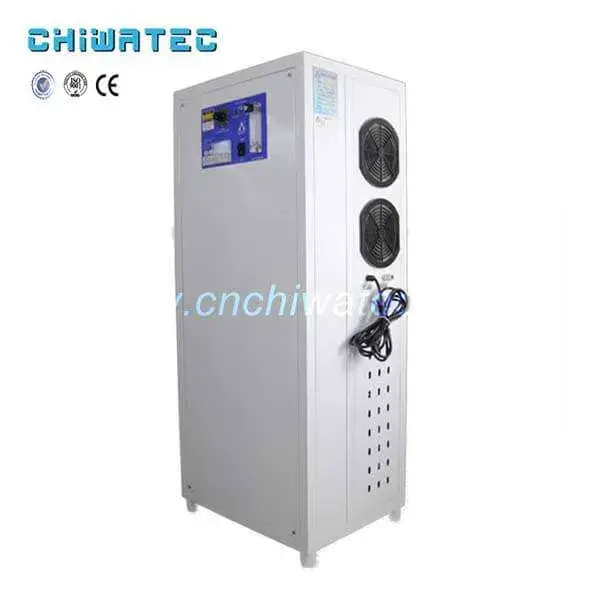
Ozone for aquaculture water treatment is a proven, versatile technology that delivers rapid disinfection, organic matter oxidation, and oxygenation without chemical residues. When properly dosed and monitored, ozone significantly improves water quality, enhances fish and shrimp health, reduces disease outbreaks, and enables higher-density production in recirculating aquaculture systems. The combination of broad-spectrum antimicrobial efficacy, toxin removal, and oxygen enrichment makes ozone one of the most cost-effective water treatment solutions for modern aquaculture. CHIWATEC supplies high-quality ozone generators and integrated water treatment systems designed specifically for aquaculture applications.
For expert guidance on selecting and installing the right ozone system for your aquaculture operation, contact us at [email protected] or [email protected]. Let CHIWATEC help you optimize your aquaculture water quality with advanced ozone technology.
Do you have a water treatment project we can help with
* Designing,machining,installing,commissioning, customize and one-stop service






 English
  Spanish
  Portuguese




