Common Water Treatment Methods: Complete Guide to Sediment Filtration, Softening, and Activated Carbon 2026
Looking for a practical understanding of common water treatment methods and their principles? Water treatment is essential for ensuring safe, high-quality water for drinking, industrial processes, and environmental protection. From simple sediment filtration to advanced ion exchange softening and activated carbon adsorption, each method serves a specific purpose in removing contaminants and improving water quality. This comprehensive guide explains the three most widely used water treatment methods – sediment filtration, hard water softening, and activated carbon adsorption – covering their working principles, applications, design parameters, and maintenance requirements for 2026.
*Last Updated: May 2026 | Industry-Verified Data*
Why This Guide Matters
The global water treatment equipment market was valued at approximately USD 65.2 billion in 2024 and is projected to reach USD 105.8 billion by 2034, growing at a CAGR of 5.0%. Sediment filtration, water softening, and activated carbon treatment represent the most widely deployed technologies worldwide, serving applications from municipal drinking water plants to industrial process water systems and residential point-of-use devices. Understanding the principles and proper application of these fundamental methods is essential for anyone involved in water treatment system design, operation, or maintenance.
Key Industry Trends (2026 Update)
- Multi-Barrier Treatment Approach: Modern water treatment plants increasingly combine sediment filtration + activated carbon + softening as a standard pretreatment train before advanced processes (RO, UV, AOP), recognizing that these fundamental methods provide essential protection for downstream equipment.
- Automatic Backwash Filters: Self-cleaning sediment filters with automatic backwash based on pressure differential are replacing manual-cleaning units, reducing maintenance labor by 70-90% and ensuring consistent pretreatment performance.
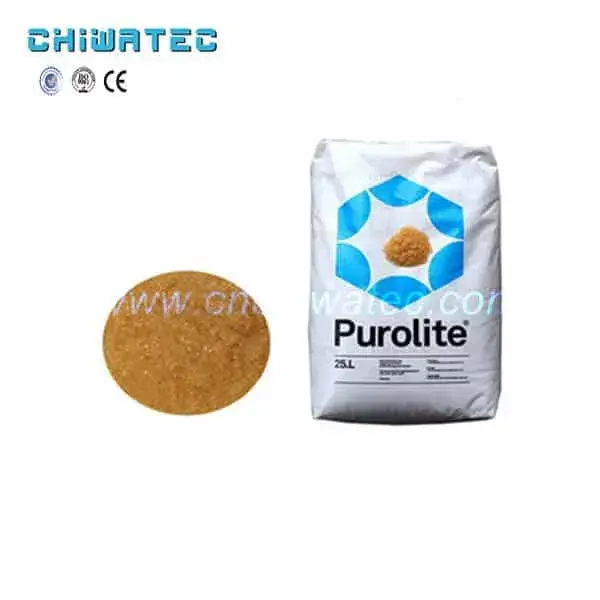
- High-Capacity Softening Resins: New uniform particle size cation exchange resins with operating capacities of 1.9-2.1 eq/L enable softer footprint systems with 30-50% longer run lengths between regenerations compared to conventional resins.
- Catalytic Activated Carbon: Impregnated and catalytic-grade activated carbons with enhanced capacity for specific contaminants (hydrogen sulfide, chloramines, PFAS) are expanding the capabilities of traditional activated carbon filtration beyond basic chlorine and organic removal.
1. Sediment Filtration: Principles and Applications
Working Principle
Sediment filtration removes suspended particulate matter and colloidal materials from water through physical straining and depth filtration mechanisms. Water passes through a porous medium – typically graded layers of quartz sand, anthracite, and garnet in multi-media filters, or wound/carbon block cartridges in point-of-use devices. Particles larger than the pore spaces are trapped on the surface (straining), while smaller particles penetrate the media bed and are captured by adhesion to media surfaces (depth filtration). Standard multi-media filters remove particles down to 20-25 microns, while cartridge filters can achieve 1-5 micron removal.
Design Parameters
Key design parameters for sediment filtration include: filtration rate of 8-15 m/h for multi-media filters; media bed depth of 1,000-1,500 mm with graded layers (coarse to fine in flow direction); backwash rate of 30-50 m/h for 10-15 minutes; and pressure drop across clean media of 0.2-0.5 bar. For pressure vessel designs, typical vessel diameters range from 300-3,000 mm with aspect ratios of 2:1 to 3:1. High-efficiency filter applications in chemical water treatment provide additional design and performance specifications for industrial sediment filtration systems.
Applications and Limitations
Sediment filtration is used as the first stage in virtually all water treatment systems, protecting downstream equipment from abrasive particles and reducing fouling loads on membranes and resins. It effectively removes sand, silt, clay, rust, and organic particulates. Limitations include: cannot remove dissolved contaminants, bacteria, or viruses; requires periodic backwashing with 2-5% of treated water volume; and media must be replaced every 3-5 years as media attrition reduces filtration efficiency.
2. Hard Water Softening: Ion Exchange Method
Working Principle
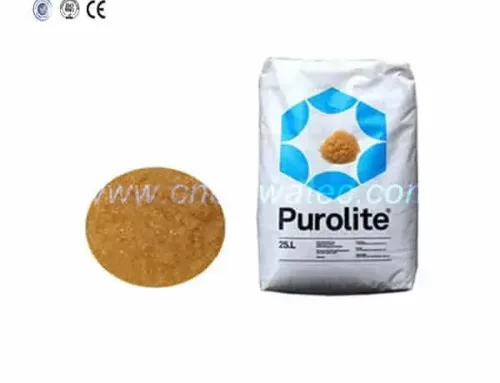
Hard water softening uses the ion exchange process to remove calcium (Ca²&sup4;) and magnesium (Mg²&sup4;) ions that cause scale formation. Water passes through a bed of strong acid cation exchange resin in the sodium form (R-Na&sup4;). As hard water flows through, calcium and magnesium ions exchange with sodium ions on the resin: 2R-Na + Ca²&sup4; → R&sub2;-Ca + 2Na&sup4;. The resulting softened water contains sodium compounds that remain soluble at elevated temperatures, preventing scale formation on pipes, water heaters, boilers, and industrial equipment. When the resin’s sodium ions are depleted, regeneration with sodium chloride (brine) restores the resin to the sodium form.
System Components and Operation
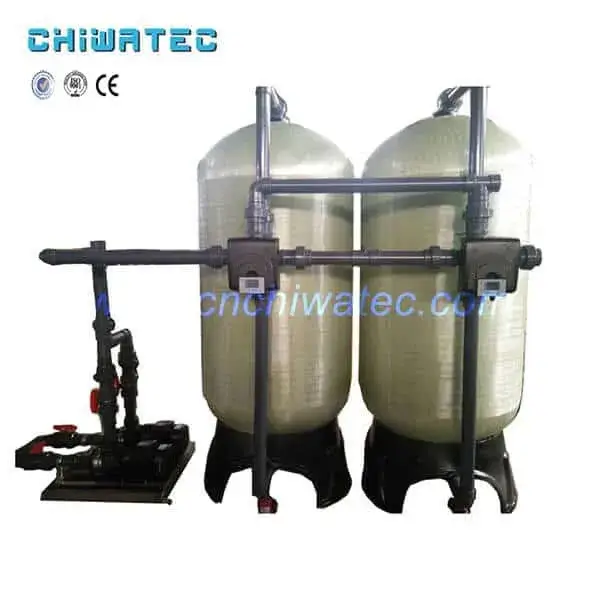
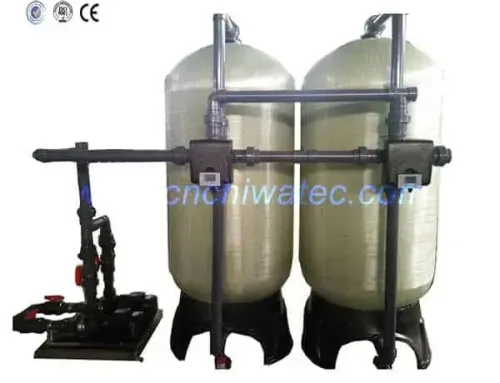
A typical water softener includes: a pressure vessel containing cation exchange resin; a brine tank for salt storage and brine preparation; a multiport control valve that directs water flow through service, backwash, brine draw, rinse, and refill cycles; and optional hardness monitoring instruments. Residential systems typically use 25-100 L of resin and regenerate every 3-14 days, while industrial systems can use 500-5,000 L of resin with regeneration triggered by water meter or hardness breakthrough. Water treatment methods and principles (part 2) provides additional coverage of advanced softening techniques and system configurations.
Design Parameters
Key softening design parameters include: service flow rate of 15-30 m/h (for 8-15 gpm/ft²); resin volume calculated based on feed water hardness (typically 100-500 ppm as CaCO&sub3;) and desired run length; salt dose of 150-240 g NaCl per liter of resin per regeneration; and regenerant concentration of 6-12% NaCl by weight. Effluent hardness should be consistently below 0.5 ppm (as CaCO&sub3;) for effective scale prevention.
3. Activated Carbon Adsorption: Principles and Applications
Working Principle
Activated carbon adsorption removes contaminants from water through physical adsorption – contaminants adhere to the extensive internal pore surface area of activated carbon. Activated carbon is produced by carbonizing organic materials (wood, coconut shells, coal, peat) at high temperatures (600-1,000 degrees C) followed by activation with steam or chemicals to create a highly porous structure with surface areas of 800-1,500 m²/g. This enormous surface area provides binding sites for organic compounds, chlorine, chloramines, taste and odor compounds, and certain dissolved contaminants. The adsorption capacity depends on the contaminant’s molecular weight, polarity, solubility, and concentration, as well as the carbon’s pore size distribution and surface chemistry.
Types of Activated Carbon
- Granular Activated Carbon (GAC): Particle size 0.5-2.5 mm, used in fixed-bed pressure vessels or gravity filters. Standard for municipal and industrial water treatment. Empty bed contact time (EBCT) of 5-20 minutes is typical.
- Powdered Activated Carbon (PAC): Particle size below 0.1 mm, added directly to water as slurry then removed by subsequent filtration. Used for seasonal taste and odor control or emergency contaminant removal.
- Catalytic/Impregnated Carbon: Modified with chemical impregnants (silver, iodine, potassium permanganate) or catalytic surface treatments for enhanced removal of specific contaminants such as hydrogen sulfide, chloramines, mercury, or PFAS.
Design Parameters and Applications
Key design parameters include: EBCT of 5-20 minutes (longer for difficult-to-adsorb contaminants); linear velocity of 10-30 m/h; carbon bed depth of 1,000-2,500 mm; and carbon replacement frequency of 6-24 months depending on contaminant loading. Activated carbon is used for chlorine removal (protecting RO membranes), organic contaminant adsorption, taste and odor improvement, and as a polishing step after sediment filtration. Pretreatment process optimization for RO systems discusses how activated carbon integration within a complete pretreatment train enhances overall system performance.
4. How to Select the Right Water Treatment Method for Your Application?
Method Selection Matrix
- For suspended solids removal: Choose sediment filtration (multi-media or cartridge) as the primary method. For particles above 20 microns, multi-media filtration is most economical. For particles below 5 microns, cartridge or bag filtration is appropriate.
- For hardness removal: Choose ion exchange water softening when feed water hardness exceeds 100 ppm as CaCO&sub3; and scaling protection is required for downstream equipment or hot water systems.
- For chlorine, taste, and odor removal: Choose activated carbon filtration. GAC for continuous flow systems, PAC for intermittent or seasonal treatment needs.
- For combined treatment: Use sediment filtration followed by activated carbon followed by water softening as a standard pretreatment train. This sequence protects each downstream stage from contaminants removed by the previous stage.
Water treatment methods and principles (part 1) provides a comprehensive overview of how these methods complement each other in complete water treatment system design.
5. What Are the Operating Costs of Each Method?
Cost Comparison
- Sediment filtration: USD 0.01-0.05/m³ – dominated by backwash water (2-5% of production), media replacement every 3-5 years, and electricity for backwash pumps. Lowest operating cost of the three methods.
- Water softening: USD 0.04-0.15/m³ – salt consumption is the largest cost item (USD 0.02-0.05/m³), plus backwash water (2-5%), resin replacement every 3-5 years, and wastewater disposal for regeneration effluent.
- Activated carbon: USD 0.03-0.10/m³ – dominated by carbon replacement cost (USD 2-5/kg for virgin GAC, USD 4-8/kg for catalytic grades). EBCT and contaminant loading determine replacement frequency.
6. How to Maintain Each Water Treatment System?
Maintenance Requirements
- Sediment filters: Automatic backwash (daily or based on pressure differential); manual media inspection monthly; complete media replacement every 3-5 years. Monitor effluent turbidity and pressure drop as key performance indicators.
- Water softeners: Maintain salt level in brine tank (never below 1/3 full); clean brine tank annually; verify effluent hardness weekly; regenerate based on water meter or hardness breakthrough; replace resin every 3-5 years when capacity declines.
- Activated carbon filters: Monitor effluent chlorine/chloramine levels weekly to detect carbon exhaustion; replace carbon every 6-24 months; backwash weekly to remove accumulated particulates and prevent channeling; inspect for biological growth in warm environments.
Regular maintenance is essential for all three methods. Neglected sediment filters become breeding grounds for bacteria. Exhausted carbon filters release previously adsorbed contaminants. Failed softeners allow hard water to reach downstream equipment, causing scale damage.
7. What Are the Limitations of Each Method?
Method Limitations
- Sediment filtration: Cannot remove dissolved solids, hardness, bacteria, viruses, or dissolved organic compounds. Filter media may crack or channel, reducing effectiveness. Backwash water disposal can be a concern in water-scarce regions.
- Water softening: Replaces calcium and magnesium with sodium – increases sodium content of treated water, which may be a concern for individuals on low-sodium diets. Cannot remove other dissolved contaminants, bacteria, or organic compounds. Regeneration produces saline wastewater requiring proper disposal.
- Activated carbon: Adsorption capacity is finite and contaminant-specific. Exhausted carbon can release adsorbed contaminants if not replaced promptly. Biological growth on carbon beds is possible in warm environments. Cannot remove dissolved salts or hardness.
8. How Do These Methods Compare with Advanced Treatment Technologies?
Fundamental vs. Advanced Treatment
Sediment filtration, softening, and activated carbon are considered fundamental or conventional water treatment methods. They remove specific classes of contaminants (particulates, hardness ions, organic compounds) but cannot provide the comprehensive purification required for high-purity applications. In modern water treatment plants, these methods serve as pretreatment before advanced technologies:
- Sediment filtration + Carbon + Softening → RO: This standard pretreatment train protects RO membranes from fouling, scaling, and chlorine damage, enabling 5-10 year membrane life.
- Sediment filtration + Carbon → UV disinfection: Pretreatment removes particles that could shield microorganisms from UV light, improving disinfection efficiency.
- Softening + Mixed bed → Ultrapure water: Primary softening reduces the ionic load on downstream mixed bed or EDI polishing stages.
Conclusion
Sediment filtration, hard water softening, and activated carbon adsorption form the foundation of practical water treatment worldwide. Each method addresses a specific water quality challenge – particulate removal, hardness reduction, and organic/chlorine removal respectively – and when combined in a well-designed treatment train, they provide effective, economical water purification for a wide range of applications. While advanced technologies such as reverse osmosis and UV disinfection offer more complete contaminant removal, these fundamental methods remain essential as cost-effective pretreatment, point-of-entry treatment, or standalone solutions for less demanding applications. Contact CHIWATEC today at [email protected] or [email protected] (WhatsApp available) for expert guidance on selecting and implementing the right combination of water treatment methods for your application.
Frequently Asked Questions
Q1: Which water treatment method is most important for household water?
The most important method depends on your water quality issues. For municipal water with chlorine taste, activated carbon is most noticeable. For hard water causing scale, a water softener is essential. For well water with sediment, a sediment filter is the first priority. Many households benefit from a combination system: sediment filter + activated carbon + optional softener.
Q2: How often should I replace activated carbon filters?
GAC in fixed-bed filters should be replaced every 6-24 months depending on contaminant loading. For point-of-use carbon cartridges, replacement every 3-6 months is typical. The key indicator is chlorine breakthrough – test effluent chlorine weekly; if any chlorine is detected, the carbon is exhausted and must be replaced immediately to prevent contaminant desorption.
Q3: Can water softeners remove iron from water?
Standard cation exchange softeners can remove dissolved ferrous iron (Fe²&sup4;) up to 5 ppm, but not ferric iron (Fe³&sup4;) which precipitates as rust particles. For water with iron above 5 ppm or with ferric iron, a dedicated iron removal filter (greensand or Birm media) is recommended before the softener.
Q4: Is sediment filtration alone sufficient for drinking water treatment?
No. Sediment filtration removes only suspended particles. It does not remove dissolved contaminants, bacteria, viruses, or chemicals. For drinking water, sediment filtration should be combined with activated carbon filtration and disinfection (UV, chlorination, or boiling as minimum). Surface water requires additional treatment for pathogen removal.
Q5: What is the difference between a water softener and a whole-house sediment filter?
A sediment filter removes physical particles (sand, silt, rust) through mechanical straining. A water softener removes dissolved calcium and magnesium ions through ion exchange chemical process. They serve different purposes and are typically used together – sediment filter first to protect the softener from particulate fouling, then the softener to remove hardness.
Related Resources and Further Reading
- Water Treatment Methods and Principles (1) – Foundational overview of water treatment methods
- Water Treatment Methods and Principles (2) – Advanced methods and system configurations
- Application of High Efficiency Filter in Chemical Water Treatment – Industrial sediment filtration applications
- Optimizing RO Systems: Analysis of Five Common Pretreatment Processes – Pretreatment integration with RO systems
- RO Water Treatment Systems by CHIWATEC – Explore complete RO system solutions
Do you have a water treatment project we can help with
* Designing,machining,installing,commissioning, customize and one-stop service
 English
  Spanish
  Portuguese