

Fine Chemical Pure Water System: RO+EDI Technology, Process, and Quality Standards 2026
A fine chemical pure water system is essential for producing the high-purity water required in cosmetics, soaps, pharmaceuticals, specialty chemicals, and other fine chemical manufacturing processes where water quality directly impacts product consistency and safety. Unlike general industrial water, fine chemical pure water must achieve resistivity above 18 MΩ·cm, conductivity below 0.5 µS/cm, and strict limits on ammonia (< 0.3 µg/mL), nitrates (< 0.06 µg/mL), and heavy metals (< 0.5 µg/mL). Modern fine chemical pure water systems combine reverse osmosis (RO) with electrodeionization (EDI) technology — the most advanced and environmentally friendly approach — eliminating acid-base regeneration while delivering consistently high-quality effluent. This article covers the technology, process, quality standards, and key features of fine chemical pure water equipment.
Fine Chemical Pure Water System — RO and EDI Technology Overview
The core of a modern fine chemical pure water system is the combination of RO and EDI. Reverse osmosis removes 99.0–99.5% of dissolved salts, organic compounds, bacteria, and particles from feed water using semipermeable membranes operating at 10–15 bar. The RO permeate, at 5–20 µS/cm, then feeds the EDI stack, which uses ion exchange membranes and an electric field to continuously remove residual ions without chemical regeneration. EDI achieves resistivity up to 18.2 MΩ·cm — the theoretical maximum for pure water at 25°C. Compared to traditional mixed-bed ion exchange, the RO+EDI approach eliminates acid and caustic handling, reduces operating costs by 30–50%, and produces no chemical waste. This makes it the preferred technology for fine chemical applications where environmental compliance and water quality consistency are paramount. The development from distillation → ion exchange → RO+EDI represents the most significant advancement in pure water production over the past three decades.
Process Description of the Fine Chemical Pure Water System
A complete fine chemical pure water system follows a multi-stage process train designed to progressively remove contaminants and polish water to the required quality:
- Raw water intake and pressurization: Feed water enters a raw water tank and is pressurized by a booster pump to 3–4 bar for pretreatment.
- Four-stage pretreatment: The raw water passes through a multimedia filter (removes suspended solids > 20 µm), an activated carbon filter (removes residual chlorine and organic matter), a water softener (removes calcium and magnesium hardness to < 1 ppm), and a 5 µm cartridge security filter. This pretreatment is critical for protecting downstream RO membranes from fouling and scaling.
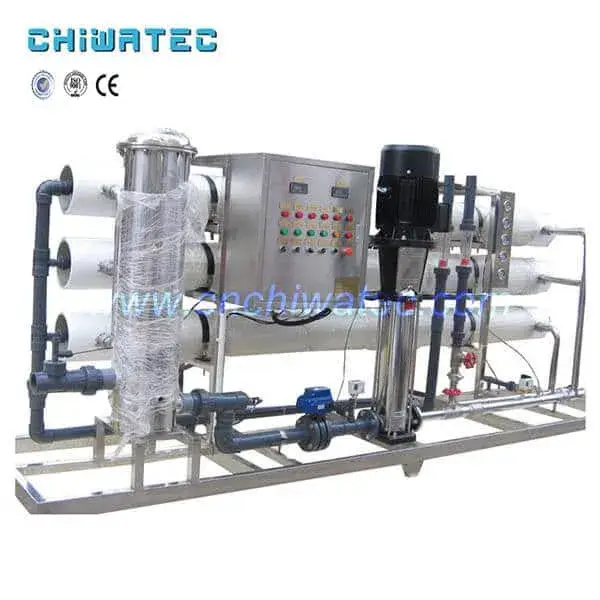
- Reverse osmosis (RO): The pretreated water enters the RO main frame, where high-pressure pumps (10–15 bar) force water through spiral-wound thin-film composite (TFC) membranes. RO removes 99%+ of dissolved salts, reducing TDS from 300–500 ppm to 5–20 ppm and conductivity to 5–20 µS/cm.
- Electrodeionization (EDI): RO permeate feeds the EDI module, where ion exchange resins and ion-exchange membranes are sandwiched between electrodes. Under a DC electric field (typically 100–400 V), cations migrate toward the cathode and anions toward the anode, passing through selective membranes into concentrate chambers and out to drain. Purified water exits at 15–18.2 MΩ·cm.
- Final polishing: An ultraviolet sterilizer (254 nm, 30–50 mJ/cm²) deactivates any remaining microorganisms, and a 0.22 µm microporous filter removes bacterial fragments and particulates, delivering sterile, particle-free pure water ready for fine chemical processing.
Fine Chemical Pure Water Quality Standards and Specifications
The effluent from a fine chemical pure water system must meet stringent national and international standards. Key quality parameters include:
| Parameter | Target Value | Test Method |
| Resistivity (25°C) | ≥ 18 MΩ·cm (18.2 MΩ·cm theoretical max) | Online conductivity meter |
| Conductivity | ≤ 0.5 µS/cm (typically 0.055 µS/cm) | In-line monitoring |
| Ammonia (NH₃) | < 0.3 µg/mL | Nessler reagent colorimetry |
| Nitrate (NO₃⁻) | < 0.06 µg/mL | Ion chromatography |
| Heavy metals (as Pb) | < 0.5 µg/mL | Atomic absorption |
| Silica (SiO₂) | < 0.01 mg/L | Molybdosilicate method |
| TOC (Total Organic Carbon) | < 20 µg/L (fine chemical); < 5 µg/L (pharma) | UV-persulfate oxidation |
| pH at 25°C | 6.8–7.2 (neutral) | pH meter |
These standards ensure that the pure water does not introduce contaminants that could alter chemical reactions, affect product stability, or compromise the safety of cosmetics, personal care products, or pharmaceutical ingredients.
Key Features of Fine Chemical Pure Water Equipment
Equipment designed for fine chemical pure water systems incorporates several features specific to the industry’s stringent requirements:
- Stainless steel construction: All wetted components — including piping, valves, storage tanks, and distribution loops — are constructed from 304L or 316L stainless steel with electrophished internal surfaces (Ra < 0.5 µm) to prevent corrosion and bacterial adhesion.
- Rigorous, easy-disassembly design: The equipment uses tri-clamp sanitary connections, quick-disconnect fittings, and hinged access panels for rapid disassembly, cleaning, and part replacement without specialized tools.
- Fully automatic PLC operation: The system runs 24/7 unattended with automatic start/stop, membrane flush cycles, EDI voltage adjustment, and quality-based divert-to-drain for out-of-spec water. Touchscreen HMI displays all operating parameters in real time.
- Energy efficiency: Low-energy RO membranes and EDI (which consumes only 0.3–0.8 kWh/m³) reduce total energy consumption to 2–4 kWh/m³ — 50–70% less than distillation.
- Environmental compliance: No acid or caustic regeneration required. Only RO concentrate (which is typically 50–70% of feed volume for single-pass systems) is sent to drain. The EDI process generates no chemical waste.
- Stable, high-quality output: The dual RO+EDI barrier ensures consistent water quality even with feed water fluctuations, meeting the pure water standards of both the US (ASTM Type I) and German (DIN VDE) specifications.
Comparison of Pure Water Production Methods for Fine Chemicals
| Method | Resistivity | Energy Use | Chemicals | Environmental Impact |
| Distillation | 0.5–1 MΩ·cm | Very high (20–40 kWh/m³) | None | High energy footprint |
| Ion exchange (mixed bed) | 18.2 MΩ·cm | Low (0.1 kWh/m³) | HCl + NaOH regeneration | Acid/caustic wastewater |
| Reverse osmosis only | 0.1–0.5 MΩ·cm | Medium (2–5 kWh/m³) | None | Concentrate brine |
| RO + EDI | 15–18.2 MΩ·cm | Low (2–4 kWh/m³) | None | Minimal (concentrate only) |
Frequently Asked Questions (FAQ)
What is a fine chemical pure water system?
A fine chemical pure water system is a multi-stage water treatment system combining reverse osmosis and electrodeionization (RO+EDI) to produce high-purity water with resistivity ≥ 18 MΩ·cm for use in cosmetics, soaps, pharmaceuticals, specialty chemicals, and other fine chemical manufacturing applications.
Why is RO+EDI preferred over traditional ion exchange for fine chemicals?
RO+EDI eliminates the need for acid and caustic regeneration chemicals, reducing operating costs by 30–50%, eliminating hazardous chemical storage, and producing no chemical waste. It also provides continuous operation with consistent water quality, unlike batch-regenerated mixed-bed systems that experience quality fluctuations during regeneration cycles.
What water quality can a fine chemical pure water system achieve?
A well-designed RO+EDI system achieves resistivity of 15–18.2 MΩ·cm, conductivity below 0.5 µS/cm, ammonia < 0.3 µg/mL, nitrates < 0.06 µg/mL, heavy metals < 0.5 µg/mL, and TOC < 20 µg/L. This meets the pure water standards specified by the US Ministry of Electronics Industry (ASTM Type I), German DIN VDE, and Chinese GB/T 6682-2008 Grade 1.
What pretreatment is needed before RO+EDI for fine chemicals?
A four-stage pretreatment train is standard: multimedia filtration (removes suspended solids), activated carbon filtration (removes chlorine and organics), water softening (removes hardness to prevent RO membrane scaling), and 5 µm cartridge filtration (final protection). For feed water with high TDS (> 500 ppm), a second pass RO may be added before EDI.
Does a fine chemical pure water system require chemical regeneration?
No. The RO+EDI process is entirely chemical-free. RO is a physical membrane separation, and EDI uses an electric field to continuously regenerate ion exchange resins within the stack. No acid, caustic, or brine regeneration is needed. Periodic CIP cleaning of RO membranes (every 3–12 months) uses mild biodegradable detergents, but no routine chemical handling is required.
Conclusion and Call to Action
A fine chemical pure water system based on RO+EDI technology delivers the high-purity water required for cosmetics, pharmaceuticals, and specialty chemical manufacturing — achieving 18 MΩ·cm resistivity without acid-base regeneration and with minimal environmental impact. The combination of robust pretreatment, low-energy RO membranes, and continuous EDI polishing ensures consistent water quality that meets both domestic and international standards. At CHIWATEC, we engineer complete fine chemical pure water systems with capacities from 0.5 to 100 m³/h, including stainless steel distribution loops and fully automatic PLC control with remote monitoring. For a system tailored to your specific water quality requirements and production volume, contact us at [email protected] or [email protected].
Related Resources and Further Reading
Do you have a water treatment project we can help with
* Designing,machining,installing,commissioning, customize and one-stop service






 English
  Spanish
  Portuguese




