

EDI Ultrapure Water Equipment Problems and Solutions: Complete Troubleshooting Guide
Electrodeionization (EDI) is one of the most advanced and efficient technologies for producing ultrapure water, capable of delivering resistivity up to 18.2 MΩ·cm without chemical regeneration. However, like any precision water treatment system, EDI ultrapure water equipment problems can arise — from low flow rates and poor water quality to complete system shutdown. In this troubleshooting guide, CHIWATEC covers the most common EDI system issues, their root causes, and practical solutions to restore optimal performance quickly.
Common EDI Ultrapure Water Equipment Problems: An Overview
EDI ultrapure water equipment integrates reverse osmosis pretreatment, ion-exchange membranes, and DC electrical power to continuously deionize water. When problems occur, they typically fall into three categories: flow issues, water quality issues, and electrical issues. The table below summarizes the most frequently encountered problems and their likely causes:
| Problem | Primary Symptoms | Most Common Cause |
|---|---|---|
| Low flow rate | Reduced production volume, slow tank fill | Low inlet pressure, partially closed valve, EDI module blockage |
| Poor water quality | High conductivity, low resistivity, TDS breakthrough | Feed water exceeding spec, incorrect DC voltage, membrane fouling |
| Extremely low flow / no flow | Near-zero output, alarm activation | Concentrate circulation pump failure, flow switch malfunction |
| High pressure drop | Increased pump load, premature wear | Module scaling, debris accumulation in feed channels |
| Electrical fault / high voltage | System shutdown, error codes on HMI | Power supply failure, wiring issues, water conductivity too high |
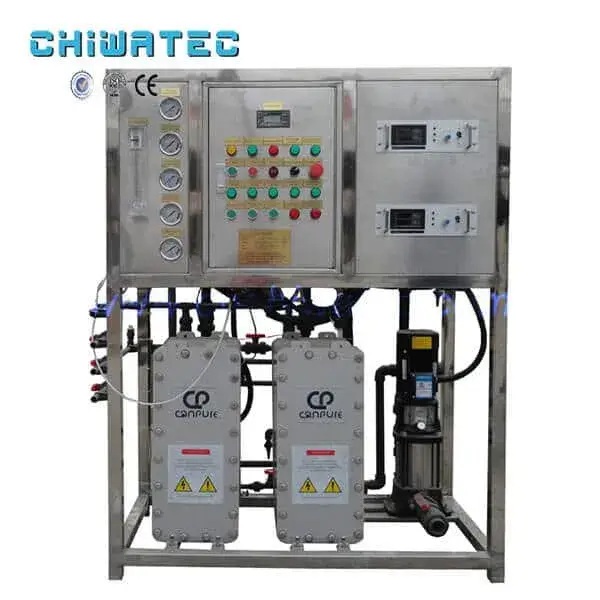
Problem 1: Low Flow Rate in EDI System
A reduced flow rate in EDI ultrapure water equipment is one of the most common operational complaints. It directly impacts production capacity and can disrupt downstream processes if not addressed promptly. The potential causes and corresponding solutions include:
- Low inlet water pressure — EDI modules require a minimum feed water pressure (typically 0.2–0.7 MPa, depending on the manufacturer) to maintain proper flow through the dilute and concentrate chambers. Check the feed water pump operation and verify that the inlet pressure gauge reads within the specified range. If the pump is underperforming, inspect the pump motor, impeller, and inlet strainer for blockages or wear.
- Partially closed or restricted valve — A valve on the feed line, concentrate line, or product line that is not fully open can restrict flow. Inspect all valves in the flow path to ensure they are in the fully open position. Check for partially closed bypass valves that may be diverting flow away from the EDI module.
- EDI module blockage or scaling — Over time, the dilute and concentrate channels within the EDI module can become blocked by suspended particles, biological growth, or hardness scale. If the pressure drop across the module has increased significantly, the module may need chemical cleaning or replacement. Consult the manufacturer’s cleaning procedure and use approved cleaning chemicals.
If none of these checks resolve the low flow issue, verify that the concentrate circulation pump is operating correctly and that the flow control valves on the concentrate loop are properly adjusted.
Problem 2: Poor Water Quality from EDI System
When EDI ultrapure water equipment produces water with higher-than-expected conductivity or lower resistivity, the system is not performing its deionization function properly. Diagnosis should follow this sequence:
- Check influent water quality — EDI systems are designed to treat RO permeate with a specific conductivity range (typically <40 µS/cm, often <20 µS/cm). If the RO system is underperforming due to membrane fouling, temperature changes, or pressure fluctuations, the EDI feed water quality may exceed the allowable limit. Test the RO permeate conductivity at the EDI inlet sampling point.
- Inspect DC voltage settings — The DC voltage applied across the EDI stack directly controls ion removal efficiency. If the voltage is too low, ions will not be fully transferred across the membranes, resulting in high product water conductivity. If the voltage is too high, water splitting may occur, generating excess H⁺ and OH⁻ ions that increase conductivity. Check the manufacturer’s voltage specification for your module and adjust accordingly.
- Examine ion-exchange membranes for fouling — Organic fouling, iron fouling, or silica scaling on the ion-exchange membranes reduces their ion transfer efficiency. If fouling is suspected, a professional chemical cleaning or module replacement may be required. Preventive measures include maintaining proper RO pretreatment and monitoring feed water quality trends.
Different EDI brands (e.g., Ionpure, E-Cell, GE) have different voltage and flow specifications. Always consult the specific technical documentation for your installed equipment.
Problem 3: Extremely Low or No Water Flow
When an EDI system produces an extremely low flow rate or stops producing water entirely, the issue is often related to the concentrate recirculation loop or safety interlocks:
- Concentrate circulation pump malfunction — EDI modules require continuous concentrate flow to carry away the rejected ions. If the concentrate circulation pump is not operating (due to motor failure, tripped circuit breaker, or air lock), the EDI module will not function and may trigger a low-flow alarm or safety shutdown. Verify pump operation by checking for vibration, listening for normal operating sound, and confirming the discharge pressure.
- Flow switch wiring or position error — Most EDI systems include a flow switch on the product water outlet that verifies sufficient flow before allowing the DC power supply to energize. If the flow switch is incorrectly positioned (e.g., installed in the wrong orientation), has faulty wiring, or its set point is incorrectly calibrated, the system will not operate. Check the flow switch installation against the manufacturer’s specifications and test continuity across the switch contacts.
- Safety interlock triggered — EDI systems have multiple safety interlocks that shut down the system if any parameter is out of range (high conductivity, low flow, high pressure, high temperature). Check the HMI or controller display for active alarms and reset the system after addressing the underlying condition.
Preventive Maintenance for EDI Ultrapure Water Systems
Regular preventive maintenance dramatically reduces the frequency and severity of EDI ultrapure water equipment problems. Establish a maintenance schedule that includes:
| Interval | Task | Purpose |
|---|---|---|
| Daily | Record feed and product conductivity, flow rates, pressure, voltage, and current | Establish baseline trends for early problem detection |
| Weekly | Inspect feed water pre-filters and replace if pressure drop exceeds threshold | Prevent particle ingress into EDI module |
| Monthly | Check DC power supply output voltage and current against nameplate values | Verify electrical system is operating correctly |
| Quarterly | Calibrate in-line conductivity/resistivity sensors | Ensure accurate water quality monitoring |
| Annually | Professional inspection and cleaning of EDI module | Remove accumulated fouling, restore performance |
Maintaining detailed logs of system performance parameters is the single most valuable tool for diagnosing emerging problems before they lead to production interruptions.
EDI System Performance Monitoring Guidelines
Proactive monitoring helps operators identify developing issues before they cause production downtime. Key performance indicators to track include:
- Pressure differential across the module — A gradual increase indicates channel blockage or scaling. A sudden drop may indicate internal damage or bypass flow.
- Product water resistivity — Should remain stable above 16 MΩ·cm for properly operating systems. Gradual decline suggests membrane degradation or feed water quality deterioration.
- DC current draw — An increase in current at constant voltage indicates higher ionic load, which may mean the RO pretreatment is underperforming. A decrease may indicate loss of membrane conductivity.
- Temperature correction — Resistivity readings should be temperature-compensated to 25°C. Without compensation, a 1°C change in water temperature causes approximately 2% error in resistivity measurement.
Modern EDI systems with PLC and HMI can automatically log these parameters and generate trend reports, making it easy to spot deviations from normal operating ranges.
Frequently Asked Questions (FAQ)
How often does an EDI module need to be cleaned?
Cleaning frequency depends on feed water quality and operating conditions. Under normal conditions with good RO pretreatment, an EDI module may operate 1–3 years between cleanings. If the pressure drop increases by 30% or more above baseline, or if product water resistivity declines, cleaning should be scheduled.
Can I clean an EDI module myself?
EDI module cleaning requires specialized chemicals (typically dilute acid and caustic solutions), a dedicated cleaning skid, and knowledge of the manufacturer’s procedures. It is recommended to have cleaning performed by a qualified service technician or to send the module to the manufacturer for professional cleaning.
What is the typical lifespan of an EDI module?
A well-maintained EDI module typically lasts 3–7 years in continuous service. Factors affecting lifespan include feed water quality, operating temperature, chemical cleaning frequency, and whether the module experiences any system upsets that expose it to out-of-spec water.
Why does my EDI system keep tripping the low-flow alarm?
Persistent low-flow alarms typically indicate one of three issues: a failing concentrate circulation pump, a blocked or scaled EDI module, or a misconfigured flow switch. Start by verifying the concentrate pump is running and delivering the rated flow, then check the flow switch calibration.
Can high feed water conductivity damage the EDI module?
Yes. If the feed water conductivity exceeds the maximum specified by the manufacturer (typically 40–60 µS/cm), the EDI module may experience irreversible damage due to excessive current draw and localized heating. Always ensure the RO system is functioning correctly before water enters the EDI module.
Conclusion & Call to Action
Understanding and addressing common EDI ultrapure water equipment problems is essential for maintaining the reliable, continuous production of high-purity water. By systematically diagnosing flow, quality, and electrical issues, and implementing a preventive maintenance schedule, you can maximize equipment uptime, extend module life, and ensure consistent water quality for your ultrapure water applications. CHIWATEC provides complete EDI ultrapure water systems, replacement modules, spare parts, and professional maintenance services. Contact our team for technical support or system upgrades: [email protected] or [email protected].
Related Resources and Further Reading
Do you have a water treatment project we can help with
* Designing,machining,installing,commissioning, customize and one-stop service






 English
  Spanish
  Portuguese




