

Case Description of Reverse Osmosis Water Treatment Scheme
This article provides a comprehensive technical overview of a reverse osmosis water treatment scheme, detailing the working principles, equipment configuration, water quality requirements, and operational controls of an industrial RO system. It serves as a practical guide for industries including electronics, pharmaceuticals, food & beverage, chemicals, and power generation that rely on high-purity or ultrapure water systems.
1. Overview of the Reverse Osmosis Water Treatment Scheme
A reverse osmosis (RO) system is one of the most efficient and widely used water treatment methods for producing pure and ultrapure water. It operates on the principle of forcing raw water through a semi-permeable membrane under high pressure, effectively removing dissolved salts, minerals, bacteria, and organic impurities.
Application Scope
The RO water treatment scheme is used across numerous industries:
- Electronics and semiconductor manufacturing for ultrapure water
- Pharmaceutical and medical water preparation
- Food and beverage industries for product quality and safety
- Chemical and textile industries for process water purification
- Power plants for high-pressure boiler feed water
- Seawater and brackish water desalination
- Recycling and recovery of valuable materials in industrial processes
RO systems can also act as the first-stage desalination unit in multi-step high-purity water production lines.
2. Feed Water Quality Requirements
The performance and lifespan of an RO membrane depend heavily on the quality of feed water. To maintain high efficiency and prevent scaling or fouling, the following parameters should be met:
| Parameter | Recommended Value |
|---|---|
| Silt Density Index (SDI, 15 min) | < 5 |
| Turbidity | < 1.0 NTU |
| Free Chlorine | < 0.1 ppm |
| Inlet Water Temperature | < 45 °C |
| Iron (Fe) Content | < 0.05 ppm |
These parameters ensure that the feed water is clear, chemically stable, and non-corrosive—ideal for long-term membrane operation.
3. Major Components of the Reverse Osmosis Water Treatment Scheme
Each stage of the RO system plays a crucial role in achieving consistent and high-quality water output.
3.1 Raw Water Tank
Function:
Stores and stabilizes raw water supply, ensuring continuous flow and pressure. It compensates for fluctuations in the main supply network, safeguarding the system’s reliability.
Design & Control:
Constructed from PE or stainless steel, the tank uses a float valve and low-level switch for automatic level control. When the tank is full, the float valve closes to stop filling; when water is low, the pump stops to prevent dry running.
3.2 Booster Pump
Function:
Provides the necessary working pressure for pretreatment units such as sand filters and carbon filters.
Design:
The pump is sized based on the total pressure loss through the pretreatment system (usually ≤ 0.05 MPa per filter) to ensure a minimum of 0.5 kg/cm² pressure before the high-pressure pump.
A regulating valve is used to fine-tune flow and pressure.
3.3 Mechanical Filter
Function:
Removes large particles, sediment, rust, and suspended solids from the raw water using fine quartz sand (12–24 mesh).
Design:
Housed in FRP (fiberglass-reinforced plastic) tanks for corrosion resistance.
Maintenance:
Filters should be backwashed daily (10–20 minutes) to remove trapped impurities and prevent clogging.
3.4 Activated Carbon Filter
Function:
This step is critical in the reverse osmosis water treatment scheme. It performs:
- Adsorption of organic compounds (up to 60%)
- Removal of residual chlorine, which can damage RO membranes
Activated carbon has a massive surface area (500–2000 m²/g) with micropores (20–50 Å), allowing it to effectively trap organic molecules and oxidizing agents.
Benefits:
- Removes odor and color
- Improves clarity
- Protects membranes from chemical attack
Maintenance:
Activated carbon must be backwashed and rinsed daily (15–30 minutes) and replaced or regenerated regularly to maintain performance.
3.5 Fully Automatic Water Softener / Dosing Device
Function:
Removes hardness ions (Ca²⁺ and Mg²⁺) that cause scaling on RO membranes using strong acid cation exchange resin (001×7).
The result: residual hardness < 0.03 mmol/L.
Control System:
An automatic valve controls the regeneration cycle based on time or flow rate, performing backwash, brine absorption, and forward rinse.
Regular salt replenishment in the brine tank is essential; non-iodized salt should be used.
3.6 Precision Filter (Security Filter)
Function:
Protects RO membranes by filtering out any fine particles missed by previous stages.
Uses PP melt-blown cartridges with large dirt-holding capacity and minimal pressure loss.
Maintenance:
Replace the cartridge when the pressure drop exceeds 0.05–0.1 MPa.
Housed in a stainless steel vessel for durability and hygiene.
3.7 High-Pressure Pump
Function:
Supplies the RO membranes with the required high pressure (typically 10 kg/cm² or 1 MPa) to drive the reverse osmosis process.
Design & Control:
Uses multi-stage stainless steel pumps (e.g., Grundfos).
A pressure switch stops the pump automatically if inlet pressure drops below 1 kg/cm² to protect the system.
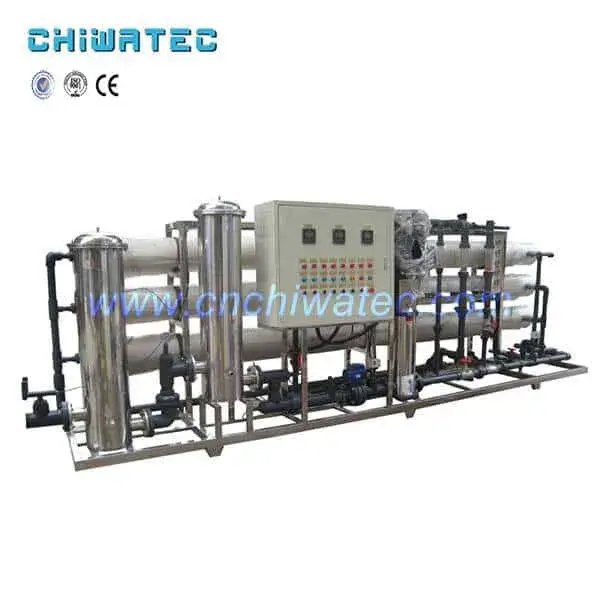
3.8 Reverse Osmosis Device (Core Unit)
Function:
The heart of the system, where desalination occurs.
It uses energy-efficient composite RO membranes (e.g., ESPA series from Nitto Denko or Hydranautics).
Performance:
- Average salt rejection: 99.5%
- High permeate flux at lower operating pressure
- Long membrane life with proper pretreatment
The treated water meets the highest purity standards for industrial applications.
Conclusion
The reverse osmosis water treatment scheme is a highly efficient, modular, and scalable solution for producing pure and ultrapure water across various industries.
By combining mechanical filtration, chemical adsorption, ion exchange, and membrane separation technologies, RO systems can consistently deliver stable water quality while minimizing maintenance costs.
Proper pretreatment design, automatic control systems, and routine maintenance are essential to maximize system lifespan and ensure optimal performance.
FAQ
1. What industries benefit most from reverse osmosis water treatment schemes?
Industries such as electronics, pharmaceuticals, food and beverage, chemical production, and power generation benefit greatly due to their high water purity requirements.
2. What is the average salt rejection rate of RO membranes?
Modern composite RO membranes can achieve up to 99.5% salt rejection, ensuring high-purity water output.
3. How often should filters and membranes be replaced?
- Mechanical and carbon filters: daily backwash, replace every 6–12 months
- Softener resin: regenerate regularly, replace every 2–3 years
- RO membranes: replace every 2–5 years depending on feed quality and maintenance
4. How does an activated carbon filter protect the RO membrane?
It removes residual chlorine and absorbs organic pollutants, preventing oxidation and fouling of the sensitive RO membranes.
5. What are common problems in RO systems?
Common issues include membrane fouling, scaling, pressure loss, and insufficient pretreatment, all of which can be prevented through regular monitoring and maintenance.
Xi’an CHIWATEC Water Treatment Technology is a high-tech enterprise specialized in various water processing devices. Aside from these individual products, which cover a number of types and series, we can also help with related comprehensive engineering projects. Thanks to our hard work and dedication upon our founding, we are now one of the fastest-developing water treatment equipment manufacturers in Western China.
Further reading:
- RO reverse osmosis water treatment equipment program description
- RO reverse osmosis water treatment equipment program description(2)
- CHIWATEAC reverse osmosis water treatment equipment program process introduction
- What is reverse osmosis water treatment technology?
- The working principle and advantages of reverse osmosis water treatment
FOLLOW US
Do you have a water treatment project we can help with
* Designing,machining,installing,commissioning, customize and one-stop service






 English
  Spanish
  Portuguese




