

Seawater Desalination Equipment Principles: Complete Guide to RO Desalination Technology 2026
Seawater desalination has become essential for addressing global freshwater scarcity, with over 20,000 desalination plants operating worldwide producing 100 million m³ of freshwater daily. Understanding the seawater desalination equipment principles — particularly reverse osmosis (RO), multi-stage flash (MSF), and low-temperature multi-effect distillation (LT-MED) — is critical for selecting the right technology for coastal water supply projects. This guide explains the working principles, equipment configurations, and performance characteristics of the three mainstream seawater desalination technologies. CHIWATEC engineers and manufactures custom seawater RO desalination systems for municipal and industrial applications.
Why Seawater Desalination Is Critical for Global Water Supply
Global water stress affects 4 billion people for at least one month each year. Seawater desalination offers a climate-independent water source for coastal communities and industries. Key drivers include:
- Population growth — Coastal cities in the Middle East, Asia, and the Mediterranean are expanding rapidly, straining existing freshwater resources
- Groundwater depletion — Over-extraction of aquifers causes saltwater intrusion, making desalination necessary for coastal water supplies
- Industrial demand — Power plants, refineries, and mining operations in water-scarce regions increasingly rely on desalinated seawater
- Climate resilience — Desalination provides drought-proof water supply independent of rainfall patterns
Reverse osmosis has become the dominant desalination technology, accounting for 69% of global installed capacity, followed by MSF (18%) and MED (7%).
Seawater Desalination Equipment Principles: Reverse Osmosis Technology
Reverse osmosis is the most widely adopted seawater desalination equipment principle. RO uses semi-permeable membranes that allow water molecules to pass while rejecting dissolved salts (typically 99.5-99.8% rejection for seawater).
How RO desalination works:
- Feed water intake — Seawater is collected through subsurface intake systems (beach wells) or open ocean intakes with screens to remove large debris and marine life
- Pretreatment — Multimedia filtration, cartridge filtration, and antiscalant dosing remove suspended solids and prevent membrane scaling. For seawater RO, dissolved air flotation (DAF) or ultrafiltration (UF) pretreatment is often required for open intake systems
- High-pressure pumping — Seawater RO requires 55-85 bar (800-1200 psi) operating pressure to overcome the natural osmotic pressure of seawater (approximately 25-30 bar for typical 35,000 ppm TDS seawater)
- Membrane separation — Spiral-wound thin-film composite polyamide membranes reject 99.5-99.8% of dissolved salts. Water permeates through the membrane; concentrated brine (reject) is discharged
- Energy recovery — The high-pressure brine stream passes through an energy recovery device (pressure exchanger or turbine), recovering 40-60% of the energy and reducing specific power consumption to 3-4 kWh/m³
- Post-treatment — Permeate water is remineralized (calcium, magnesium, alkalinity addition) and pH-adjusted for corrosion control and potability
Modern seawater RO systems achieve 40-50% recovery rates (the percentage of feed water converted to freshwater) with energy consumption as low as 2.5-3.5 kWh/m³ for large SWRO plants using pressure exchanger energy recovery.
Multi-Stage Flash (MSF) Distillation Principles
Multi-stage flash distillation is a thermal desalination process widely used in the Middle East for large-scale seawater desalination. MSF accounts for approximately 18% of global desalination capacity.
Operating principle: Seawater is heated to 90-110°C and then introduced into a series of flash chambers (stages) maintained at progressively lower pressures. As the water enters each lower-pressure stage, a portion flashes into steam, which condenses on heat exchanger tubes preheated by incoming feed water.
Typical MSF configuration:
- 15-25 stages arranged in a long vessel, with each stage operating at gradually decreasing temperature and pressure
- Brine heater raises feed water temperature using steam from a cogeneration power plant or dedicated boiler
- Heat recovery section: incoming seawater passes through condenser tubes, recovering latent heat from steam condensation
- Heat rejection section: cooling seawater removes excess heat from the final stages
MSF produces high-purity distillate (typically <10 μS/cm, equivalent to 10 MΩ·cm) and is immune to feed water TDS fluctuations. However, its energy consumption is significantly higher than RO at 10-15 kWh/m³ thermal energy + 3-5 kWh/m³ electrical energy.
Low-Temperature Multi-Effect Distillation (LT-MED) Principles
Low-temperature multi-effect distillation is the most energy-efficient thermal desalination method. LT-MED operates at top brine temperatures below 70°C, reducing scaling and corrosion risks compared to MSF.
Operating principle: Seawater is sprayed onto horizontal tube bundles in the first effect. Steam inside the tubes condenses, transferring latent heat to evaporate a portion of the seawater on the outside. The vapor produced in the first effect serves as the heating medium for the second effect, and the process repeats across 6-12 effects.
Key characteristics:
- Gained Output Ratio (GOR) of 8-12:1 — each kilogram of steam produces 8-12 kg of distillate
- Top brine temperature below 70°C — minimizes calcium sulfate scaling and corrosion
- Energy consumption: 6-10 kWh/m³ thermal + 1.5-2.5 kWh/m³ electrical
- Product water quality: <20 μS/cm conductivity, similar to MSF distillate
- Often paired with thermal power plants for low-cost steam supply (cogeneration)
body>
Key Components of Seawater Desalination Equipment
Understanding the seawater desalination equipment principles requires familiarity with the major components in each system type:
For RO desalination systems:
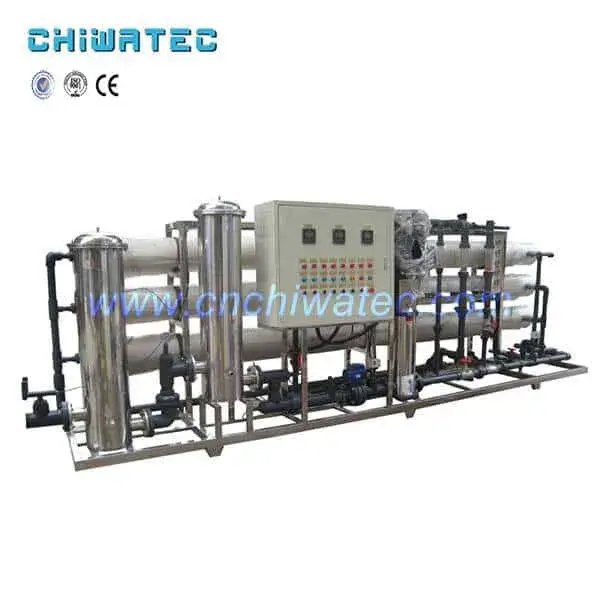
- High-pressure pump — Multi-stage centrifugal pump delivering 55-85 bar, typically 800-1200 kW for a 10,000 m³/day plant. Materials: duplex stainless steel for corrosion resistance
- RO membrane elements — Spiral-wound 8-inch or 16-inch diameter elements, arranged in pressure vessels (typically 6-8 elements per vessel). Seawater membranes have 99.5-99.8% salt rejection
- Energy recovery device — Pressure exchangers (PX) or Pelton turbines that capture hydraulic energy from the brine stream, reducing system energy consumption by 40-60%
- Pretreatment system — Multi-media filters, cartridge filters (5 μm), antiscalant dosing, and optionally UF membranes for open intake systems
- Post-treatment system — Calcite contactors or chemical dosing for remineralization, chlorine dosing for disinfection, and pH adjustment
For thermal desalination systems:
- Brine heater (MSF) — Shell-and-tube heat exchanger heating feed seawater to 90-110°C using steam
- Evaporator vessel (MSF/MED) — Multi-stage or multi-effect vessel containing flash chambers or tube bundles
- Vacuum system — Steam ejectors or vacuum pumps maintaining the pressure gradient across stages
- Condenser tubes — Titanium or copper-nickel tubes for heat transfer, resistant to seawater corrosion
Frequently Asked Questions
What is the most energy-efficient seawater desalination technology?
Reverse osmosis with energy recovery is the most energy-efficient technology, consuming 2.5-4 kWh/m³ of freshwater produced. Modern large-scale SWRO plants with pressure exchanger energy recovery achieve as low as 2.5-3.0 kWh/m³. LT-MED consumes 8-12 kWh/m³ total, and MSF requires 13-20 kWh/m³.
How does reverse osmosis remove salt from seawater?
RO uses high pressure (55-85 bar) to force seawater through a semi-permeable polyamide membrane. Water molecules pass through the membrane’s polymer matrix, while hydrated salt ions (Na⁺, Cl⁻) are too large to pass and remain in the brine stream. Seawater RO membranes achieve 99.5-99.8% salt rejection, producing permeate with TDS below 500 ppm from 35,000 ppm seawater.
What is the difference between MSF and MED desalination?
Both are thermal desalination processes, but they differ in mechanism. MSF heats seawater and flashes it into steam through multiple pressure stages — it operates at 90-110°C and uses brine recirculation. MED evaporates seawater on heat transfer tubes at progressively lower temperatures (top temperature below 70°C for LT-MED) and is more energy-efficient with a higher gained output ratio (GOR of 8-12 vs 6-8 for MSF).
How much does seawater desalination cost per cubic meter?
Large-scale SWRO desalination costs $0.50-0.90 per m³ for plants above 100,000 m³/day capacity, including capital amortization, energy, chemicals, and maintenance. Smaller plants (under 10,000 m³/day) cost $1.00-1.50 per m³. Thermal desalination costs 1.5-2x more than RO for the same capacity. Energy represents 30-50% of total operating cost.
What pretreatment is required for seawater RO desalination?
Seawater RO requires extensive pretreatment. For subsurface intakes (beach wells): screening + multimedia filtration + cartridge filtration + antiscalant dosing. For open ocean intakes: screening + dissolved air flotation (DAF) or ultrafiltration (UF) + cartridge filtration + antiscalant dosing. The target is feed water with SDI <5 and free chlorine <0.1 ppm entering the RO membranes.
Conclusion & Call to Action
Understanding the seawater desalination equipment principles — from RO membrane separation to thermal distillation — enables informed technology selection for coastal water supply projects. RO desalination dominates the market with the lowest energy consumption and operating cost, while MSF and MED remain important for large-scale cogeneration applications. CHIWATEC provides custom-engineered seawater RO desalination systems with energy recovery, suitable for municipal, industrial, and commercial applications.
Email: [email protected] or [email protected]
Related Resources and Further Reading
- Comparative Analysis of Desalination Effectiveness: Reverse Osmosis vs. Electrodialysis
- Desalination Methods for Brackish Water (2): Reverse Osmosis Method
- Features of Small Seawater Desalination Equipment
- Main Process Flow Description of Reverse Osmosis Pure Water Equipment
- Seawater RO Desalination System for Industrial and Municipal Use
Do you have a water treatment project we can help with
* Designing,machining,installing,commissioning, customize and one-stop service






 English
  Spanish
  Portuguese




