Ultrapure Water System Process Flow: Complete Guide to UPW Treatment Equipment and Technology 2026
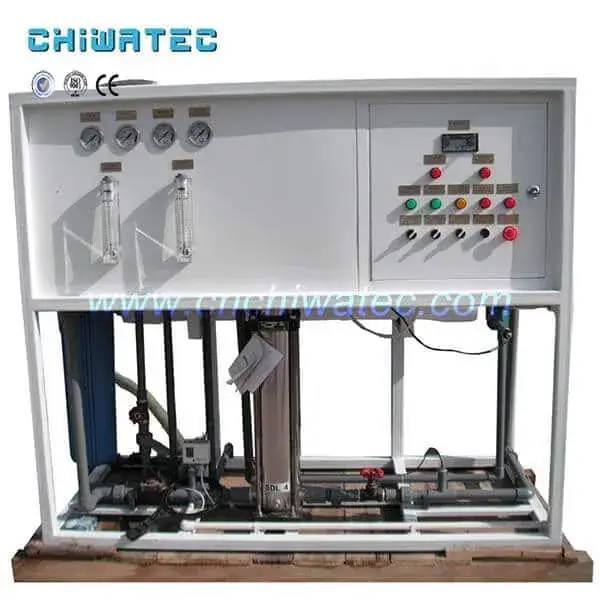
Understanding the ultrapure water system process flow is essential for designing and operating high-purity water treatment systems used in electronics manufacturing, pharmaceutical production, power generation, and laboratory applications. This guide breaks down each stage of the ultrapure water system process flow — from raw water intake to point-of-use delivery — explaining the function of every component. CHIWATEC provides complete ultrapure water system design, manufacturing, and commissioning services for industrial clients worldwide.
Ultrapure Water System Process Flow Overview
A complete ultrapure water system process flow typically follows this sequence: Raw water → Pretreatment → Primary RO → Secondary RO → Polishing (EDI/Mixed Bed) → Terminal Filtration → Point of Use. Each stage removes specific contaminants to progressively achieve resistivity of 18.2 MΩ·cm, TOC <5 ppb, and particle counts below specific class limits. Below is the detailed process flow:
Raw water → Raw water tank → Raw water pump → Flocculant dosing → Dual media filter → Activated carbon filter → Heat exchanger → Antiscalant dosing → 5 µm cartridge filter → Primary high-pressure pump → Primary RO membrane → Alkali dosing → Secondary high-pressure pump → Secondary RO membrane → Intermediate water tank → Intermediate water pump → UV germicidal lamp → TOC UV lamp → Degassing membrane → EDI device → Primary polishing mixed bed → Ultrapure water tank → Ultrapure water pump → Heat exchanger → Secondary TOC UV lamp → Secondary degassing membrane → Booster pump → Secondary polishing mixed bed → Terminal filter → Point of use
This 26-step ultrapure water system process flow represents a typical two-pass RO + EDI + mixed bed configuration used in semiconductor and pharmaceutical applications.
Pretreatment Stage: Protecting Downstream RO and EDI Equipment
Pretreatment is the first critical step in the overall treatment train, protecting downstream RO membranes and EDI modules from fouling:
| Component | Function |
|---|---|
| Raw Water Tank | Stores incoming water, buffers flow variations |
| Flocculant Dosing | Coagulates suspended particles for easier removal |
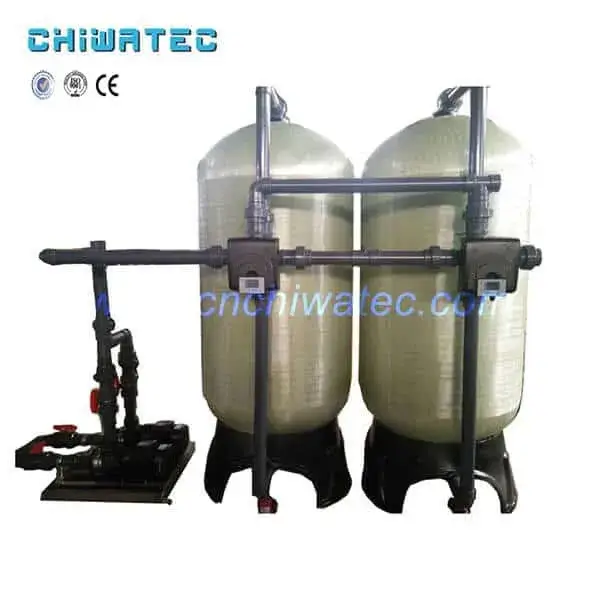
| Dual Media Filter | Removes suspended solids and colloidal matter using anthracite + sand layers |
| Activated Carbon Filter | Removes chlorine, organic compounds, and improves taste/odor |
| Plate Heat Exchanger | Controls water temperature for optimal RO membrane performance (25C ideal) |
| Antiscalant Dosing | Prevents CaCO3, CaSO4, and silica scaling on RO membranes |
| 5 um Cartridge Filter | Final particulate removal before RO membranes (SDI <5 target) |
Proper pretreatment is essential to maintain system reliability and minimize membrane cleaning frequency.
Primary and Secondary Reverse Osmosis: Double-Pass Desalination
The RO stage is the heart of the treatment system, removing 95–99% of dissolved salts:
- Primary RO membrane group: First-pass desalination, typically achieving 97–99% salt rejection. Operates at 10–15 bar for brackish water
- Alkali dosing (CO2 removal): Between primary and secondary RO, NaOH is injected to convert dissolved CO2 to bicarbonate, which is then rejected by the secondary RO membranes
- Secondary RO membrane group: Second-pass desalination, polishes the permeate to achieve <5 uS/cm conductivity. The double-pass configuration is standard in high-purity water system designs
The double-pass RO configuration reduces TDS from feed water levels (typically 200–500 ppm) to less than 5–10 ppm, preparing the water for the polishing stage.
UV Sterilization and TOC Reduction for High-Purity Water
After the RO stage, the system includes UV treatment for microbial control and TOC reduction:
- UV germicidal lamp (254 nm): Destroys bacteria and microorganisms that may have passed through RO membranes or colonized downstream piping
- TOC UV lamp (185 nm): Breaks down organic carbon compounds through photo-oxidation, reducing TOC levels to <5 ppb for semiconductor-grade water
- Degassing membrane: Removes dissolved gases (CO2, O2) that can cause corrosion in high-purity water systems and reduce resistivity
TOC UV lamps and degassing membranes are critical components in advanced UPW system designs for electronics and pharmaceutical applications.
EDI Technology: Continuous Electrodeionization for Final Polishing
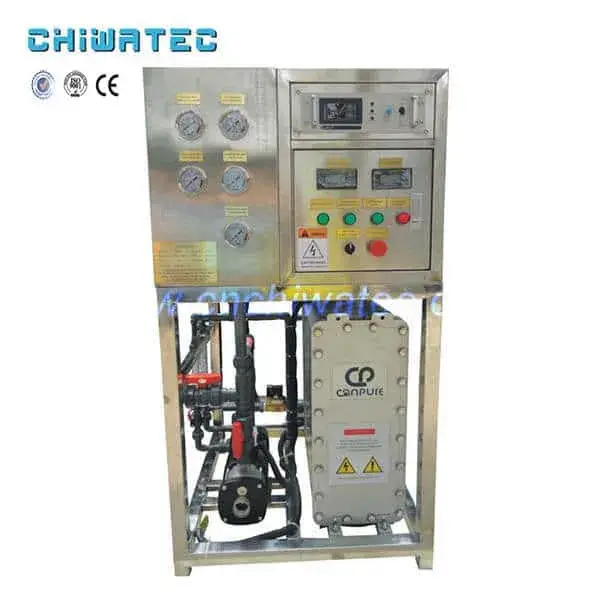
Electrodeionization (EDI) is the key polishing technology in modern high-purity water systems:
| Parameter | EDI Specification |
|---|---|
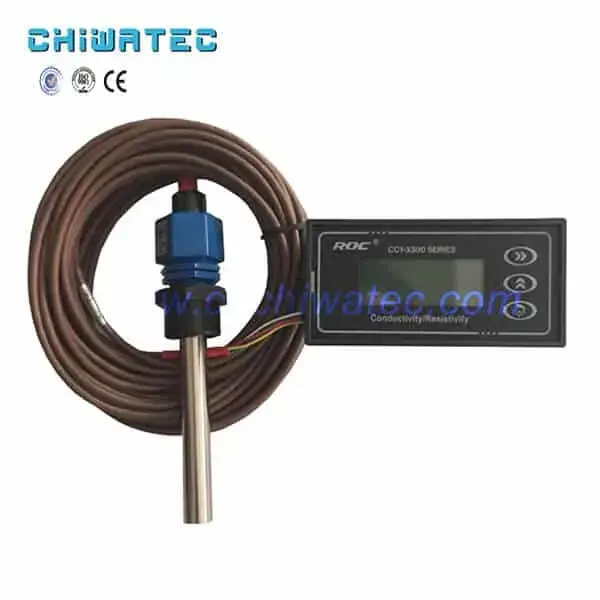
| Product Resistivity | >16–18.2 MOhm-cm |
| Silica Removal | >99% |
| TOC Removal | Additional 90%+ reduction |
| Operating Mode | Continuous, no chemical regeneration |
| Power Consumption | 0.3–1.0 kWh/m3 |
EDI replaces traditional mixed bed ion exchange in modern ultrapure water systems, providing continuous high-purity water without acid/caustic regeneration chemicals. This reduces operational costs and environmental impact while maintaining consistent water quality.
Polishing Mixed Bed and Terminal Filtration
For the highest water quality requirements, a polishing mixed bed is included after EDI:
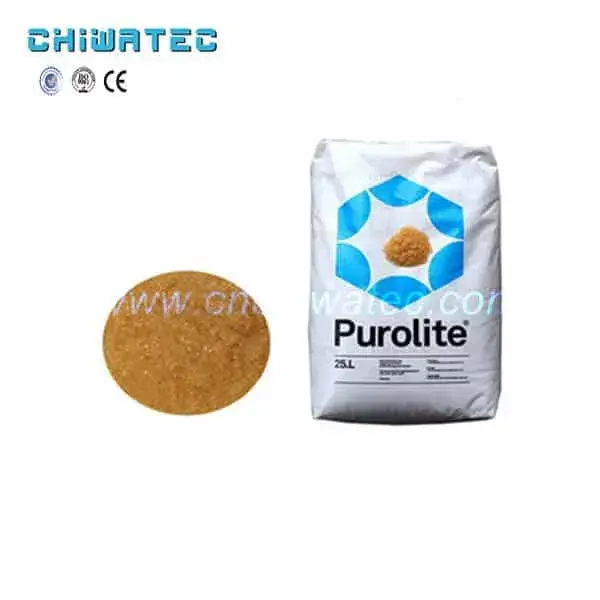
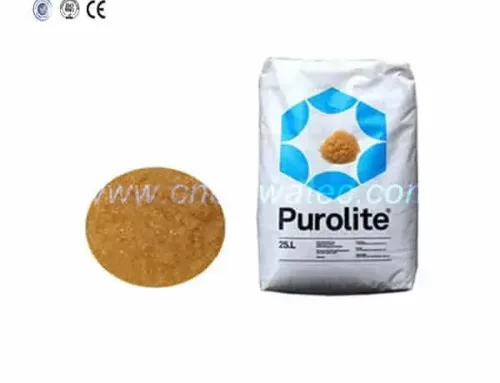
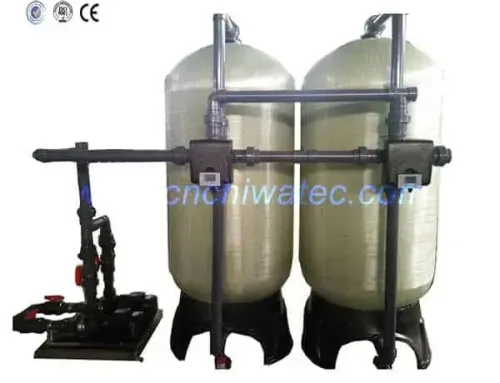
- Primary polishing mixed bed: Cation + anion mixed resin polishes EDI product water to 18.2 MOhm-cm resistivity
- Ultrapure water storage tank: Stores treated water with nitrogen blanketing to prevent CO2 absorption
- Secondary polishing mixed bed: Final polishing immediately before point of use, ensuring delivered water meets all quality specifications
- Terminal filter (0.1–0.2 um): Removes any resin fines or particulate generated in the polishing loop
The polishing loop is recirculated continuously to maintain water quality, even when no water is being drawn at the point of use.
Ultrapure Water System Process Flow by Industry Application
The ultrapure water system process flow varies by application and quality requirements:
| Industry | Process Flow | Target Resistivity | Key Requirements |
|---|---|---|---|
| Semiconductor | RO > EDI > MB > UV/TOC > 0.1 um filter | 18.2 MOhm-cm | TOC <5 ppb, DO <1 ppb, particles <0.1 um |
| Pharmaceutical (WFI) | RO > EDI > UV > Distillation | >1 MOhm-cm | GMP compliance, endotoxin <0.25 EU/mL |
| Power Generation | RO > MB > mixed bed | >10 MOhm-cm | Silica <10 ppb, low corrosion risk |
| Laboratory | RO > EDI > UV > polishing | 18.2 MOhm-cm | TOC <10 ppb, flexible flow rates |
Selecting the right treatment configuration depends on feed water quality, target purity standards, and operational budget.
Frequently Asked Questions
Q1: What is the standard ultrapure water system process flow?
The standard ultrapure water system process flow includes: raw water → pretreatment (media filter, carbon filter, antiscalant) → primary RO → secondary RO → UV → EDI → polishing mixed bed → terminal filter → point of use. Some configurations add degassing membranes and TOC UV lamps for higher purity requirements.
Q2: Why does the system include double-pass RO?
Double-pass RO reduces TDS from feed water to <5 uS/cm before the polishing stage. The second RO pass also removes CO2 (converted to bicarbonate by NaOH dosing) that would otherwise reduce EDI efficiency and lower product water resistivity.
Q3: How does EDI replace mixed bed ion exchange?
EDI continuously regenerates its ion exchange resin using electrical current, eliminating the need for acid/caustic chemical regeneration. Modern UPW system designs typically use EDI as the primary polisher, with a small polishing mixed bed as a final safeguard.
Q4: What water quality can a complete ultrapure water system process flow achieve?
A well-designed system with RO + EDI + polishing mixed bed can achieve: resistivity of 18.2 MOhm-cm, TOC <5 ppb, silica <1 ppb, sodium <0.1 ppb, dissolved oxygen <1 ppb, and particles >0.1 um <1 per mL.
Q5: How long does an ultrapure water system last?
With proper operation and maintenance, an ultrapure water system has a 15–20 year equipment lifespan. RO membranes require replacement every 3–5 years, EDI modules last 5–10 years, and UV lamps need annual replacement. The system design affects maintenance frequency and operating costs.
Conclusion & Call to Action
The ultrapure water system process flow is a multi-stage treatment train that progressively removes contaminants to achieve the highest water purity standards. From pretreatment through double-pass RO, UV, EDI, and polishing, each component plays a critical role in delivering 18.2 MOhm-cm ultrapure water for demanding industrial applications. For customized system design and equipment supply, contact CHIWATEC today. Email us at [email protected] or [email protected] for a free consultation and project quotation.
Do you have a water treatment project we can help with
* Designing,machining,installing,commissioning, customize and one-stop service
 English
  Spanish
  Portuguese