Natural Mineral Water Purification Filter Media: Complete Technical Guide to System Design and Applications 2026
Looking for a long-lasting, chemical-free water filtration solution? Natural mineral water purification filter media offers 30+ years of service life with fluoride removal efficiency meeting national drinking water standards, at an operating cost of just 0.2-0.3 yuan per ton of water. Unlike synthetic media that require frequent replacement, natural zeolite-based mineral media provides consistent filtration performance through its unique crystalline structure and ion exchange capabilities. CHIWATEC supplies natural mineral water purification filter media and complete filtration system solutions for municipal water plants, industrial facilities, and residential applications worldwide.
What Is Natural Mineral Water Purification Filter Media?
Natural mineral water purification filter media is a filtration material derived from naturally occurring zeolite minerals — aluminosilicate crystals composed of silicon-oxygen and aluminum-oxygen tetrahedra. These minerals possess a unique honeycomb-like crystalline structure containing cavities and channels that account for more than 50% of their total volume, creating an exceptionally high specific surface area of 500-1,000 m²/g.
The natural mineral undergoes modification activation treatment to adjust its pore structure and increase surface area activity. This treatment enhances its ability to adsorb contaminants including fluoride, arsenic, heavy metals, and organic compounds through a combination of mechanisms:
- Ion exchange: The crystal lattice contains exchangeable cations (Na⁺, Ca²⁺, K⁺) that can be replaced by heavy metal ions and other contaminants in water
- Adsorption selectivity: The uniform pore size creates molecular sieve effects, selectively trapping specific contaminants while allowing water molecules to pass through
- Catalytic properties: The activated mineral surface promotes chemical reactions that break down organic pollutants
- Physical filtration: The porous structure mechanically traps suspended particles and sediments
The combination of these mechanisms makes natural mineral filter media uniquely effective compared to conventional filtration materials. The 2026 complete guide to natural mineral water filter media provides a comprehensive overview of characteristics and applications.
Key Technical Characteristics of Natural Mineral Filter Media
The exceptional performance of natural mineral water purification filter media is defined by a set of measurable technical characteristics that distinguish it from synthetic and carbon-based alternatives.
| Parameter | Value/Range | Significance |
|---|---|---|
| Specific surface area | 500-1,000 m²/g | High adsorption capacity for contaminants |
| Pore volume ratio | >50% of crystal volume | Excellent diffusion and mass transfer |
| Service life | 30+ years | No media hardening over time |
| Operating cost | 0.2-0.3 yuan/ton | Extremely low lifecycle cost |
| Fluoride removal efficiency | Meets GB 5749-2022 | Compliant with national drinking water standards |
| Modification method | Aluminum salt activation | Enhanced fluoride and arsenic adsorption |
| Operation complexity | Simple | Minimal training required for operators |
The filter media can operate at various scales — from small household water purifiers to large municipal water treatment plants — without significant design changes. The processing scale can be adapted flexibly, making it suitable for rural towns, urban communities, and industrial facilities alike.
Fluoride Removal Performance and Mechanism
One of the most valuable properties of natural mineral water purification filter media is its exceptional fluoride removal efficiency. Fluoride contamination in groundwater affects millions of people worldwide, particularly in regions with geological fluoride deposits. Chronic exposure to elevated fluoride levels causes dental and skeletal fluorosis, making effective defluoridation a public health priority.
The modified natural mineral media removes fluoride through a specific adsorption mechanism:
- Surface complexation: Aluminum ions (Al³⁺) introduced during the modification process form stable complexes with fluoride ions (F⁻) on the mineral surface
- Ion exchange: Fluoride ions replace hydroxyl groups (OH⁻) on the activated mineral surface, forming Al-F bonds that are resistant to desorption
- Diffusion into pores: Fluoride ions diffuse through the pore channels and are retained within the crystal structure
The treated water’s fluoride content consistently meets the national drinking water standard (GB 5749-2022, maximum 1.0 mg/L), even when influent fluoride levels exceed 5 mg/L. The media also simultaneously removes other chemical contaminants and toxic substances that exceed regulatory limits.
System Design Parameters and Installation
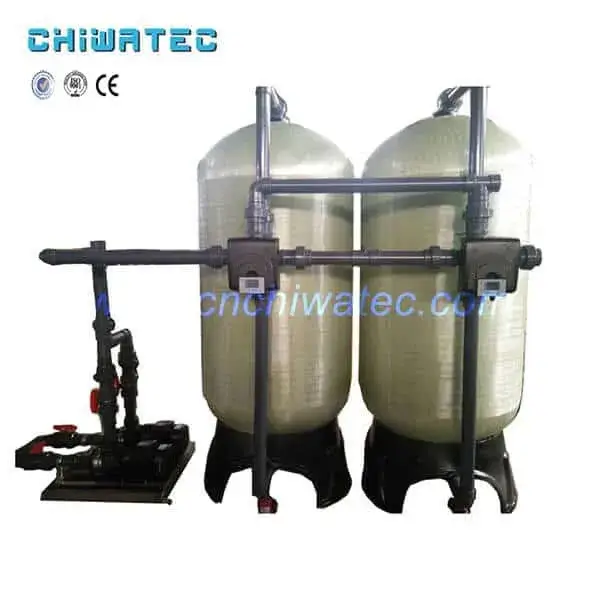
Proper system design is essential to maximize the performance of natural mineral water purification filter media. The following parameters should be considered during installation:
- Filtration bed depth: 800-1,200 mm for gravity-fed systems, 1,000-1,500 mm for pressure vessel systems. Deeper beds provide longer contact time and higher contaminant removal efficiency
- Filtration velocity: 5-15 m/h for standard operation. Lower velocities (5-8 m/h) are recommended for high-fluoride applications to ensure adequate contact time
- Backwash requirements: Periodic backwashing at 15-25 m/h for 5-10 minutes removes accumulated suspended solids and maintains bed porosity. Backwash frequency depends on influent turbidity — typically every 24-48 hours for surface water, every 72-96 hours for groundwater
- Media support layers: Use graded gravel or quartz sand support layers (200-400 mm) below the mineral media to prevent media loss during backwashing and ensure uniform flow distribution
- Pretreatment: For turbid water sources above 10 NTU, install a sedimentation or sand filtration pretreatment stage to protect the mineral media from excessive solids loading
The practical application of activated carbon in water treatment provides complementary filtration for organic contaminant removal when combined with mineral media systems.
Application Range of Natural Mineral Water Filtration Systems
The versatility of natural mineral water purification filter media makes it suitable for a wide range of applications across municipal, industrial, and residential sectors.
Municipal Water Treatment Plants
Natural mineral media can be installed in rapid gravity filters at municipal water treatment plants, replacing or supplementing conventional sand filtration. The media’s fluoride removal capability addresses a critical water quality issue in regions with high-fluoride groundwater sources. The long 30-year service life and minimal maintenance requirements make it particularly attractive for water utilities with limited operational budgets.
Small and Medium-Sized Water Purification Stations
Rural towns, townships, communities, and government organizations can deploy natural mineral filter media in compact water purification stations. These systems are simple to operate and manage, requiring no chemical dosing or complex monitoring equipment. The media can treat water volumes ranging from a few cubic meters per day for small communities to hundreds of cubic meters per day for district-level systems.
Household Water Purifiers
For individual households concerned about fluoride and heavy metals in tap water, cartridge-based systems using natural mineral filter media are available. These compact units install under the sink or as countertop devices, providing point-of-use treatment with minimal maintenance.
Industrial Process Water
Industries including pharmaceuticals, beverage manufacturing, food processing, and printing/dyeing use natural mineral media to improve feed water quality. The media is also used for boiler feed water pretreatment in power plants, providing initial softening and contaminant reduction before downstream ion exchange or membrane processes.
Wastewater and Reclaimed Water Treatment
Swimming pools, hotels, restaurants, and urban communities apply natural mineral media for reclaimed water treatment. The media effectively removes residual contaminants from secondary-treated wastewater, enabling water reuse for non-potable applications. In domestic and industrial wastewater treatment, the media serves as a polishing stage to meet discharge standards.
Natural Mineral Media vs. Other Filtration Technologies
Understanding where natural mineral media fits in the broader water treatment landscape helps system designers make informed choices. Here is how it compares to common alternatives:
| Parameter | Natural Mineral Media | Activated Carbon | Sand Filtration |
|---|---|---|---|
| Service life | 30+ years | 1-3 years | 5-10 years |
| Fluoride removal | Excellent (>95%) | Poor | None |
| Heavy metal removal | Good | Limited | None |
| Organic removal | Moderate | Excellent | Poor |
| Chlorine removal | Moderate | Excellent | None |
| Operating cost | Very low | Low-Medium | Very low |
For water treatment systems requiring both fluoride/organic removal, a combined approach using natural mineral media as the primary filtration stage followed by activated carbon quality specifications for polishing organic removal provides the most comprehensive treatment.
Frequently Asked Questions
Q1: How long does natural mineral water purification filter media actually last?
Natural mineral filter media has a service life exceeding 30 years under normal operating conditions. Unlike sand filters that can become compacted or activated carbon that loses adsorption capacity over time, the mineral media maintains its crystalline structure and ion exchange properties indefinitely. There is no media hardening, and periodic backwashing is the only routine maintenance required to restore filtration performance.
Q2: What contaminants can natural mineral filter media remove besides fluoride?
In addition to fluoride removal (meeting GB 5749-2022 standards), natural mineral media effectively removes arsenic, lead, mercury, cadmium, and other heavy metals through ion exchange mechanisms. It also reduces organic compounds, turbidity, color, and certain pathogenic microorganisms. The specific removal efficiency depends on the mineral type (clinoptilolite, chabazite, mordenite) and the modification treatment applied.
Q3: How does the operating cost compare to other filtration methods?
At 0.2-0.3 yuan per ton of treated water, natural mineral media has one of the lowest operating costs of any filtration technology. For comparison, activated carbon systems typically cost 0.5-1.0 yuan/ton (including replacement media), and reverse osmosis systems cost 1.5-3.0 yuan/ton (including membrane replacement and energy). The 30-year media lifespan means replacement costs are essentially negligible over the system’s operational life.
Q4: Can natural mineral filter media be used with chlorinated water?
Yes. Natural mineral media is compatible with chlorinated water supplies and is not degraded by residual chlorine. In fact, the media can provide synergistic benefits in chlorinated systems by removing chlorinated byproduct precursors before disinfection, potentially reducing trihalomethane (THM) formation in the distribution system.
Q5: What is the difference between natural mineral media and synthetic ion exchange resin?
Natural mineral media is a naturally occurring zeolite that undergoes physical modification to enhance its adsorption properties. It is non-toxic, chemically inert under normal conditions, and requires no chemical regeneration. Synthetic ion exchange resin is a manufactured polymer bead that requires periodic chemical regeneration with acid or alkali. Mineral media has a 30-year lifespan versus 3-5 years for resin, but resin generally has higher total ion exchange capacity for water softening applications.
Conclusion and Call to Action
Natural mineral water purification filter media offers a unique combination of exceptional fluoride and heavy metal removal, ultra-long service life exceeding 30 years, and extremely low operating costs of 0.2-0.3 yuan per ton. Its versatility spans from household water purifiers to municipal water treatment plants, making it one of the most cost-effective and sustainable filtration solutions available for addressing fluoride contamination and general water quality improvement.
CHIWATEC supplies high-quality natural mineral water purification filter media, custom filtration system designs, and ongoing technical support for municipal, industrial, and residential applications. Contact us at [email protected] or [email protected] (WhatsApp available) for expert consultation on selecting and integrating natural mineral filter media into your water treatment system.
Related Resources and Further Reading
- 2026 Complete Guide to Natural Mineral Water Filter Media: Technical Characteristics, Applications, and Benefits
- Practical Application of Activated Carbon in Water Treatment
- Standard Analysis for Buying Activated Carbon
- The Mechanism of Action of Silver-Loaded Nutshell Activated Carbon
- Mechanical Filtration Equipment Product Line
Do you have a water treatment project we can help with
* Designing,machining,installing,commissioning, customize and one-stop service
 English
  Spanish
  Portuguese