

Reverse Osmosis Technology: The Complete Guide to RO Water Treatment (2025)
Reverse osmosis (RO) technology stands as the most advanced and widely adopted membrane-based water purification method in the world today. By leveraging semi-permeable membranes and hydraulic pressure, reverse osmosis technology effectively removes up to 99% of dissolved salts, organic compounds, bacteria, viruses, and heavy metals from water. The global RO water treatment market was valued at approximately USD 11.2 billion in 2024 and is projected to reach USD 22.8 billion by 2032, growing at a CAGR of 9.3% (Grand View Research, 2024). Originally developed for NASA’s aerospace programs in the 1960s, this reverse osmosis membrane technology has since transformed into an indispensable solution for municipal water supply, industrial processing, pharmaceutical production, and seawater desalination across more than 150 countries worldwide.
What makes reverse osmosis water treatment uniquely powerful is its ability to deliver consistently high-purity water at a molecular level. Unlike conventional filtration methods that rely on physical straining, how reverse osmosis works involves a natural process reversed — applying external pressure to overcome osmotic pressure, forcing pure water molecules through a membrane while rejecting virtually all dissolved contaminants. Modern RO systems achieve salt rejection rates exceeding 99.5%, with effluent conductivity as low as 5 μS/cm from standard tap water, meeting and often exceeding the most stringent international water quality standards.
How Reverse Osmosis Technology Works: Principles and Mechanisms
The Semi-Permeable Membrane: The Heart of RO Technology
At the core of reverse osmosis technology lies the semi-permeable membrane, a thin-film composite (TFC) material with pore sizes measuring approximately 0.0001 microns (0.1 nanometers). To put this into perspective, a human hair is roughly 500,000 times thicker than the diameter of an RO membrane pore. These microscopic pores allow water molecules (H₂O) to pass through while blocking dissolved salts, metal ions, organic molecules, bacteria, and viruses. The RO membrane filtration process operates at pressures ranging from 100 to 1,200 psi (7 to 83 bar), depending on the feed water’s total dissolved solids (TDS) concentration and the specific membrane configuration employed.
The Pressure-Driven Separation Process
Understanding how reverse osmosis works requires grasping the concept of osmotic pressure. In natural osmosis, water moves from a low-solute area to a high-solute area across a membrane. Reverse osmosis reverses this flow by applying external pressure greater than the natural osmotic pressure, forcing water from the concentrated side (feed water) to the purified side (permeate). This pressure-driven membrane separation produces two distinct streams: permeate (pure water) and concentrate (rejected contaminants). Modern RO systems incorporate energy recovery devices (ERDs) that capture pressure energy from the concentrate stream, reducing overall energy consumption by up to 60% compared to earlier designs.
Key Components of an RO System
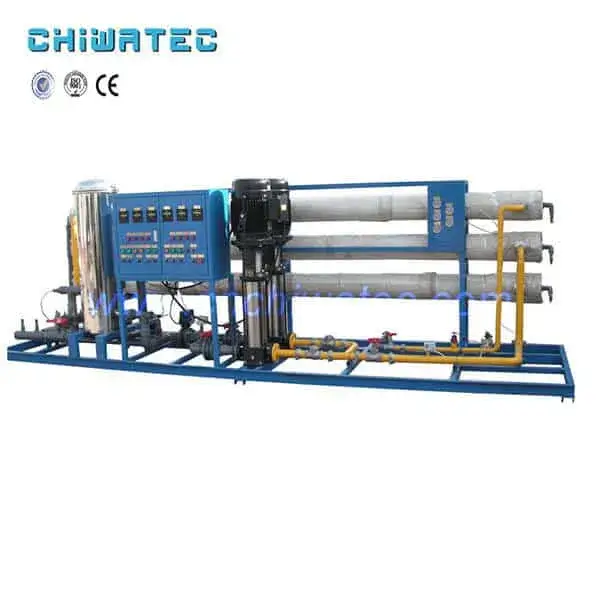
A complete reverse osmosis water treatment system comprises several critical components working in sequence: feed water pumps to generate operating pressure, pre-filtration stages (sediment and carbon filters) to protect the membrane, the RO membrane vessel housing the spiral-wound elements, flow controllers to manage recovery rates, and post-treatment polishing stages such as UV sterilization or deionization. Each component must be carefully sized and configured to match the specific feed water quality and target output specifications.
Key Performance Metrics of Reverse Osmosis Water Treatment
Salt Rejection Rate and Membrane Efficiency
The salt rejection rate is the primary performance indicator for any reverse osmosis membrane. Premium-grade commercial RO membranes routinely achieve 99.5% to 99.8% salt rejection under optimal operating conditions. For example, when treating tap water with a conductivity of 500 μS/cm, a membrane with 99.5% rejection produces permeate water with conductivity below 2.5 μS/cm. Industry-leading manufacturers such as FilmTec (DuPont), Hydranautics, and Toray have introduced advanced membrane chemistries that maintain above 97% rejection rates even after 5 years of continuous operation, significantly reducing total cost of ownership for end users.
Water Quality Standards Achievable with RO Technology
The water quality produced by RO water treatment systems consistently meets or exceeds international standards. Single-pass RO systems typically achieve permeate conductivity of 1–10 μS/cm, satisfying WHO drinking water guidelines and US EPA primary drinking water regulations. For applications demanding higher purity, two-pass RO configurations can reduce conductivity to less than 1 μS/cm, while RO combined with electrodeionization (EDI) or mixed-bed ion exchange produces ultrapure water with resistivity reaching 18.2 MΩ·cm — the theoretical maximum for pure water. This makes reverse osmosis technology indispensable for pharmaceutical USP Purified Water production, semiconductor manufacturing, and clinical laboratory applications requiring ASTM Type I water quality.
Industrial Applications of Reverse Osmosis Technology
Seawater Desalination
Seawater reverse osmosis (SWRO) has become the dominant desalination technology globally, accounting for over 70% of newly commissioned desalination capacity. Modern SWRO plants consume just 2.5–3.5 kWh per cubic meter of produced water — a 75% reduction from thermal desalination methods. Major facilities such as the Sorek Desalination Plant in Israel (624,000 m³/day) demonstrate the scalability of reverse osmosis technology for municipal water supply.
Food and Beverage Processing
The food and beverage industry relies on RO water treatment for process water purification, juice concentration (up to 25–35° Brix), dairy whey concentration, and wastewater recovery. RO membrane systems enable up to 90% water recovery in beverage manufacturing, significantly reducing freshwater consumption and wastewater disposal costs.
Pharmaceutical and Healthcare
Pharmaceutical manufacturers depend on reverse osmosis water treatment systems to produce USP Purified Water and Water for Injection (WFI). The technology ensures consistent removal of endotoxins, bacterial contaminants, and chemical impurities critical for drug formulation and medical device sterilization processes.
Power Generation
Thermal power plants and nuclear facilities use reverse osmosis technology for boiler feed water treatment, cooling tower makeup, and wastewater recycling. RO pre-treatment has been shown to reduce ion exchange regeneration frequency by 90%, cutting chemical consumption and operational costs substantially.
Latest Trends in Reverse Osmosis Technology (2024–2025)
The reverse osmosis membrane industry is experiencing rapid innovation across several fronts. Graphene oxide-based membranes, currently in advanced development, promise 3–5 times higher water permeability while maintaining comparable salt rejection rates, potentially reducing system pressure requirements by 40%. Artificial intelligence (AI)-powered system monitoring and predictive maintenance platforms are being deployed in large-scale RO plants, reducing unplanned downtime by up to 35%. The integration of renewable energy — particularly solar and wind — with SWRO plants is accelerating, with several hybrid-powered facilities now operating at 100% renewable energy during peak production hours. Additionally, low-energy membrane elements certified for operation at ultra-low pressures (4–6 bar) are expanding the application of reverse osmosis water treatment into residential and small commercial markets, making point-of-use RO systems more accessible than ever before.
Conclusion
Reverse osmosis technology remains the gold standard for water purification in the 21st century. From its origins in aerospace research to its current status as a USD 11+ billion global industry, RO technology continues to evolve, delivering higher efficiency, lower energy consumption, and broader accessibility. As global water scarcity intensifies — with UNESCO projecting that 2.4 billion people will face water stress by 2030 — the role of RO water treatment in ensuring safe, sustainable water supplies will only grow. Whether for industrial-scale desalination, pharmaceutical-grade water production, or residential drinking water purification, understanding the principles and capabilities of reverse osmosis technology is essential for anyone involved in water treatment and management.
Frequently Asked Questions (FAQ)
What is reverse osmosis technology?
Reverse osmosis (RO) technology is a membrane-based water purification process that uses pressure to force water through a semi-permeable membrane, removing up to 99% of dissolved salts, contaminants, bacteria, and viruses. It is the most widely used technology for desalination and high-purity water production worldwide.
How does reverse osmosis differ from regular filtration?
While conventional filtration uses physical barriers to strain out particles larger than a certain size, reverse osmosis technology operates at the molecular level, rejecting dissolved ions and molecules smaller than 0.001 microns — far beyond the capability of sand filters, carbon filters, or microfiltration systems.
Is reverse osmosis water safe to drink?
Yes, RO-purified water meets or exceeds WHO and EPA drinking water standards. The minimal mineral content can be addressed with remineralization filters if desired, but RO water is widely consumed in homes and bottled water facilities globally without health concerns.
What is the lifespan of an RO membrane?
With proper pre-treatment and regular maintenance, commercial-grade reverse osmosis membranes typically last 3 to 7 years. Salt rejection rates gradually decline over time from 99.5% to approximately 97% before membrane replacement is recommended.
What industries benefit most from RO technology?
The key industries benefiting from reverse osmosis water treatment include seawater desalination (municipal water supply), food and beverage processing, pharmaceutical manufacturing, power generation, semiconductor fabrication, and healthcare. Each sector leverages RO’s ability to produce consistent, high-purity water at scale.
Further Reading
For more in-depth information about reverse osmosis systems and water treatment, explore these related articles:
- Main Process Flow of Reverse Osmosis Pure Water Equipment — A detailed breakdown of RO system components and process stages.
- Essential Conditions for Installing Reverse Osmosis Systems — Critical installation guidelines for optimal RO system performance.
- Complete Guide to RO System Operation and Maintenance — Comprehensive operation, maintenance, and troubleshooting procedures.
- Pollution Control Methods for Reverse Osmosis Systems — Strategies to prevent membrane fouling and extend system life.
Do you have a water treatment project we can help with
* Designing,machining,installing,commissioning, customize and one-stop service






 English
  Spanish
  Portuguese




