

FRP Tank Production Process: Complete Guide to Manufacturing, Materials, and Quality Control 2026
FRP (Fiberglass Reinforced Plastic) tanks are essential pressure vessels in water treatment systems, manufactured through precise winding and curing processes that ensure structural integrity under operating pressures up to 10 bar. Understanding the FRP tank production process helps system designers and plant operators evaluate tank quality, service life, and suitability for specific applications. CHIWATEC supplies high-quality FRP tanks manufactured to international standards for water filtration, softening, and reverse osmosis pretreatment systems.
Overview of the FRP Tank Production Process
The FRP tank production process involves continuous filament winding of fiberglass strands impregnated with thermosetting resin onto a rotating mandrel. Unlike metal tanks that require welding and corrosion protection, FRP tanks are corrosion-resistant by nature, weighing 70-80% less than equivalent steel vessels. The production process consists of five main stages: mandrel preparation, filament winding, resin curing, demolding, and quality testing. Each stage directly influences the tank’s pressure rating — typically 6-10 bar (87-150 psi) for standard water treatment vessels — and its service life of 15-20 years in normal operating conditions.
Raw Materials: Resin Systems and Fiberglass
The two primary materials in the FRP tank production process are reinforcement fibers and thermosetting resin. E-glass fiberglass is the standard reinforcement, offering tensile strength of 3,400 MPa and modulus of 73 GPa. The resin matrix is typically unsaturated polyester, vinyl ester, or epoxy resin — each selected based on the application’s chemical resistance requirements. Vinyl ester resins provide superior corrosion resistance for acidic or alkaline water conditions, while standard polyester resins are cost-effective for neutral pH applications. The resin-to-glass ratio is carefully controlled at 30-40% resin by weight, achieving a laminate density of 1.8-2.0 g/cm³ and a Barcol hardness of 40-50 for cured tanks.
Step 1: Mandrel Preparation and Tooling
The production begins with a precision-machined steel or aluminum mandrel that defines the tank’s internal dimensions. Mandrels are manufactured with a slight taper (typically 1-2 degrees) to facilitate demolding after curing. The mandrel surface is coated with a mold release agent — usually a semi-permanent wax or PVA (polyvinyl alcohol) film — to prevent the cured FRP from bonding to the metal surface. For tanks with threaded openings, the mandrel includes removable inserts that form the top and bottom ports, with thread sizes ranging from 2.5 to 4 inches NPT for standard water treatment vessels. The mandrel surface is polished to a mirror finish (Ra 0.8-1.6 microns) to ensure a smooth internal tank surface that minimizes pressure drop during operation.
Step 2: Continuous Filament Winding Process
Filament winding is the core of the FRP tank production process. Continuous fiberglass roving (typically 1200-2400 tex) passes through a resin bath containing catalyzed resin, then is wound onto the rotating mandrel at a controlled angle. The winding angle determines the tank’s mechanical properties — helical winding (54-60 degrees to the tank axis) provides hoop strength for internal pressure resistance, while longitudinal winding (10-30 degrees) adds axial strength for bending and compression loads. Computer-controlled winding machines maintain precise tension (5-15 N per strand) and traverse speed to achieve consistent laminate thickness, typically 3-8 mm depending on the design pressure. Multi-layer winding with alternating angle orientations produces a balanced laminate structure that withstands cyclic pressure loading without delamination.
Step 3: Resin Curing and Polymerization
After winding, the resin-impregnated tank on the mandrel enters the curing stage. The curing process polymerizes the thermosetting resin, crosslinking the molecular chains to form a rigid, insoluble structure. For polyester and vinyl ester resins, curing uses a methyl ethyl ketone peroxide (MEKP) catalyst at 0.5-2.0% by weight, activated by cobalt naphthenate accelerator. Curing parameters vary by resin type and tank thickness — typical cycles range from 30-90 minutes at 40-80°C in a temperature-controlled oven. Post-curing at 60-80°C for 2-4 hours further develops the resin’s mechanical properties and chemical resistance. The degree of cure is verified through Barcol hardness testing (minimum 40) or differential scanning calorimetry (DSC) to ensure the tank meets its design strength specifications.
Step 4: Demolding and Surface Finishing
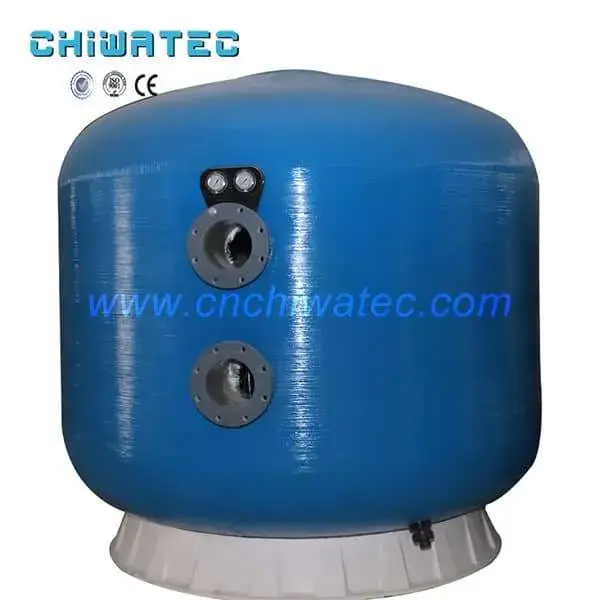
Once fully cured, the FRP tank is demolded by applying hydraulic or pneumatic pressure between the mandrel and the inner tank surface. The tapered mandrel design facilitates release, with typical demolding pressure of 2-5 bar. After removal, the tank undergoes surface finishing including trimming of the top and bottom edges to exact height specifications (typically ±2 mm tolerance), threading of the ports, and application of a UV-protective gel coat on the exterior surface. The gel coat — a pigmented resin layer 0.3-0.5 mm thick — provides weather resistance and the characteristic blue, green, or beige color of water treatment FRP tanks. For tanks with side connections, additional port openings are machined and reinforced with local laminate buildup.
Step 5: Hydrostatic Pressure Testing and Quality Control
Every FRP tank must pass hydrostatic pressure testing before shipment. The tank is filled with water and pressurized to 1.5 times the design working pressure (e.g., 15 bar for a 10-bar rated tank) and held for 10-30 minutes. During the test, inspectors check for visible leaks, pressure drop, and surface deformation. Additional quality control measures include dimensional verification (inner diameter tolerance ±1.5 mm, height tolerance ±3 mm), thread gauge inspection for port fittings, and visual inspection for surface defects such as blisters, dry spots, or resin-rich areas. ASTM D3299 and ASME RTP-1 standards are commonly referenced specifications for FRP tank manufacturing, ensuring consistent quality across production batches.
FRP Tank Sizes and Pressure Ratings
The FRP tank production process accommodates a wide range of sizes and pressure classes. Standard water treatment FRP tanks range from 6×17 inches (150×430 mm, 1.5 ft³ media volume) to 63×82 inches (1,600×2,080 mm, 100 ft³ media volume). Pressure ratings are standardized at 6 bar (90 psi), 10 bar (150 psi), and 17 bar (250 psi). The wall thickness increases proportionally with diameter and pressure rating — a 10×54 inch tank rated at 10 bar requires approximately 4 mm wall thickness, while a 36×72 inch tank at the same pressure requires 7-8 mm. Manufacturers provide detailed pressure vessel data sheets specifying maximum operating pressure, test pressure, and temperature limits (typically 1-50°C for standard applications).
Frequently Asked Questions (FAQ)
How long does the FRP tank production process take?
A complete production cycle for a single FRP tank — from mandrel preparation to final testing — takes approximately 4-8 hours for standard sizes. Filament winding itself takes 15-45 minutes, curing requires 1-4 hours depending on resin chemistry and temperature, and testing adds 30 minutes. Mass production facilities operate multiple winding stations to achieve throughput of 100-500 tanks per day.
What is the difference between FRP and polypropylene tanks?
FRP tanks offer higher strength (up to 25 times the tensile strength of polypropylene), better pressure resistance (6-17 bar vs 1-3 bar for polypropylene), and wider temperature tolerance. Polypropylene tanks are lower cost and suitable for atmospheric or low-pressure applications, while FRP tanks are required for pressurized water treatment systems.
Can FRP tanks be repaired if damaged?
Yes, minor FRP tank damage such as surface cracks or localized impact damage can be repaired by grinding out the damaged area, applying a tapered patch of resin-impregnated fiberglass mat, and re-curing at room temperature. Major structural damage typically requires tank replacement. Regular inspection every 6-12 months helps identify damage early.
What certifications should quality FRP tanks have?
Look for tanks manufactured to ASTM D3299 (filament-wound vessels) or ASME RTP-1 (reinforced thermoset plastic vessels) standards. Additional certifications include NSF/ANSI 61 for drinking water system components and ISO 9001 for quality management systems. CHIWATEC FRP tanks meet these international standards.
How do I choose the right FRP tank size for my system?
Tank size selection depends on the required media volume, service flow rate (typically 8-25 m/h), and available installation space. A simple rule: calculate media volume based on flow rate and EBCT, then select the smallest standard tank diameter that provides that volume with a bed depth of 600-1,200 mm.
Conclusion & Call to Action
The FRP tank production process — from precision filament winding to hydrostatic testing — delivers corrosion-resistant, lightweight pressure vessels essential for modern water treatment systems. CHIWATEC offers a complete range of FRP tanks in standard and custom configurations, with pressure ratings from 6 to 17 bar and diameters from 6 to 63 inches. Contact our team for technical specifications, pricing, and custom manufacturing options. Email us at [email protected] or [email protected] for expert assistance with your FRP tank requirements.
Related Resources and Further Reading
- FRP Water Treatment Tank: 2026 Complete Guide to Large FRP Tank Structure and Advantages
- Water Pretreatment Filter System: Complete Guide to RO Pretreatment Equipment and Applications 2026
- Water Quality Preconditioner: Complete Guide to Water Pretreatment Systems and Filtration Technology 2026
- Mechanical Filter for Water Treatment: Principle, Characteristics, Selection, and Applications Guide 2026
- RO Water Treatment Systems and FRP Tank Products — View Our Complete Range
Do you have a water treatment project we can help with
* Designing,machining,installing,commissioning, customize and one-stop service






 English
  Spanish
  Portuguese




