Pressure Gauge Types and Working Principles: Bourdon Tube, Diaphragm and Digital Guide 2026
Pressure measurement is essential for safe and efficient operation in water treatment systems, boilers, and industrial pipelines. Selecting the right pressure gauge type — whether Bourdon tube, diaphragm, bellows, or digital — requires understanding the working principles, measurement range, and application environment. This guide covers the major pressure gauge types, their operating mechanisms, and typical applications in water treatment and industrial settings. CHIWATEC offers reliable instrumentation solutions for pressure monitoring in water and wastewater treatment systems.
Bourdon Tube Pressure Gauge: Core Working Principle
The working principle of a pressure gauge is based on the elastic deformation of a sensitive element — typically a Bourdon tube, bellows, or diaphragm — which converts pressure into mechanical displacement. This displacement is transmitted through a gear mechanism to rotate a pointer, displaying the pressure value on a calibrated dial.
The Bourdon tube is the most widely used pressure-sensing element. It comes in three configurations: C-type tube, coiled spring tube, and spiral tube. The tube is made from a cold-work-hardened material blank that is plastically formed under pressure processing, then heat-treated to achieve high elasticity and strength. When pressure is applied to the inner cavity of the spring tube, the elastic characteristics cause the free end to displace proportionally to the applied pressure. This displacement is the fundamental mechanism for converting pressure into a readable measurement across all Bourdon-type gauges.
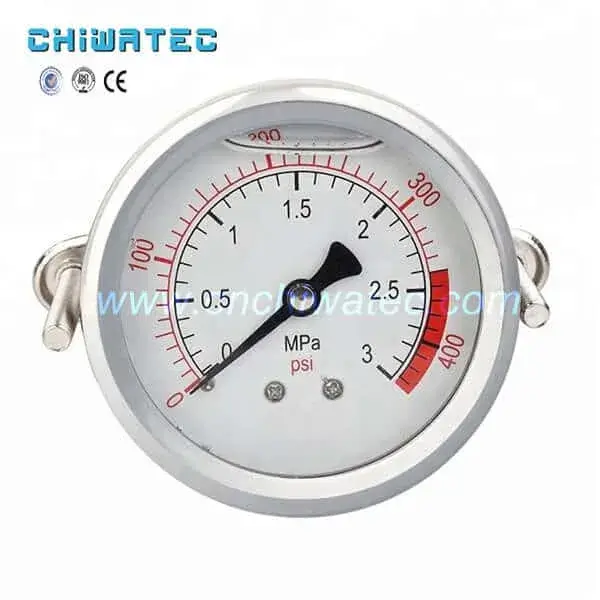
Spring Tube Design: Structure and Industrial Applications
The spring tube pressure gauge consists of a circular shell containing a spring elbow — typically made from seamed phosphor bronze tube or seamless steel tube with an elliptical cross-section. One end connects to the pressure source (e.g., a boiler steam pipe), while the other is a closed free end linked to a connecting rod. The rod connects to a sector gear and pinion on the central shaft, which drives the pointer.
When the spring tube is pressurized, the free end moves outward, rotating the sector gear and pinion through the connecting rod, causing the pointer to rotate clockwise. Greater medium pressure produces larger pointer rotation. When pressure drops, the spring elbow contracts inward, returning the pointer. At zero pressure, the hairspring returns the pointer to its starting position. Bourdon tube pressure gauges are valued for their compact structure, high accuracy, wide measurement range, and convenient use, making them ideal for measuring pressure in boiler drums, headers, and industrial pipelines.
| Feature | Bourdon Tube Gauge | Diaphragm Gauge | Bellows Gauge | Digital Gauge |
| Measurement range | Wide (0–1000+ bar) | Medium (0–60 bar) | Low (250 Pa–60 kPa) | Wide (0–1000+ bar) |
| Accuracy | High (±0.1–1.6%) | Medium (±0.5–2%) | Medium (±1–2%) | High (≤±1%) |
| Vibration resistance | Moderate | Good | Moderate | Good |
| Corrosion resistance | Limited | Good (coated diaphragm) | Limited | Varies by material |
| Viscous/dirty media | Not suitable | Suitable (flushed) | Not suitable | Varies by sensor |
Diaphragm and Bellows: Alternative Sensing Elements
The diaphragm pressure gauge uses a circular diaphragm with wave-shaped corrugations as the sensing element. The diaphragm is positioned between two flanges — either welded to the flange or clamped between them. One side receives the medium pressure, and the slight bending deformation of the diaphragm is transmitted to the pointer. Compared with the Bourdon tube, the diaphragm provides a larger transmission force and better vibration resistance because the diaphragm periphery is fixed. Diaphragm gauges can achieve high overpressure protection (e.g., the diaphragm resting against the upper flange) and can be coated for improved corrosion resistance. With open flanges, flushing rings, or openings, diaphragm pressure gauges are suitable for high-viscosity, dirty, or crystallizing media.
The bellows pressure gauge consists of two diaphragms with circular wave cross-sections buckled together. The measured medium pressure acts inside the bellows cavity, and the resulting deformation is transmitted to the pointer. Bellows gauges are typically used for measuring micro-pressure of gases with a range of 250 Pa to 60,000 Pa. Several bellows can be stacked together to produce a larger transmission force for measuring extremely low pressures.
Specialized Pressure Gauges: Vibration-Resistant and Digital Models
Vibration-resistant pressure gauges feature a sealed shell filled with damping fluid — typically silicone oil or glycerin. The damping fluid effectively absorbs vibration from the working environment and reduces pulsation in the medium pressure. These gauges are suitable for environments with severe vibration, capable of withstanding pulsation, impact, and sudden unloading of the medium while maintaining stable, clear readings. They are widely used in machinery, petroleum, chemical, metallurgy, mining, and power generation industries for measuring pressure of media that do not corrode copper and copper alloys.
Digital pressure gauges display measured pressure in digital form. They are battery-powered with long service life, requiring no external power supply for easy installation. Key advantages include high accuracy (error ≤±1%), high stability, micro-power consumption, and a stainless steel casing for robust protection. Digital pressure gauges have been widely adopted in petroleum, chemical, and power industries for online pressure measurement applications requiring precision and reliability.
Frequently Asked Questions
What is the working principle of a pressure gauge?
A pressure gauge works by using elastic deformation of a sensitive element (Bourdon tube, diaphragm, or bellows) when pressure is applied. This deformation is mechanically amplified and transmitted through a gear mechanism to rotate a pointer that indicates the pressure value on a calibrated dial.
What are the main types of pressure gauges used in water treatment?
The main types include Bourdon tube pressure gauges (most common, for general pressure measurement), diaphragm pressure gauges (for viscous or corrosive media), bellows pressure gauges (for micro-pressure gas measurement), vibration-resistant pressure gauges (for high-vibration environments), and digital pressure gauges (for high-precision online measurement).
When should a diaphragm pressure gauge be used instead of a Bourdon tube?
A diaphragm pressure gauge should be used for measuring high-viscosity, dirty, crystallizing, or corrosive media. The diaphragm provides better vibration resistance, larger transmission force, and can be coated for corrosion protection. It can also be used with open flanges and flushing connections for harsh process conditions.
What is the difference between a bellows gauge and a Bourdon tube gauge?
A bellows gauge measures micro-pressure (250 Pa to 60,000 Pa) using stacked diaphragm elements that expand or contract under pressure, while a Bourdon tube gauge measures a much wider range (up to 1000+ bar) using a curved tube that straightens under pressure. Bellows gauges are specifically for low-pressure gas applications, whereas Bourdon gauges are general-purpose.
Why use a vibration-resistant pressure gauge?
Vibration-resistant pressure gauges are filled with damping fluid (silicone oil or glycerin) to absorb mechanical vibration and pulsation. They are essential in environments with pumps, compressors, or other rotating equipment where standard gauges would experience pointer flutter, premature wear, or reading errors.
Conclusion & Call to Action
Choosing the correct pressure gauge type — Bourdon tube, diaphragm, bellows, vibration-resistant, or digital — depends on the measurement range, medium properties, environmental conditions, and accuracy requirements of the application. Understanding the working principles and design characteristics of each type enables engineers to select the most appropriate and cost-effective solution for their water treatment or industrial process system.
For expert guidance on pressure gauge selection and complete instrumentation solutions, contact CHIWATEC today. Email us at [email protected] or [email protected] for customized support.
Related Resources and Further Reading
- Water Treatment Instrumentation Types: Physical vs Analytical Instruments
- Water Treatment Instrument Selection: Key Requirements and Level Measurement
- Frequently Asked Questions (FAQ) on Water Treatment Instrumentation
- Water Treatment Instrument Selection (2): Flow Measurement Guide
- Water Treatment Accessories and Instrumentation Products
Do you have a water treatment project we can help with
* Designing,machining,installing,commissioning, customize and one-stop service

 English
  Spanish
  Portuguese