

RO membrane technology has revolutionized water purification across industries, delivering 99%+ contaminant removal through advanced semi-permeable membranes. As global demand for high-purity water grows—projected to reach $155 billion by 2030—understanding reverse osmosis principles becomes essential for businesses investing in water purification systems.
This comprehensive guide explains the science behind osmosis and reverse osmosis, explores cutting-edge RO membrane technology advancements, and demonstrates how modern water purification principles drive efficiency in industrial, commercial, and municipal applications.
What Is Osmosis? Understanding the Natural Process
Osmosis is a fundamental physical phenomenon where water molecules naturally migrate through a semi-permeable membrane from a low-concentration solution to a high-concentration solution. This spontaneous movement continues until equilibrium is reached—balancing solute concentrations on both sides of the membrane.
In nature, osmosis principles govern cellular water transport in plants and animals. When salt water and fresh water are separated by a membrane with pore sizes around 0.0001 microns (one ten-thousandth of a micron), pure water naturally flows toward the saltier side due to osmotic pressure differences.
Reverse Osmosis: Reversing Nature for Water Purification
Reverse osmosis (RO) applies external pressure greater than the natural osmotic pressure to force water molecules in the opposite direction—pushing contaminated water through the membrane while blocking dissolved salts, bacteria, viruses, heavy metals, and organic compounds.
Key Pressure Requirements
- Brackish water RO: 150-400 PSI operating pressure
- Seawater desalination: 800-1,000 PSI operating pressure
- Ultra-pure water systems: 200-600 PSI with multi-stage configurations
Modern RO membrane technology achieves recovery rates of 50-85% for brackish water and 40-50% for seawater applications, with salt rejection rates exceeding 99.5%.
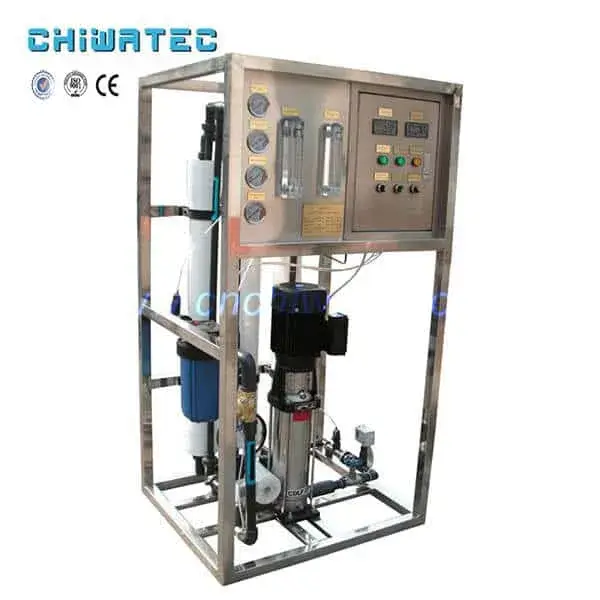
How RO Membranes Work: The Science Behind Filtration
Membrane Structure and Composition
Contemporary RO membrane technology employs thin-film composite (TFC) membranes consisting of three layers:
- Polyester support web: Provides structural strength and stability
- Microporous polysulfone interlayer: Creates smooth surface for active layer deposition
- Ultra-thin polyamide barrier: The active separation layer (0.2 microns thick) that rejects contaminants
Filtration Mechanisms
Water purification principles in RO systems rely on multiple mechanisms:
- Size exclusion: Pores of 0.0001 microns physically block particles larger than water molecules
- Solution-diffusion: Water dissolves into the membrane material and diffuses through while salts are rejected
- Charge repulsion: Negatively charged membrane surfaces repel dissolved ions and charged contaminants
- Hydrogen bonding: Water molecules form temporary bonds with membrane polymers, facilitating passage
Contaminant Removal Efficiency
| Contaminant Type | Removal Rate | Examples |
|---|---|---|
| Dissolved Salts | 95-99.5% | Sodium, chloride, calcium, magnesium |
| Heavy Metals | 96-99% | Lead, mercury, arsenic, chromium |
| Microorganisms | 99.9%+ | Bacteria, viruses, protozoa, cysts |
| Organic Compounds | 98-99% | Pesticides, pharmaceuticals, VOCs |
| Colloids & Particles | 99%+ | Silt, clay, rust, microplastics |
Applications of Reverse Osmosis Technology
Industrial Process Water
Manufacturing facilities depend on RO membrane technology for boiler feed water, cooling systems, and production processes. Industries including power generation, petrochemicals, textiles, and electronics require consistent water quality to prevent scaling, corrosion, and product defects.
Drinking Water Production
Municipal water utilities and bottled water producers utilize reverse osmosis principles to remove contaminants meeting WHO and EPA drinking water standards. RO systems treat surface water, groundwater, and seawater for safe human consumption.
Pharmaceutical and Laboratory Use
Pharmaceutical manufacturing demands ultrapure water (UPW) with resistivity of 18.2 MΩ·cm. Water purification systems combining RO with electrodeionization (EDI) and UV oxidation produce water meeting USP, EP, and JP pharmacopeia standards.
Seawater and Brackish Water Desalination
With over 1 billion people lacking access to safe drinking water, RO membrane technology enables large-scale desalination. Modern seawater RO plants achieve energy consumption as low as 2.5-3.5 kWh/m³ through energy recovery devices and optimized membrane configurations.
Wastewater Recycling and Reuse
Industrial facilities implement RO-based water purification principles for zero liquid discharge (ZLD) systems, recovering 95%+ of process water for reuse. This reduces freshwater intake, minimizes discharge permits, and lowers operational costs.
Advantages of RO Water Treatment Systems
- Physical separation process: No chemical additives required, eliminating secondary contamination risks
- Consistent water quality: Automated operation maintains stable TDS and contaminant levels
- Continuous production: 24/7 operation with minimal downtime for maintenance
- Low operating costs: Energy-efficient designs reduce electricity consumption by 40-60% versus older systems
- Compact footprint: Modular designs fit constrained spaces in existing facilities
- Wide applicability: Treats diverse feed water sources from municipal supply to seawater
- Environmental benefits: Reduced chemical discharge and lower carbon footprint
Latest Innovations in RO Membrane Technology (2026)
The RO membrane technology landscape continues evolving with breakthrough developments:
Graphene Oxide Membranes
Next-generation membranes incorporating graphene oxide nanosheets demonstrate 20-30% higher water flux while maintaining 99%+ salt rejection. These advanced materials reduce energy consumption and increase throughput capacity.
Biofouling-Resistant Coatings
Antimicrobial surface modifications using silver nanoparticles and quaternary ammonium compounds reduce biofilm formation by 70-80%, extending cleaning intervals and membrane lifespan.
Smart Monitoring Integration
IoT-enabled sensors track real-time pressure, flow, TDS, pH, and membrane performance metrics. Predictive analytics identify fouling trends 2-3 weeks in advance, enabling proactive maintenance and reducing unplanned downtime by 35%.
High-Recovery Configurations
Advanced multi-stage RO systems with intermediate concentrate softening achieve 90-95% recovery rates for brackish water applications, dramatically reducing wastewater volumes and improving sustainability metrics.
Conclusion
Understanding reverse osmosis principles and RO membrane technology empowers businesses to make informed decisions about water purification systems. From fundamental osmosis science to cutting-edge graphene-enhanced membranes, RO continues advancing as the gold standard for high-purity water production.
CHIWATEC combines decades of expertise in water purification principles with state-of-the-art RO membrane technology to deliver customized solutions for industrial, commercial, and municipal applications. Our engineering team provides comprehensive support—from system design and installation to ongoing maintenance and optimization.
Contact CHIWATEC today for a free consultation on implementing reverse osmosis water treatment systems tailored to your specific water quality requirements and operational goals.
FAQ: RO Membrane Technology and Reverse Osmosis
1. What is the difference between osmosis and reverse osmosis?
Osmosis is the natural movement of water from low to high concentration through a semi-permeable membrane. Reverse osmosis applies external pressure to reverse this flow, forcing water from high to low concentration while filtering out contaminants.
2. How small are RO membrane pores?
RO membrane technology features pores approximately 0.0001 microns (0.1 nanometers) in size—small enough to block dissolved salts, bacteria, viruses, and most organic molecules while allowing water molecules to pass through.
3. What contaminants does reverse osmosis remove?
RO systems remove 95-99.5% of dissolved salts, 96-99% of heavy metals, 99.9%+ of microorganisms, and 98-99% of organic compounds including pesticides, pharmaceuticals, and industrial chemicals.
4. How long do RO membranes last?
With proper pretreatment and maintenance, industrial RO membrane technology typically lasts 3-5 years. Regular cleaning (every 3-6 months) and monitoring pressure differentials can extend membrane service life by 30-40%.
5. Does reverse osmosis waste water?
Traditional RO systems produce 25-50% concentrate wastewater. However, modern water purification systems with energy recovery and high-recovery configurations achieve 75-95% recovery rates, significantly reducing water waste and environmental impact.
Further Reading
- CHIWATEC Complete Guide to RO System Operation and Maintenance
- Advanced Water Purification System: Process Principles and Flow Diagram
- Pollution Control Methods for Reverse Osmosis (RO) Systems
Do you have a water treatment project we can help with
* Designing,machining,installing,commissioning, customize and one-stop service






 English
  Spanish
  Portuguese




